James Cleveland (Jesse) Owens
(1913 - 1980)
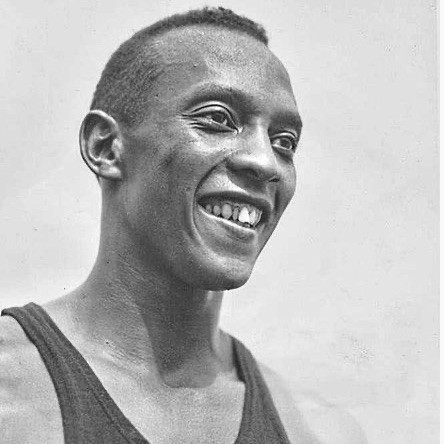
Jesse Owens: The Legendary Olympic Star
James Cleveland Owens, famously known as Jesse Owens, was born on September 12, 1913, in Oakville, Alabama, to parents Henry Cleveland Owens and Mary Emma Fitzgerald, both of whom were born into slavery. This heritage placed Owens at the intersection of a rapidly changing America, still deeply scarred by its history of racial inequality. His story of triumph over adversity would not only etch his name into the annals of sports history but also serve as a powerful symbol of perseverance and resilience.
Jesse Owens was the youngest of ten children. His family worked as sharecroppers, a system that perpetuated economic hardship for African Americans even after slavery was abolished. Life in the rural South was fraught with challenges, and young James Cleveland Owens grew up in poverty, witnessing the harsh realities of racial segregation.
The moniker “Jesse” was born of a misunderstanding during Owens’s childhood. When his family moved to Cleveland, Ohio, as part of the Great Migration, Owens attended a new school. On his first day, a teacher asked for his name, and his thick Southern accent turned “J.C.” into “Jesse.” The name stuck, and it was by this nickname that the world would come to know him.
Jesse’s move to Cleveland marked the beginning of a life-changing chapter. Despite working multiple jobs to support his family, Owens discovered a natural talent for running and jumping. At East Technical High School, he gained recognition for his extraordinary athletic ability, setting records in track and field that hinted at his future greatness.
Owens’s prowess earned him a scholarship to Ohio State University, where he continued to excel despite the racial barriers he faced. The university did not provide athletic scholarships, so Owens worked part-time jobs to finance his education. Segregation was rampant, and Owens was often excluded from campus housing, dining halls, and hotels when traveling with his team. Still, he persevered, breaking multiple collegiate records and earning the nickname “The Buckeye Bullet.”
Owens’s defining moment before the Olympics came on May 25, 1935, at the Big Ten Championships in Ann Arbor, Michigan. In what is often referred to as the greatest 45 minutes in sports history, Owens broke three world records and tied a fourth, achieving these feats despite a severe back injury. He set records in the 100-yard dash, the long jump, and the 220-yard sprint, and tied the world record for the 220-yard hurdles. This incredible performance solidified his reputation as one of the greatest athletes of his time.
Owens’s fame reached its zenith during the 1936 Summer Olympics in Berlin, Germany. The event was highly politicized, as Adolf Hitler sought to use the Games to promote Nazi ideology, particularly the belief in Aryan racial superiority. Owens, a Black athlete, shattered this narrative by winning four gold medals in track and field—a feat that included victories in the 100 meters, 200 meters, long jump, and 4×100 meter relay.
Owens’s performance not only embarrassed the Nazi regime but also captivated audiences worldwide. He became the first American track and field athlete to win four gold medals in a single Olympics, a record that stood unchallenged for decades. Despite his remarkable achievements, Owens faced continued racial discrimination upon returning to the United States. He was not invited to the White House by President Franklin D. Roosevelt, nor was he given the hero’s welcome he deserved.
The years following Owens’s Olympic triumph were challenging. Unable to capitalize on his fame due to the amateurism rules of the time, Owens faced financial difficulties. He briefly turned to exhibition races against horses and dogs to make ends meet, a testament to the limited opportunities available to Black athletes in America.
Eventually, Owens found success as a public speaker and advocate for youth sports. He used his platform to promote the values of hard work and determination, often reflecting on his own journey from poverty to global acclaim. In 1955, President Dwight D. Eisenhower appointed Owens as a goodwill ambassador, a role that took him around the world to promote American values during the Cold War.
Jesse Owens’s legacy transcends his athletic achievements. He is remembered as a pioneer who broke racial barriers in sports and inspired countless others to pursue their dreams, regardless of the obstacles they face. In recognition of his contributions, Owens received numerous posthumous honors, including the Presidential Medal of Freedom in 1976 and the Congressional Gold Medal in 1990.
Owens passed away from lung cancer on March 31, 1980, in Tucson, Arizona, but his impact endures. Schools, streets, and sports facilities across the United States bear his name, and his life story continues to inspire generations
From the cotton fields of Alabama to the world stage in Berlin, Jesse Owens’s journey was marked by extraordinary resilience and determination. His triumphs defied the prejudices of his time, proving that talent and hard work can overcome even the most entrenched barriers. More than an athlete, Owens was a symbol of hope and a reminder that greatness is not determined by the circumstances of one’s birth but by the courage to rise above them.
“Netflix has a movie, titled “Race” made in 2016 about Jesse Owens and the 1836 Berlin Olympics