Click on the above photo to see a review of the above
Note: Please let me know your thoughts about this single family website. If you enjoyed the website, please send a short text to 4 of your immediate family members and tell them about FindingtheCleveland600.com
The Vikings were originally from the Scandinavian countries of Denmark, Norway and Sweden. They were both raiders and settlers in England starting in AD. 789. On 8 June 793, Viking pirates launched their firs significant attack in western Europe, at Lindisfarne England. Pagans killed many people and desecrated Churches. Lindisfarne was one of the most important places in Anglo-Saxon England. Its bishops had close links to the Northumbrian kings. The raid was devastating and shocked the entire continent.
Many raids, and settlements, continued for 250+ years. The Vikings were seafarers. As a result, some Viking DNA can be found in British, Scottish, and Irish populations. Approximately, 10 percent of the people of Sweden and 6 percent in the UK are believed to have Viking DNA.
Viking influence declined until they lost the Battle of Stamford Bridge, located near Yorkshire, on September 25 1066 and most vikings were killed. This is about 50 miles from Guisborough, The Ancient Capital of Cleveland. However, the English army suffered significant losses. Less than three weeks later, on October 14, 1066, and after a long forced march, the English army was defeated by the Norman army led by the Duke of Normandy, later to be know as ‘William the Conqueror’, at the Battle of Hastings. This battled changed the course of world history.
The first Cleveland’s to come to the “British Colonies” originated in Ipswich, England. Vikings were also widespread near Ipswich, England. The Netflix movie “The Dig” highlights the most significant Viking Anglo-Saxon ship burial, found near Ipswich, which is now on display at the British Museum.
You may find these 11 links below interesting:
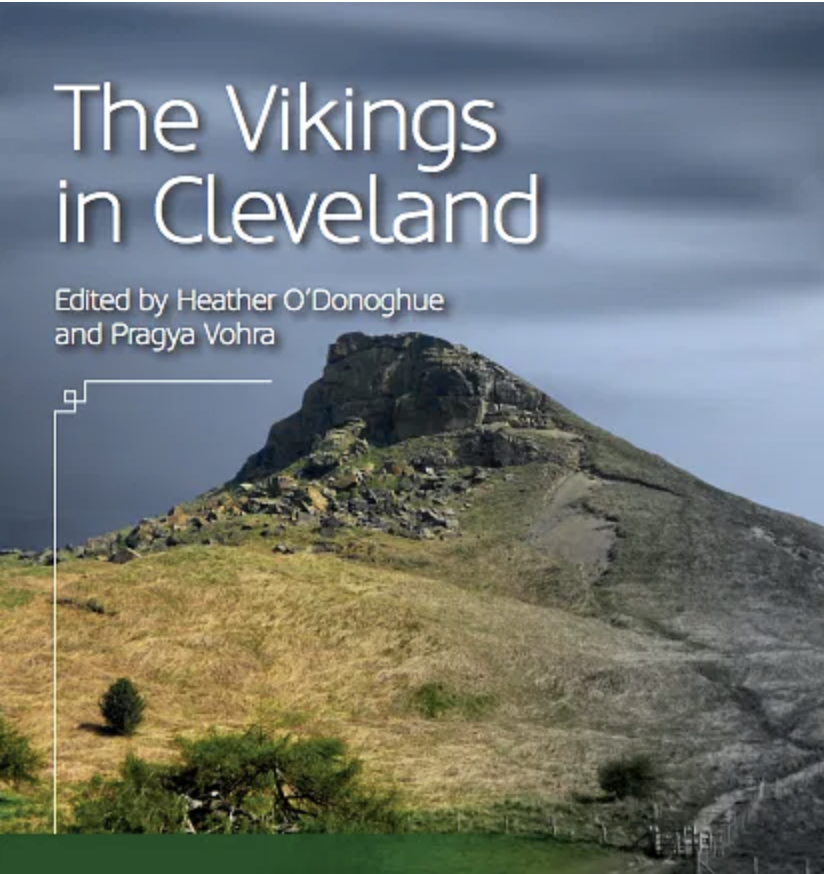
- The Vikings in Cleveland – https://www.nottingham.ac.uk/research/groups/csva/documents/lmfpublications/lmf4-cleveland,thevikingsincleveland.pdf
- The Vikings and Genetics – https://www.medievalists.net/2014/12/vikings-genetics/
- The Anglo-Saxon ship burial at Sutton Hoo – https://www.britishmuseum.org/collection/death-and-memory/anglo-saxon-ship-burial-sutton-hoo
- FamilyTreeDNA – Discover Haplogroup Reports: – Share your results – https://discover.familytreedna.com/y-dna/R-FTC48905/story
- Cleveland Family Chronicles – https://www.angelfire.com/il/ClevelandFamilyChron/Early.html
- The Political Graveyard. Index to Politicians: Cleveland – https://politicalgraveyard.com/bio/cleveland.html
- SNP Tracker – http://scaledinnovation.com/gg/snpTracker.html
- YSEQ Clade Finder – https://cladefinder.yseq.net/
- The DNA Geek – https://thednageek.com/dna-tests/
- IF YOU LIKE CONTROVERSY: https://historycooperative.org/who-discovered-dna/
DNA Testing for Genealogy
Approximately 21% of Americans report having taken a mail-in DNA test for genealogy, which translates to about 70 million individuals. Leading companies in this field have developed extensive user databases. For example, Ancestry has over 30 million users, including 3 million paying subscribers.
There are three primary types of DNA tests used in genealogical research: Autosomal DNA, Y-DNA, and mitochondrial DNA (mtDNA).
- Autosomal DNA: This is the most common type of test for genealogy and is offered by companies like AncestryDNA and myHeritage. It analyzes DNA inherited from both parents, identifying relatives from both paternal and maternal lines. Autosomal DNA testing is particularly effective for tracing family connections up to 6–7 generations.
- Y-DNA: This test examines the Y chromosome, which is passed directly from father to son. Y-DNA testing is used to trace direct paternal ancestry, following mutations along the Y chromosome back to the earliest known male ancestor. The Y-DNA haplogroup tree currently contains over 80,000 branches and continues to expand annually.
- Mitochondrial DNA (mtDNA): Found in the mitochondria outside the cell nucleus, mtDNA is passed from mother to child. This test traces direct maternal ancestry. FamilyTreeDNA.com is the primary provider of both Y-DNA and mtDNA tests.
In genealogy, haplogroups are classifications based on shared genetic markers that trace back to a common ancestor. These are valuable tools for understanding ancient ancestral lineages.
The Cleveland Family in the Americas
The Cleveland family in the Americas has two major branches: the New England Clevelands and the Southern Clevelands.
- The New England Clevelands trace their ancestry to Moses Cleveland, the first Cleveland to migrate to the British Colonies from Ipswich, England, in 1635.
- The Southern Clevelands descend from two brothers, Alexander Cleveland and Roger Cleveland, who settled in Virginia around 1669 (although the exact dates remain debated). These brothers were grandsons of Elizabeth Cleveland, also of Ipswich, England.
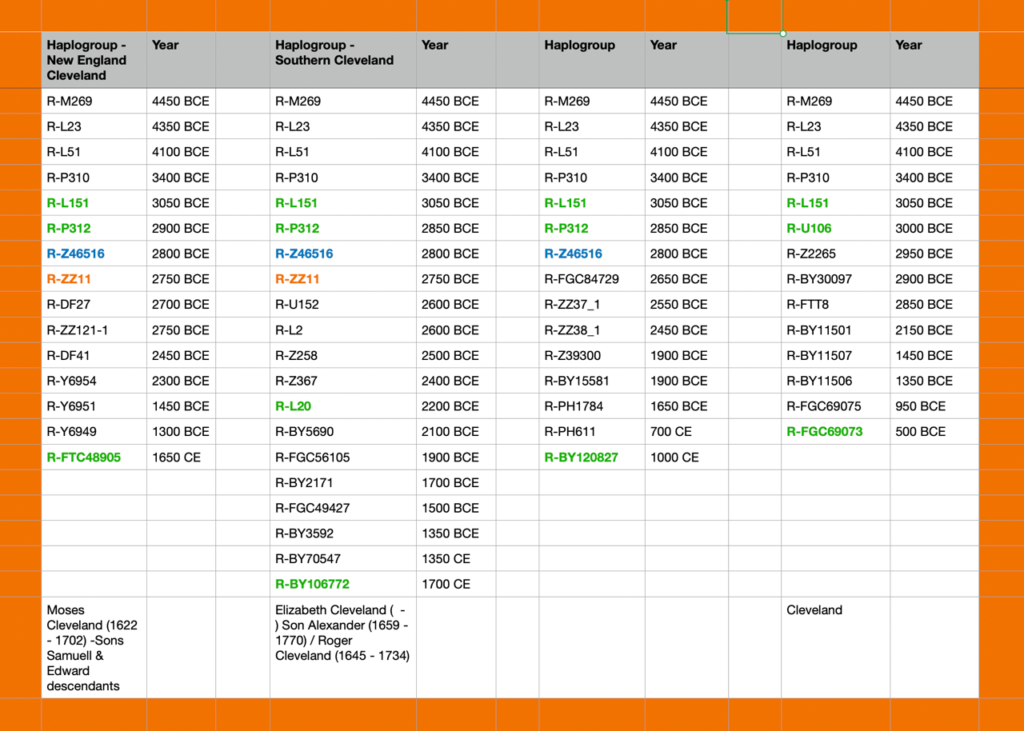
The two American Cleveland branches correspond to two distinct haplogroups. Y-DNA testing has revealed that Clevelands who trace their direct paternal ancestry to Moses Cleveland belong to the haplogroup R- FTC48905. Similarly, those who trace their lineage to Alexander or Roger Cleveland have been assigned the haplogroup R-BY106772.
Recent Y-DNA testing of a Cleveland family residing in the United Kingdom, whose ancestors have always lived there, has identified a third haplogroup: R-FGC69073. Since DNA testing is less common in the United Kingdom compared to the United States, it is possible that additional Cleveland haplogroups exist. Further Y- DNA testing, especially in UK would be required to identify these potential haplogroups.
Identifying a confirmed haplogroup involves analyzing the Y chromosome-a thread-like structure composed of DNA and proteins-down to its most detailed data. This process can be both costly and time-consuming. However, using autosomal DNA data, it is possible to infer the structure of earlier branches in the haplogroup tree, often covering everything except the most recent few thousand years.
The table below provides examples of haplogroup names and the approximate number of years ago they originated:
Note: 1 A partial estimated Haplogroup can be determined from autosomal data by exporting autosomal data from DNA testing company and then importing this data to YSEQ Clade Finder noted above. A typical returned value will be R-P312 or R-U106.
Note: 2 Please let me know your thoughts about this single family website. If you enjoyed the website, please send a short text to 4 of your immediate family members and tell them about FindingtheCleveland600.com