Horace Gillette Cleveland
(1832 - 1888)
Page 2, # 4480
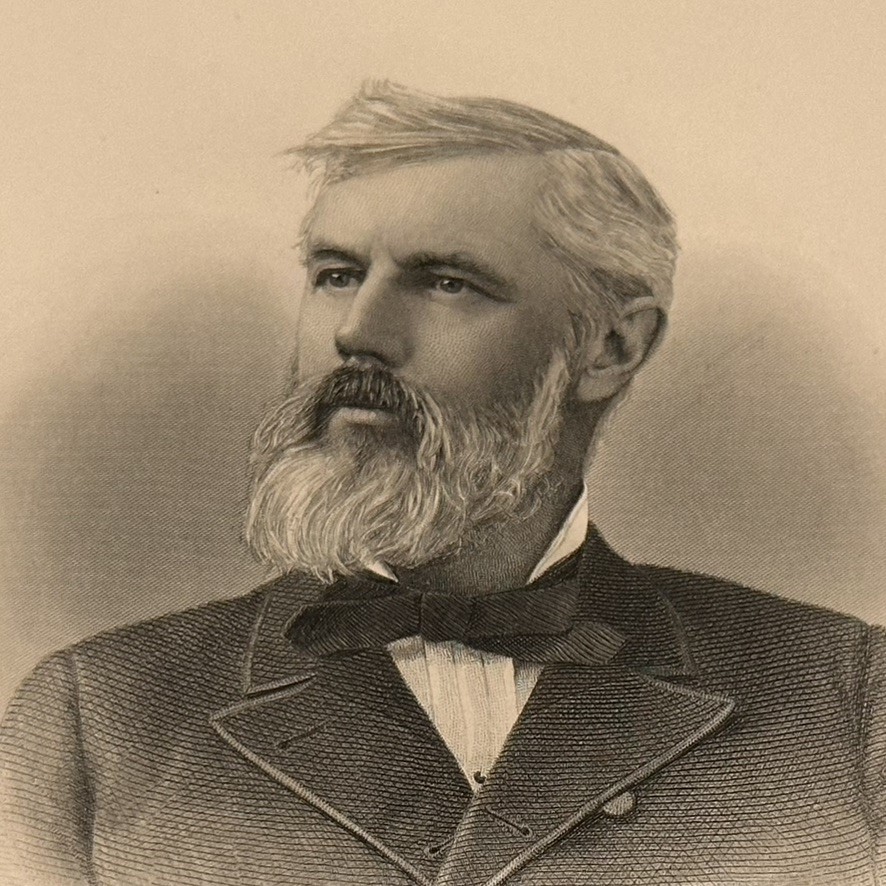
The following biographical account, accompanied by a steel portrait of him, appears in The Biographical Cyclopedia and Portrait Gallery, with an Historical Sketch of the State of Ohio. Illustrated with many fine steel engravings. Volume IV, Western Biographical Publishing Co., Publishers, Cincinnati, O., 1887, p. 980 :
Horace Gillette Cleveland.— The life of Horace Gillette Cleveland has been one of unceasing business activity, and the greatest portion of it has been identified with the wonderful growth and expansion of the city of Cleveland. He was born January 3, 1852, at Winchester, Litchfield county, Connecticut, and was the youngest son of eleven children. His father, Oren Cleveland, being a man of good education and fine literary taste, devoted many years of his life to teaching, at the same time cultivating a farm. Moses Cleveland, from whom this branch of the family descended, came over from Ipswich, England, about 1640, and settled in Woburn, Massachusetts ; his son Samuel settled in Connecticut in 1693 ; Oren Cleveland, the father of Horace, removed his family to Ohio in 1839, and settled in Geauga county.
Although raised on a farm, and attending district schools in the winter, young Cleveland early manifested a strong disposition toward business life. After he was seventeen he worked for a couple of years as a carpenter and joiner, becoming well versed in the use of tools, and waiting, meanwhile, for some opportunity to begin a mercantile career. When nineteen years of age he entered the store of Kile, Wilkins & Company, at Huntsburgh, where he remained as general clerk for about a year. Determined to broaden his business education, he came to Cleveland in 1852 and entered a mercantile college for the purpose of perfecting himself in bookkeeping, and at the end of a few weeks he had so thoroughly mastered the science that he was offered the position of tutor in the college, but declined, wishing to connect himself more actively with the business of the city.
Immediately on leaving college, he entered as bookkeeper with Mr. A. M. Beebe, at that time doing a large and profitable business on Bank street. He remained with Mr. Beebe about a year, and then was employed in the Forest City Bank, organized under the free banking law of Ohio. At the end of about a year he was prostrated by a severe and lingering illness, which necessitated his resignation, much to the regret of the officers of the institution, for his clerical abilities were of a high order, and, joined to a uniformly courteous deportment, made him a general favorite. After his restoration to health, he was employed for a time by the Bank of Geauga, at Painesville, Ohio., where his skill as an accountant was called into requisition in examining, writing up, and balancing books and accounts that had been neglected for many years. This service done, he returned to Cleveland, and in the spring of 1855 entered the well-known wholesale hardware store of George Worthington & Co., then on the corner of Water and Superior streets, the present site of the National Bank building. He was the bookkeeper and chief clerk of this enterprising and very successful business house for nearly ten years. These were years of close application, and taxed to the utmost a constitution not naturally robust ; yet the experience was of great advantage, for by it he was being educated for the more responsible duties the years were to bring to him
In the fall of 1864 he formed a copartnership with Joseph H. Brown, Richard Brown, Thomas Brown, and William Bonnell, of Youngstown, Ohio, under the name of Cleveland, Brown & Company, and opened a large iron and steel warehouse at Nos. 25 to 31 Merwin street, making heavy hardware a specialty. They imported largely of Swedish iron, English steel, etc. Under Mr. Cleveland’s energetic and capable management, their business operations reached an average of two millions per annum, and their trade extended throughout Northern Ohio, Indiana, Michigan, and the upper lakes, and, in some lines of goods, as far east as Boston. The reputation of the house for enterprise and honorable dealing was thoroughly established. There have been several changes of partners during the twenty-two years of its existence, the present firm consisting of H. G. Cleveland, Richard Brown, Peter Marshall Hitchcock, Aaron Morley Wilcox [who married. Helen Mary Cleveland +15449], and Martyn Bonnell.
In 1870 Mr. Cleveland was elected president of the Painesville & Youngstown railroad, a narrow-gauge running from Fairport, on the lake, to Youngstown, built for the special purpose of transporting iron ore from the lake to the extensive iron works at Youngstown, and coal from that region to the lake, being under the control of parties engaged in these interests. After about a year he resigned on account of the increasing demands of his regular business.
Exemplary in all transactions, whether of a public or private character, an active, earnest man, with a keen insight into the multiplied details of such a life, and with rare judgment to meet them, he is the recognized head of one of Cleveland’s most enterprising and substantial commercial houses. In politics he is a conservative Republican. He is thoroughly patriotic, and heartily supported the war, giving liberally to all those charitable enterprises that grew out of that struggle. He was for two years in the city council and rendered valuable service on the finance committee. He is a communicant in the Episcopal Church, uniting with Grace church about twenty-one years ago, He engages actively in its Christian work, cheerfully giving of his time and money to its advancement ; indeed, all worthy charitable objects find in him a friend. He is a warden of Grace church, and for several years was one of the standing committee of the diocese.
We cannot more appropriately close this necessarily inadequate sketch than by appending the following deserved tribute from the pen of Judge Charles Candee Baldwin:
When I first knew Horace G. Cleveland he was. a clerk in the employ of George Worington & Company, a leading and strong hardware firm. His safe and solid business character made him much trusted by them. His character and ability, I suppose, caused him to be selected by the large house of Brown, Bonnell & Company, to represent their iron, the firm being Cleveland, Brown & Company. In all the revolutions of the iron trade, and in the midst of litigation and misfortune to the firm of Brown, Bonnell & Company, the business of the firm of Cleveland, Brown & Company justified the very wise selection of Mr. Cleveland. I regard him as a man of very exceptional ability. I have met him in various positions and places to test his character. His mind is acute, quick, and very active in its knowledge and in conclusions. He is energetic, but not rash. Many men achieve business success and large resources by the accident of being in a channel of profit, or by running risk. His is the higher type of business talent — an accurate knowledge of business affairs, and logical, safe reasoning therein, leading to safe and profitable conclusions, so that one may be sure his business will be conducted to success and with profit, and at the same time wisely and prudently. In the very large business interest and capital owned and conducted by the firm of which he is the head, this is of the highest importance. It is often much easier to acquire money than to safely keep it. Whether as iron merchant, manufacturer, bank president, or conducting a railroad, his mind applied to the business would be sure to make him well-known and respected by all he might meet. Mr. Cleveland has not only this character in his business life, but he is a gentleman of wide culture besides. He is a man of much general and literary intelligence. His interest in literature he has shown by various literary enterprises, and his general intelligence is made useful not only for private ends, but also for wise public enterprises. His intellectual character impresses strongly those who meet him. Quiet, but not reserved, genial in manner, bright of face, quick of perception, always ready, but not too ready, to impart knowledge or judgment in general conversation, or in meetings of private or public business, he seems to be possessed of great force. He is quick, terse in speech, logical and accurate, but appreciative of others’ views, and not censorious as such minds are apt to be. Criticism is cheap and easy, but his social intercourse is very free from it. A prominent feature is the force and strength which he carries with such certainty of being accurate. Very few men are as well calculated as he to lead safely, sand few inspire such confidence. It hardly seems necessary for me to speak of the very high reputation-he has for integrity and Christian character. His instincts seem always for the best, and his labors not lavish but wisely unselfish. He has that even poise of character possessed by very few indeed — a happy possession. He seems to make a most wise use of life, and is its master. WILSON M. DAY.
The above . biographical account originally appeared (with portrait) in the Magazine of Western History, Dec, 1886, V : 302, and was republished in Geauga Republican, Chardon, Ohio, Feb. p, 1887.
The Bulletin, Philadelphia, Pa., Jan. 12, 1887— The Magazine of Western History closes the year 1886 with an issue covering a wide range of historical subjects. Among its biographical papers, of which the magazine makes a specialty, is a sketch of H. G. Cleveland, who is prominently identified with the Mahoning Valley iron interests.
A biography of Horace Gillette Cleveland is published in Cleavers Biographical Cyclopaedia and Portrait Gallery of the U. S., 1878, Ohio Vol., Distinguished Men of Ohio, Cuyahoga Co., p. 94.
The City of Cleveland and Environs, 1886, p. 66 — contains a sketch of :
Cleveland, Brown & Co., manufacturers of and dealers in pig iron etc., Viaduct Block, River Front and Merwin Street. The wonderful development and progress of American manufacturing interests have attracted the attention of the world, and the natural advantages of Ohio for securing manufacturers the utmost facilities and the liberal investment of capital are noticeable in the various, extensive, and well-equipped works located in close proximity to the necessary raw materials, the coal and iron ores, which are procured in large quantities from Pennsylvania, Michigan, and the district bordering on Lake Superior.
One of the representative firms in Cleveland engaged in the production of pig-iron, wrought-iron, steel, etc., is recognized to be that of Messrs. Cleveland, Brown & Co., whose office and warehouses are located in the Viaduct Block, Merwin street, of which they are the owners. This house was founded in 1864. The following are at the present time the partners, viz.: Messrs. H. G. Cleveland, Richard Brown, P. M. Hitchcock, A. M. Wilcox, and Martyn Bonnell. Mr. R. Brown is superintending the manufacturing and Mr. H. O. Bonnell the financial affairs of the works at Youngstown. The works cover an area of thirty acres, and consist of a splendid series of buildings, admirably arranged and equipped with all the latest improved machinery, tools, and appliances which capital, skill, and science can devise in order to make them complete in every particular. The capacity of the furnaces is one hundred and twenty tons of pig-iron, and the finishing mills one hundred and sixty tons of every description of wrought iron per day.
The firm are joint owners of seven coal mines in Butler county, Pa., and possess every facility for promptly filling all contracts under the most favorable auspices, and is always prepared to render its customers every possible advantage in goods and prices. Messrs. Cleveland, Brown & Co. represent a number of first-class firms and companies. The annual trade of this progressive and responsible firm amounts to upward of $3,000,000, and the number of operatives employed by it in its various departments is over five thousand. At the warehouses in Cleveland the following goods can be obtained at manufacturers’ prices : Bar iron, angle iron, hoop and band iron, polished shafting, light and heavy sheet, galvanized sheet, tank and plate iron, iron and steel nails, steels of all kinds, steel plates, boiler tubes, boiler and tank rivets, nuts and washers, bolts of all kinds, boat spikes, railroad spikes, beams and channels, Burdens’ horseshoes, Perkins’ horseshoes, horse nails, Swedish and Norway irons, chain, nail rod, etc., etc. Mr. H. G. Cleveland, the senior partner, is widely and favorably known throughout the leading commercial and industrial circles of the “United States, and no citizen in Cleveland is more generous and public-spirited. Mr. Richard Brown is one of the representative manufacturers of the country, and as widely known for his talents as for the just manner he attends to the interests of the firm. Messrs. Hitchcock, Wilcox, and Bonnell are energetic, hard-working gentlemen, who are held in the highest estimation in mercantile life for their sound business principles and sterling probity. The standing of Messrs. Cleveland, Brown & Co. in the financial world is too high to require any comments at our hands, and both as regards business ability and true American enterprise they justly merit the excellent reputation to which they have permanently attained in the iron and steel industry throughout the country.
See Commerce, Manufactures, and Resources of Cleveland, p. 58.
From 1879 to 1881 the firm (represented by H. G. Cleveland) was a member of the firm Hale, Cleveland, Bonnell & Co., iron manufacturers, 74, 76, and 78 Michigan ave., Chicago, 111., Mr, Cleveland remaining in Chicago during this period. The same firm name, Cleveland, Brown & Co., has always since been used by the remaining partners (1895).
Horace Gillette Cleveland, for many years, was an active member of the Western Reserve and Northern Ohio Historical Society, and served on the most important committees ; was at one time elected a member of the Board of Aldermen of the city of Cleveland.
He ever manifested much interest in the welfare of the Protestant Episcopal Church, and was repeatedly lay delegate to the Diocesan Convention, and to the General Convention. In the spring of 1882 he was elected a trustee of Racine College, Wis. In 1 886 he was chosen a life member of the Cleveland, O., Bethel Union.
The funeral of Mrs. Anna Maria (Knapp) Cleveland, wife of Horace Gillette Cleveland, was held Friday afternoon, January 22, 1886, at Grace Church, Cleveland. This old and beautiful edifice was filled with the many friends of the departed. At the tolling of the bell the large surpliced choir passed from the chancel to the entrance door to the solemn organ music of the funeral march. The choir was followed by Rev. William R. Webb, assistant minister of Grace Church ; Rev. Thomas Lyle, rector of Church of the Good Shepherd ; Rev. Y. Peyton Morgan, rector of Trinity Church ; Rev. Dr. French and Rev. Dr. Bolles.
The entire service was chorally rendered, and began with the well-known sentences of the burial office, intoned by” the clergy while the procession moved down the aisle to the chancel. The alter being finished, both choirs sang St. Bernard’s famous hymn, ” Brief Life is here our Portion.” The lesson was read by Rev. Dr. French, editor of the Standard of the Cross. After the beautiful hymn, ” For all the Saints who from their Labors Rest,” was sung, the creed, the versicles, and appropriate prayers from the prayerbook followed. When the quartette had finished chanting the ” De Profundis ” the committal office was said by the rector of the parish, the Rev. Frank Montrose Clendenin. During this office was sung, very expressively, ” I heard a Voice from Heaven saying unto Me.” The benediction was pronounced by Rev. Dr. Bolles, rector emeritus of Trinity Church. The solemn and impressive service concluded with the recessional hymn, “Abide with me, fast falls the eventide.” During the entire ceremony the cross-bearer of the choir stood motionless with his cross at the foot of the casket. The burial was private.
The following prominent citizens acted as pall bearers : Messrs. E. W. Palmer, William K. Corlett, William H. Burridge r P. M. Hitchcock, George Deming, and Charles H. Sanford.
The peculiar sadness which surrounds the death of this, good wife and noble mother is that her fatal illness was contracted caring for her sick son, Dr. Charles L. Cleveland. Though the doctor had every care and comfort that skilled nurses could give, the mother’s heart watched and worried over her youngest son till great anxiety brought on nervous prostration. This, together with blood poisoning, brought to a sudden close one of the most gentle and considerate lives that has ever been lived. — Cleveland Leader.
Cleveland, O., Leader and Herald, Oct. 31, 1886 : —
A MEMORIAL WINDOW.
A BEAUTIFUL DESIGN IN ECCLESIASTICAL GLASS PLACED IN GRACE CHURCH YESTERDAY.
One of the most beautiful memorial windows in the city was placed in position at Grace Church, corner of Erie and Prospect street, yesterday. The window is the offering of Mr. H. G. Cleveland, of the firm of Cleveland, Brown & Co., of this city, in memory of his deceased wife, Mrs. Anna M. Cleveland. The design represents two little children, protected from the thorns, in their journey through life by the outstretched wings of a guardian angel. It illustrates the great affection of Mrs. Cleveland for her two grandchildren, Ethel and Coral Wilson, the daughters of Floyd B. Wilson, Esq., of New York. Both these children died on the same day of scarlet fever, and Mrs. Cleveland never fully recovered from the shock their death caused her. The mellowness of color and realistic consistency in shade wrought in the window are remarkable. Retrospective reverie is depicted on the countenance of the older child and expectancy on that of the younger. An irregularity of texture is produced upon their garments by the corrugated appearance of the glass. A reclining cross, entwined with passion flowers, signifying the suffering of Christ, is set in the base of the window, surrounded by variegated nuggets. Over the cross is a scroll bearing the inscription, “Their angels do always behold the face of my Father.” A band of jewels in imitation of purple flowers surmounts the base. In the canopy a “Cross Beautified” is set in nuggets designed in beautifully blended light colors. The entire window is constructed in antique and opalescent glass. It is mosaic in style, and in its realistic consistency is distinguished from the uncouthness of early English art.
Cleveland Plain Dealer, Nov. 1, 1886 : —
MEMORIAL SERVICE YESTERDAY IN GRACE CHURCH.
TRIBUTES TO THE MEMORY OF PARISHIONERS WHO HAVE CROSSED THE DARK RIVER — HONORED NAMES— THE NOBLE LIFE OF MRS. ANNA MARIA CLEVELAND COMMEMORATED IN CATHEDRAL GLASS.
All Saints’ Day, which is observed by the Episcopal Church, was recognized by a
memorial service in Grace Church yesterday forenoon, anticipating the proper festival
of All Saints, which is to-day.
The middle west window of the church is a new one, presented by Mr. H. G. Cleveland as a memorial to his dead wife. The window, which was described in yesterday’s issue of the Plain Dealer, is one of the most artistic specimens of that beautiful form of decorative art, stained glass designing.
It was a delicate thought which prompted the placing of this beautiful memorial in position so that it should greet the congregation on entering the church yesterday, and turn the mind gently to remembrance of Mrs. Cleveland before the tender and just account of her character was rendered by her pastor.
The service of Sunday opened with music, the surpliced choir entering the auditorium singing a hymn and marching to the chancel with the cross borne in advance of the singers. The exercises did not differ from those of other Sundays except in the matter of the memorial sermon, which was preached by the rector, Rev. Frank M. Clendenin. He deplored the fact that the modern tendency is to worship God on Sundays but not week days. He told of the gradual decay of church festivals, how the world has grasped for itself more and more of men’s time until the church has been impelled to combine many festival days in one and call this All Saints’ day.
“Our prayer-book,” said the preacher, “keeps in the church the memory of holy days, and while we are speaking of holy days it is worth calling to remembrance that the saints were not men of perfect character. There has been but one perfect character and that a divine as well as human one. In the few short years during which I have served as rector of this church I have been called to read the burial service thirty-seven times. It would be to our profit to study the records of all these lives which have passed from us. This can not be done, however, in the short time for this sermon. I have selected for your consideration not the names of those who were well known to the world, those whose business or social life brought them into prominence. I have selected the honored names of those whose upright, beautiful lives are an example to us all.”
The last name given was that of Anna Maria Cleveland. She was cited as an example of true gentleness and heroic self-sacrifice. ” In the days of her youth,” said the preacher, she joined the church and was always an active church woman. Hers was a true gentleness, nothing weak about it, but marked by its strength and bravery. The
parish societies to which Mrs. Cleveland belonged said at the time of her death that they had lost a companion who had endeared herself to them by her kindness and gentle manner. They said, also, ” May we feel the force of her example and follow Christ as she also followed him.” One lady said to me, ‘ I am a better and truer woman for having known her.’ In conclusion, my friends, let me say that for you life hurries on. Another year and more names shall be added to the thirty-seven. It will not make much difference what estimate is put upon us by man, it is God’s estimate we care for, and his alone. Every man writes day by day the story of his life.’ “
At the close of the sermon the surpliced chorus choir of men and boys sang a hymn, in which the members of the congregation joined. Then the holy communion was administered, and the service was at an end.
The discourse has been printed by request in pamphlet form: In Memoriam ; A Sermon, delivered in Grace Church, Cleveland, O., Sunday Morning, Oct. 31, 1886, by the Rector, Rev. Frank M. Clendenin. Subject : The Vigil of All Saints.
Knap, Knapp ancestry .•— i arms : KNAPPE ; 3 : KNAPP :• Argent, a cross of gules between four roses proper. . . . The family of Knapp is traced back for 20 or more generations, and derive from Roger de Knap, who figured in English history in the 12th century. . . . Nicholas 1 Knap, b. prob. in Buoy, St. Mary’s, Eng., came from Sussex, Eng., ab. 1630, may have come in the fleet with Gov. John Winthrop and Sir Richard Saltonstall, settled in Watertown, Mass., was of Stamford, Conn., 1645, settled later in Greenwich, Conn., in the part afterward set off to New York, now Rye, N. Y., d. Stamford, Apr. 16, 1670, m. 1st, Elinor , she d. Aug. 16, 1658 ; Caleb, b. Watertown, January 20, 1637, of Stamford,, freeman 1670, made will Dec. n, 1674, m. Hannah ; John’, b.1664, believed by Horace G. Cleveland to have been grandfather (or great-grandfather) of following: John Knapp of Danbury, Conn., m. Ruth Gregory ; John Knapp, b. May 13, 1772, farmer and shoemaker, d. Huntsburgh, Ohio., July n, 1850, m. 2d, Feb., 1829, Albacmda Barnum 8 , b. South East, Putnam co., N. Y., May 12, 1790, d. Huntsburgh, Oct. 2, 1867.
Barnum, Barnam, Barnham ancestry : — Thomas, b. ab. 1625, of Fairfield, Conn., 1663, afterward of Norwalk, Conn., and finally of Danbury, one of the first 8 settlers of
Danbury, 1684-g, d. D., Dec. 26, 1695, a. 70, m. 1st, ; Thomas 2 , b. July g, 1663; Joshua;
Capt. Azor, of South East, N.Y., m. Anna Sweet ; Albacinda Barnum m. John Knapp .