General John Blake
(1753 - 1842)
Page 242, # 386
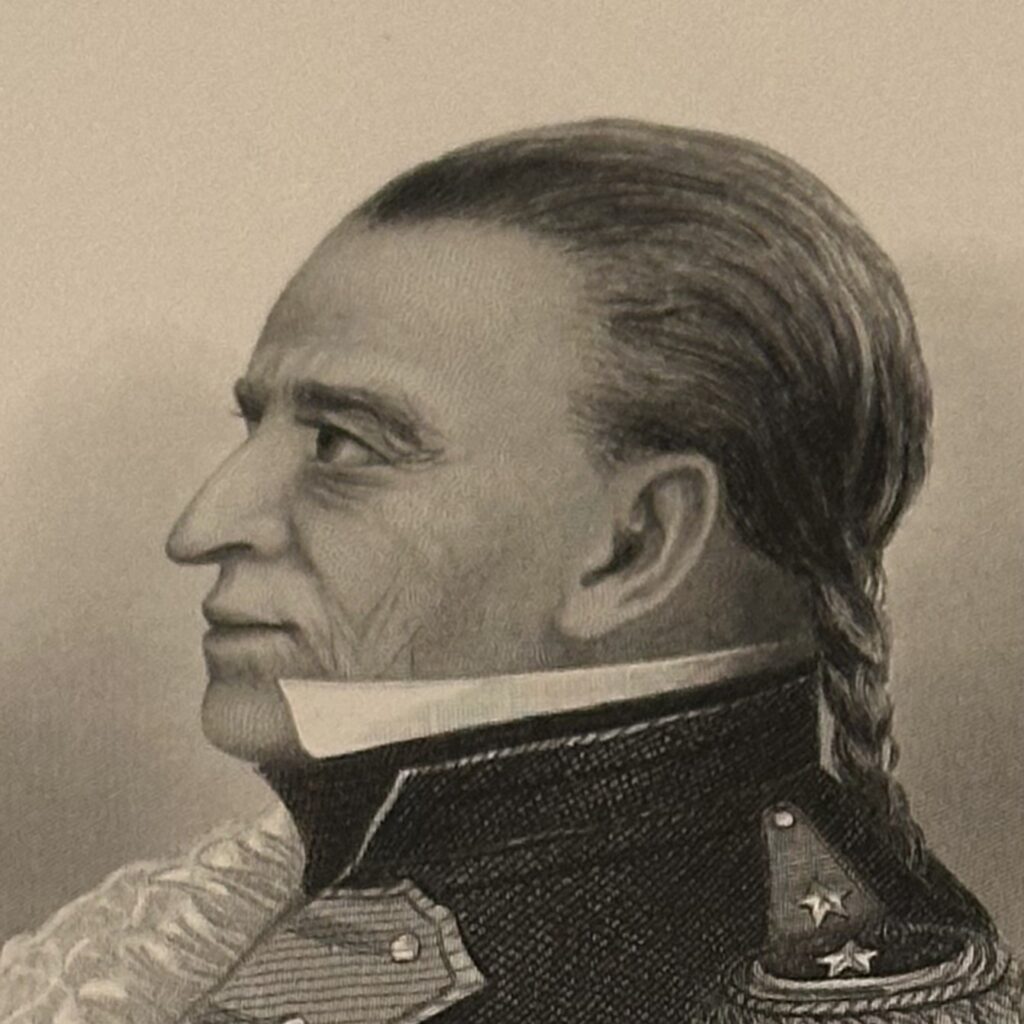
Major General John Blake, the grandson of Sarah Cleaveland, spent his youth on his father’s farm, where his chance for education was limited. He was plowing in the field Apr. 19, 1775, when the signal of alarm called him to arms, just after noon, at Wrentham, and he entered service as Sargent. in Capt. Oliver Pond’s co., minute-men, 13th Cont. Inf., — Col. Joseph Reed. That night they rendezvoused at Roxbury. His own narrative of the next 7 years is here inserted, — from Memoir of Maj.-Gen. John Blake. By Charles Morris Blake, in Bangor Historical Magazine, July, 1886 — being his letter July, 1820.
” To the Hon. J. C. Calhoun, Esq., Secretary at War, at Washington.
Sir: Agreeably to your statement of May 11, 1820, respecting pensioners I beg leave to make to your Honor a statement of some of the military services performed by myself during the revolution. On April 19, 1775, it is well known the battle at Lexington took place, and the sound of war spread with the rapidity of lightning through our country. I was at that time a young man of 21, Sergeant in the Light Infantry company in Wrentham, 27 miles from Boston, the seat of war. This Company was commanded by Capt. Oliver Pond. On April 19, I marched with this Co. to Roxbury, and enlisted under Capt. Pond as a Sergeant for the term of eight months. We were put under command of Col. Joseph Reed, of Uxbridge, Massachusetts; which Regiment was afterwards known as the 13th Regt. U. S. In. I continued in this Regt. 8 months, according to my term of enlistment. January 1, 1776, I re-enlisted into the same co. and Regt. as a Sargent. for the term of 1 year.
April 1, 1776, I marched from Roxbury to New York, under the command of General Washington. In August following, I was in the action on Long Island, under Lord Stirling; at which time our company suffered severely, both in killed and wounded. Lord Stirling and the right wing of his army were made prisoners. The left wing, in which I was placed, by the skillful maneuvre of General Washington, made good their retreat in the twilight of the morning to York Island. Sept. 6, following, I was detached, and put under command of Capt. Gleason, of the 6th Regt. The next day I was in an action under Capt. Gleason on Harlem Heights on N. Y. Island, n. King’s Bridge, in which our brave Capt. fell, and the company suffered very great loss. Sept. 8 I again encountered the enemy in an action at East Chester, under command of Capt. Walbridge of 13th Regt.; at which time our company suffered the loss of 7 killed, 3 wounded. On the 10thI was engaged with the enemy at the White Plains, under Col. M’Doogle, of N. Y. The action continued 1 1/2hours, when we were overpowered by superior numbers, and were obliged to retreat with considerable loss.
October 1, Gen. Washington was pleased to appoint me an ensign. I did not, however, receive my commission until January 1, 1777, which commission I have forwarded to the War Department. Our term of enlistment being for 1 year, would expire on the first day of 1777. General Washington therefore, about the middle of Dec, 1776 (knowing that his men’s time was nearly out), solicited volunteers for 6 weeks. I then volunteered, and called for others to follow me; when at this very depressed state of American affairs, 24 brave soldiers, in defense of their country s rights, stepped forward, altho’ almost naked, and their feet bare and bleeding in the snow; exclaimed that they would follow me in vindication of their country’s rights wherever I should see fit to lead them.
We were then at Peekskill, N. Y., on the margin of Hudsons river. After three days’ march I found my men’s feet lacerated by the ice and snow, and bleeding in a shocking manner; insomuch that I found it impossible to continue the march in that situation. I then took from my pocket the last Dollar, purchased two raw hides and gave them to my men, of which they made moccasins, and so were enabled to pursue their march. We then continued our march to the forks of the Delaware, from which we went to Corills Ferry, on the Delaware. We next marched upon Trenton, where we attacked and captured a large body of Hessians. 900 prisoners was the fruit of this brilliant affair. This’ happened about the 25th of Dec, 1776.
Immediately after this, a reorganization of the army took place. I was put into Capt. Nathan Goodales co. 5th Massachusetts Regt., commanded by Col. Rufus Putnam. In March, 1777, we joined the Northern Army, com. by Gen. Gates, and I was with that General in his retreat from Skeensborough to Fort Edward, and the Half Moon. When we had retreated as far as Fort Edward I was sent out by General Gates on a scout to Fort George, 14 miles through a wilderness. On my return to camp, the Indians having received information of my route, laid an ambuscade two mile- before we arrived at Camp, and there fired upon us, and killed 1 Sergeant and 6 privates. I instantly charged the Savages, and they retired. We then took up our dead and wounded and carried them to the camp. Sept. 2 Gen. Gates sent for me to his quarters, and informed me that a Hessian guard was posted about 2 miles from his left wing; to ascertain the situation and numbers of which he said would be only sport for me to do. On the night of Sept. 3 I took a party of men and went out and took their two sentinals, and then their guard, consisting of a Lieutenant and 18 . men, without the loss of a man.
On the first of October following, I was notified by Gen. Gates to repair to his quarters, which I immediately did. Upon my arrival he told me that the same conduct that took a Hessian guard would undoubtedly conquer a British guard. ‘ There is (said he) a British guard posted about one mile in front of my line. The situation of the guard, together with the ground, I was informed of yesterday by an Indian.” The ensuing night, therefore, I took with me a party consisting of 30 men, and went and brought off the British guard without any essential loss on our side, 3 men only being slightly wounded with the bayonet. Oct. 5 I was detached and put under Capt. Shaves, and annexed to Col. Morgan’s Regt. of Riflemen, and posted on the left of the army. On the morning of the 7th, a guard was sent out from our Regt. of Riflemen about 160 rods. About 11 o’clock this guard was attacked by a small body of British troups. I immediately received orders from Col. Morgan with 36 men, to support the guard, with orders to maintain the ground if possible; if not, to retreat to him in good order. Having arrived at the scene of action I found the enemy to be vastly superior in numbers. We fought them a few moments, lost two men, and then retired to .the Regt. in good order. _
Tne action soon became general through our line. We fought from, 11 o clock A. M. until the twilight of the evening, without the least cessation. Heme among the light troops, I had frequently that day to contend with the British Grenadiers at the point of the bayonet; but they had constantly .to recede before the charge of our brave troops. We encamped on the field of battle In the nieht the British army retreated, leaving their dead and wounded on the ground. Never perhaps did embattled armies contend with greater obstinacy and perseverance. Our loss that day was 2 Commissioned officers and 17 privates killed out of our Company, and 19 wounded. Oct. 17 I was with my own Regt., commanded by Col Putnam, and had no command in the line, but was the bearer of the standard of the Regt. On this dav our Regt., with the rest of the army, were engaged with the enemy about 3 hours. Our ioss was considerable. Not long after our intrepid Commander again drew up his troops, in order once more to give battle to the enemy, but General Burgoyne dreading the event of another conflict , was clad to sign the articles of capitulation.
From Oct. 17, 1777 to May 15, i779, nothing more than the common fatigues and hardships of armies happened to me being only engaged in a few skirmishes, too trifling to mention in a statement of the kind. On May 15, being then encamped at Crumpond, in New York State I receded a line from General Washington, requesting me to repair to his quarters
NOTE : LINES SKIPPED
Immediately. I speedily and cheerfully obeyed the summons: and having arrived at the General’s quarters, he addressed me to the following effect: “Friend Blake, I have a pleasant tour of duty allowed to you. Col. Delaney, with a detachment of Refugees, is encamped near King’s Bridge, about 15 miles from my quarters. Take, therefore, a party, of men and capture the Col. and bring him together with his men, to my camp.” Immediately, I obeyed the order, and taking together with his men, to my camp. Immediately I obeyed the order, and taking with me 37 chosen men, proceeded with a forced march to Delancev’s station.
We were challenged by his sentinels about 1.5 hours before daylight; which having taken without opposition, we instantly repaired to the house where the Col. and his troops were quartered. Having arrived at the house, I ordered my men to force the door with the butt of their muskets: and on entering the house I received a bayonet wound in my side, the mark of which I carry to this day. The Refugee guard cried out, “ Who in the name of God are you?” I replied “Black Jack” of the 5th Massachusetts Regt. Lay down your arms instantly or you will all fall beneath the bayonets of my soldiers.’
I took without further opposition 6 officers and 30 privates; also Col. Delancey’s servant. The Col. himself being absent, escaped capture. I also took from a neighboring stable, 8 horses and their equipments, belonging to Col. De Worm’s corps of Hessian Cavalry. I now set out with my prisoners on my return to camp, and after proceeding at a rapid march about 6 miles, was overtaken by a large body of Col. De Worm’s cavalry, consisting of 200 horse, who made repeated attempts to force my guard, but all was in vain. Having formed my men into close column, we kept up a scattering but incessant fire, which made the numerous and violent charges of the enemy ineffectual. I succeeded in arriving at camp in safety, with all my prisoners ; but found myself much exhausted with the fatigues of the night, and the loss of blood. I had 7 men wounded, which we mounted on horseback, and so brought them in safety to the camp. This service called forth the public thanks of General Washington in my behalf.
In July, 1779, I was with Gen. Wayne at the storming of the fort at Stony Point, and had the honor of commanding one of his advance guards. It may perhaps be unnecessary to inform your honor that our arms were crowned with the most signal success ; and that the whole garrison, consisting of 500 men, became prisoners to the Americans, ‘with a small loss on either side.
Thus, sir, have I given you, in as concise a manner as possible, a history of the most important services which I rendered my Country during her struggle with Great Britain.
Oct. 14, 1780, I received an honorable discharge from Col. Harrison, Gen. Washington’s Secretary. Gen. Washington manifested much reluctance in consenting to my resignation, as I had been with him several years, and had ever been found a faithful and successful officer. My resignation did violence to my own feelings and inclinations. It was with much regret that I left the service of my beloved Country. But filial duty and considerations ‘ triumphed over every other consideration. My parents were sickly, were far advanced in life, and were also in destitute circumstances, became very anxious for me to retire from the service, in order to afford them some assistance in their necessitous situation; it being absolutely impossible for me to grant them any pecuniary aid while I remained in the army, my pay and emoluments (owing to the depreciation of our paper currency) being scarcely sufficient for my own maintenance. I accordingly complied with what I considered my duty, and so left the army.
From the commencement of the war to the date of my resignation, in 1780, I performed every tour of duty assigned me, being always in health, and ever ready to meet my fate. ‘
When I entered the service I had $150 which I had accumulated by my industry. When I left it, I was not worth a dollar. In April, ’82, I was married. In 1787 I removed from Boston to Penobscot River (Maine). 1 went back 6 miles from the river into the wilderness, and the same distance from any inhabitant, purchased 100 acres of wild land upon credit where I now live, and where I have suffered so many hardships and privations, and by incessant labor accumulated a small estate, which will be set forth to your honor in a schedule which will be herewith transmitted. I am now 67 years old, and my health, owing to my age, and the hardships and fatigues of my life, is very much impaired, so that labor is no longer practicable. I have 4 sons, who have all become of age, and have left me.
I received a pension certificate from your Honor, dated Apr. 10, 1819, as an officer on the pension list, for services performed in the revolutionary war between the U. S. and Great Britain, the No. of which is 9162; and I cannot but hope and believe that your Honor will continue to me the small pittance, to cheer and make glad my few remaining days.
I am, dear sir, your Hon.’s friend and humble Servant. Very respectfully,
[Signed] JNO. BLAKE.”
He was a soldier in all his bearing, trained 1777-8, with the officers by Baron Von Steuben, Maj. Gen. of Drills. He went from Wrentham, Ms., Apr., 1786, to Penobscot River country District of Maine, and spent the season surveying the unexplored region opposite Bangor with a view of bringing in a colony. In 1787 he entered this region with his wife and 2 children, built a log cabin S. of Potash Hill (6 mi. E. of the river), near the Congregational church in Holden (then Orrington), afterward Brewer. It was named by him New Wrentham Settlement. Here he led a busy, laborious life, caring for the white settlement and for the Penobscot Indians, whose Agent he was on the part of Ms. for 30 years. He represented, 1800-1820, the Eastern Dist., Hancock Co. General Court of Ms. He held military commissions from all the Governors of Ms. who promoted him successively from Lieut, in 1786 to Maj. General in 1816. In 1799 he was appointed by Pres. Adams, Capt. 15th Inf. U. S. A., under Lt. Gen. Washington.
The war of 1812 was very trying to Gen. Blake, who could not give himself orders, and of course, as his papers show, received no campaign orders, not even to use precautions against surprise. While Gen.Jackson was fighting at New Orleans, Blake, then Brigadier General, was working on his farm. The Penobscots were all bound in firmest ties to him by the justice and liberality of Ms. Suddenly the British Admiral, Aug. 27, 1814, sails from Halifax with 8 men-of-war and 4,000 Waterloo veterans, bound to valley of the Penobscot to annex it to British N. A.
Brig.Gen. Blake was present at the battle of Hampden, Sep. 3, 1814, where the very British battalions who conquered Napoleon turned the scale against us. A Court of Inquiry approved of Brig.-Gen. Blake’s conduct and he was promoted by Gov. Caleb Strong, 1816, to Maj. Gen., 10th Div. Mass. In 1854 Gen. Blake broke his arm by a fall on ice, and in 1834 fractured his femur, but perfectly recovered. After holding every office in the gift of his people, he was chosen, 1829, Pres. of Brewer Temperance Soc. From that day intoxicating drinks were banished from the sideboard of his mansion. No pension was allowed Gen. Blake till 1832, though in the Revolution he had spent his last dollar (of several hundred laid by to purchase land), in buying green hides to make moccasins to protect the bleeding feet of his men, not one cent of which was ever refunded him.
The close of the General’s life was peaceful and happy, surrounded by children and grandchildren. His remains repose on the mound-like eminence overlooking New Wrentham, now Holden.