William Earl Dodge
(1805 - 1883)
Page 1094, # 3224
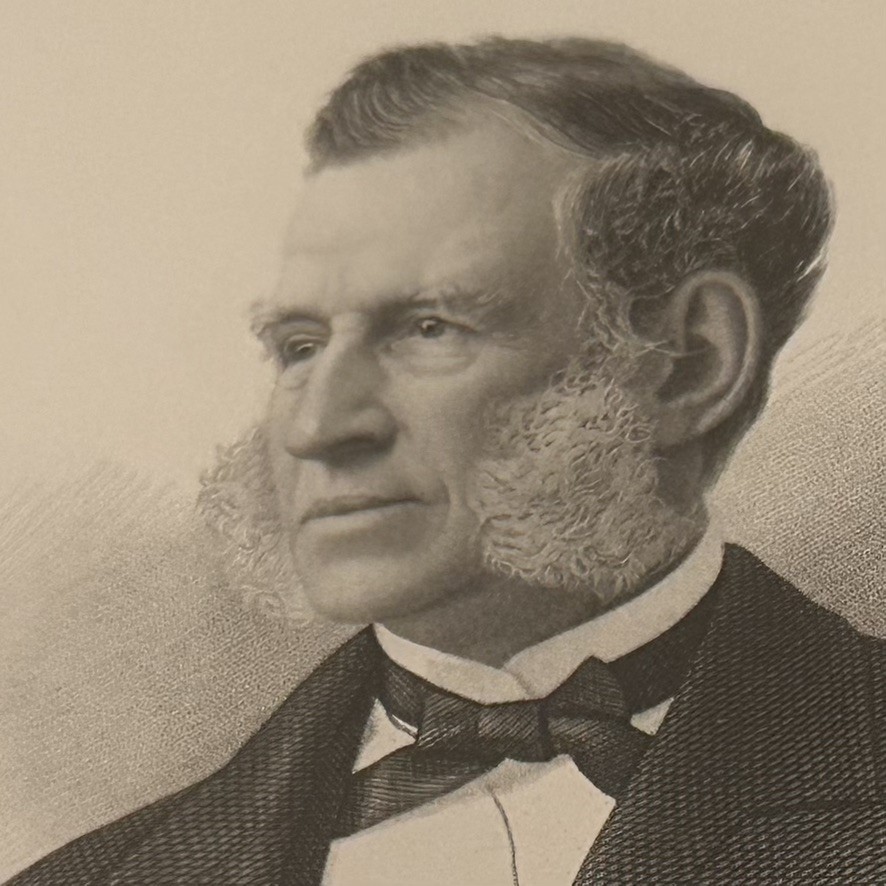
Hon. William Earl 1 Dodge of New York city, the eminent merchant and philanthropist, universally known. New York Times, Feb. 10, 1883 : —
THE HISTORY OF MANY YEARS OF WELL-REWARDED BUSINESS ACTIVITY AND OPENHANDED PHILANTHROPY.
William B. Dodge, one of the oldest merchants of this city, and a man whose philanthropy has made his name known throughout the Christian world, was in the seventy-eighth year of his age, and 65 years of his busy life were passed in this city, where he has left a record of philanthropy which has seldom been equaled. He was the son of David Low Dodge and his wife Sarah Cleveland, and was born near Hartford, Conn., Sept. 4, 1805. His father was a member of the firm of Ludlow & Dodge, dry goods merchants in this city, who also owned large cotton mills near Norwich, Conn. William was given the ordinary common school education which boys in the early part of this century received, and then, when very young, was sent to Norwich, where he worked in his father’s mills as a clerk in the office until he had reached the age of 13 years.
In 1818 he came to this city, and was taken into his father’s dry goods store, where he worked on a moderate salary for eight years. During this time he saved what he could, and when he had reached the age of 21 he joined his fortunes with the son of a retired Connecticut merchant, and the two began business for themselves as wholesale dry goods merchants at No. 213 Pearl street, under the firm name of Huntington & Dodge. Mr. Dodge was a shrewd’ business man, and, above all, a thoroughly upright man, and the firm of Huntington & Dodge thrived exceedingly well.
Mr. Dodge began business in May, 1827, and in 1831 he felt himself justified in taking a partner for life. He was married in that year to a daughter of Anson G. Phelps, a Prominent importer of metals, and this lady, who survives him, was an earnest helper to him in all his charitable works throughout his life. Two years after, in March, 1833, the new store which had just been completed by his father-in-law at the corner of Fulton and Cliff streets suddenly gave way from the foundations, and the great building fell, — burying in the ruins seven persons, among them two book-keepers and a confidential salesman. Mr. Phelps called on Mr. Dodge to join him in his business, and he sold out his interest in the dry goods firm of which he was a member and became a partner with his father-in-law and his brother-in-law, David James, the firm name in’ this country being Phelps, Dodge & Co., and in Liverpool Phelps, James & Co., the two firms being the successors of Phelps & Peck. The business of the firm in this city was done at Nos. 11 and 13 Cliff street, which is still its headquarters, although all the original partners have now passed away.
Mr. Dodge continued his connection with the firm of Phelps, Dodge & Co. for 46 years, and during that time the business of the firm increased so rapidly that large fortunes were distributed among the partners yearly, and it soon became the largest importing house of metals on the continent. Upon the death of Mr. Phelps, his father-in-law, Mr. Dodge became the senior member of the firm, and he managed its vast affairs with such good judgment and business tact that the house became known throughout the world as the most trustworthy in the business.
In the meantime Mr. Dodge had become a member of the Chamber of Commerce in 1855, and in 1863 had been elected Vice-President of that substantial body of merchants. This position he held until 1867, when he was elected President of the Chamber. He was serving his third successive term as President when these charges of defrauding the Government were made against his firm, and the Chamber declared its confidence in his integrity by re-electing him in 1873 to a fourth term. In 1875 he was offered a fifth term of the Presidency, but he positively declined to serve again, although he remained a member of the Chamber until the day of his death.
While attending strictly to the duties of his business as the head of the largest firm of metal importers in the country, Mr. Dodge still found ample time to make judicious investments in other branches of business, which added greatly to the large fortune which he was rolling up in the metal trade. He early saw the importance of covering the country with railroad lines, and believed that investments in these iron thoroughfares would pay large returns on the capital. He was one of the original incorporators of the New York & Erie Railroad, now the New York, Lake Erie & Western, and was a member of the Board of Directors of the road for 12 years. He was one of the projectors of the New Jersey Central, and continued to be a director of the company from 1843 to 1873. The Delaware, Lackawanna & Western Railroad was organized in his office in Cliff street, and he was a director and stockholder of this company at the time of his death.
He was one of the first to subscribe for the building of the Houston & Texas Road, and for seven years acted as President of this corporation. He was one of the founders of the Mutual Life Insurance Company, the Atlantic Mutual Marine Insurance Company, the Bowery Fire Insurance Company, the United States Trust Company, the Greenwich Savings Bank, the City Bank, and the American Exchange National Bank, in all of which he was a director from the time of their organization until his death. The fine timber lands of the West and the South early attracted the attention of Mr. Dodge, and he made large investments in these regions. He was one of the largest owners of timber lands and lumber mills in the country; possessing from 100,000 to 400,000 acres of land in each of the States of Wisconsin, Michigan, Georgia, West Virginia, and Texas, and extensive tracts in Canada. He was also largely interested in the development of the coal and iron interests throughout the country.
The great characteristic of Mr. Dodge, however, was not developed in his business career. He was a good business man, and knew how to make money ; but he was a greater philanthropist, and knew how to spend his money for the purpose of bettering the condition of his less fortunate fellowmen. His charities were unnumbered, and the record of many of them was undoubtedly erased with his life. He was brought up in the Presbyterian Church, and from his early boyhood he was a devout Christian. As soon as he began to make a living in this city he devoted himself to the work of a city missionary, but while he carried the Bible in one hand he carried food and drink in the other for the miserable creatures to whom he ministered.
He began his work by picking up boys in the slums of the metropolis, and in every practicable way making life easier and better for them. Then, as his means to do good increased with the increase of his wealth, he enlarged his sphere of labor, until, when he died, there was scarcely a charitable or religious work in this city which’ did not owe something to him, while many foreign religious societies will feel that they have lost their best friend. He was a member and a Ruling Elder at the time of his death of the Church of the Covenant, and this church has benefited greatly by his open-handed liberality. He was represented in all the benevolent enterprises of the church, contributed largely in building its Memorial Chapel, in Forty-second street, and was always foremost in interesting himself in the benevolent and charitable works of the church.
He was a large contributor to the support of both home and foreign missions. In 1876 he was instrumental in bringing Dwight L. Moody and Ira D. Sankey to this city, paid a good share of the expense of fitting the Hippodrome, now Madison-Square Garden, for their meetings, and took an active part in the meetings, often speaking himself. He was a delegate to the Evangelical Alliance, which met in this city in 1873, and presided over the first meeting. He contributed liberally to the erection of the Young Men’s Christian Association Building, at Twenty-third street and Fourth avenue. He was greatly interested in the work of Sunday-schools, and frequently addressed them. City missions were his favorite hobby, and he expended thousands of dollars in efforts to evangelize the poor of the city. He also took a great interest in the freedmen of the South, and in his annual visits to that part of the country he went as a missionary, establishing schools and missions in all directions. ” His hand was in his pocket whenever he was interested,” said the Rev. Mr. Vincent, his pastor, yesterday, “and he was always interested in anything that promised to advance the spiritual or temporal welfare of his fellowmen.” One of the latest achievements of his busy life was the establishment of the Jerry McAuley Mission, in the old Cremorne Garden, and he watched this experiment with -unflagging interest until his death. He also contributed liberally to establish the Syrian Mission and the Female College at Beirut.
He was very active in the work of helping young men to prepare for the ministry. He always had a number of young men on his list whom he was assisting to go through their preparatory course, and he was instrumental in sending scores of active workers into the ministerial field. ” During all the years that he lived in this great city,” said the Rev. Mr. Vincent, ” he was invariably to be found on the side of everything that was right, everything that was good. He has given away thousands of dollars that the world will never know of. He never talked of his good deeds, and he often contributed to objects when he had no faith in their expediency. I never met so open-hearted and so open-handed a man.”
Mr. Dodge was Vice-President of the American Board of Commissioners for Foreign Missions, of the New York Union Theological Seminary, and of the New York Colonization Society. He was a member of the Board of Directors of the American Bible Society, the American Tract Society, and of the Syria and Liberia Protestant Colleges. He was very much interested in the Lincoln University for colored students, to which he gave large sums of money, and devoted himself heartily to aiding in the work of educating the colored people and the Indians. In religious matters he was a strict disciplinarian, and his reverence for the Sabbath was unbounded. He declined to be present at the blowing up of Hell Gate, because it was done on Sunday, and on one occasion when a Times reporter called to see him about a proposed new charter for the city on Sunday, he declined to be interviewed, stating that he ” never engaged in secular conversation on the Sabbath.”
He resigned his position as. Director of the Erie, New Jersey Central, and Houston and Texas Railroads as soon as those companies began to run Sunday trains, and sold his stock, declining to be identified in any way with business that was conducted on the Sabbath. He was one of the most active workers to secure the enforcement of the Sunday provisions of the new Penal Code, and held that all business of a secular nature should be suspended on the Lord’s Day. He himself lived up to his belief consistently, and he believed that others should be made to do so.
Mr. Dodge was an ardent advocate of total abstinence, and although he was in every sense of the word a public man, around whose table distinguished Americans and foreigners often gathered, wine was never served at his board. He was one of the founders of the Union League Club, and took an active part in the work of that organization during the war, but a few years ago he resigned his membership because the club used wine at its banquets and many of its members were engaged in the liquor trade. When the National Temperance and Publication Society was organized, in 1866, Mr. Dodge was elected President, and he continued to fill” this position until he died. He brought Father Mathew to this country, and in every great temperance movement for the last 50 years Mr. Dodge was a prominent actor. He founded the Temperance Christian Home for Men, at Lexington avenue and Sixty-third street, and, encouraged by the success of that institution, purchased a house to be used for the care of female inebriates, which he was visiting when he was first stricken with his fatal illness last-Saturday night.
In politics Mr. Dodge was originally a Clay Whig. He was an old friend of Mr. Clay, and believed in him thoroughly, but when the Republican party was organized, in common with most of the Whigs, Mr. Dodge went over to the new party. He was a delegate to the convention which nominated Abraham Lincoln for the Presidency in 1860, and a member of the Peace Congress of 1861. During the war he acted as Chairman of the New York branch of the Christian Commission, and also took an active part in the work of the Sanitary Commission. In conjunction with the late Moses Taylor and a syndicate of bankers he raised a large sum of money for the use of the government in the early days of the war, and throughout the great rebellion gave his active aid and sympathy to the Union cause.
He was elected” a Representative to the Thirty-ninth Congress, and served on the Committee on Foreign Affairs. Political life, however, had little attraction for him, and after serving his term he retired to devote himself to his benevolent works. Mr. Dodge retired from the firm of Phelps, Dodge & Co. in 1879, and had since that time devoted himself to looking after his private interests. On Thursday ” of last week he gave a reception, which was attended by most of his old friends, including Peter Cooper, with whom he left his house to make his last appearance in public as Assistant Chairman at the protection meeting in the Cooper Union. Notwithstanding his munificent gifts to public and private charities, it is estimated that he leaves a fortune of over $6,000,000.
A special meeting of the Chamber of Commerce will be held at 1 o’clock this afternoon to take action on the death of the Hon. William E. Dodge, a former president of the organization. The call is signed, among others, by the following gentlemen, who say that Mr. Dodge’s eminent standing as a merchant and his untiring efforts in the cause of philanthropy call for a general expression of sorrow for his family, and for the loss which the city and nation has sustained : Samuel D. Babcock, James M. Brown, Howard Potter, John Crosby Brown, A. A. Low, J. Pierpont Morgan, Frederick P. Olcott, Royal Phelps, John D. Jones, Henry F. Spaulding, Charles Lanier, John Austin Stevens, Solon Humphreys, William H. Fogg, Charles M. Fry, A. Gracie King, S. B. Chittenden, Oliver Harriman, Morris K. Jesup, and C. N. Bliss.
- Y. Evening Post, Feb. 9, 1883 — Mr. William E. Dodge in a very interesting lecture on ” Old New York,” delivered by him in Association Hall three years ago, before a great audience of well known citizens, said :
” Eighteen hundred and eighteen found me a boy in a wholesale dry goods store, No. 304 Pearl Street, near Peck Slip. My employers were two most worthy Quakers. A promise made by my father to the junior partner”, that when he went into “business I was to be with, him, will account for my leaving school so early. It was a very different thing in those days to be a boy in a store from what it is now. I fear that many young ‘ men anxious to’ get started would hesitate long before facing such duties as had then to be performed. My father lived at that time at No. 98 William street, now the corner of Platt. I remember that while in this store I carried bundles of goods up Broadway to Greenwich Village, near what are now Seventh and Eighth avenues and Fourth to Tenth street, crossing the old stone bridge at Canal street. This had long square timbers on either side in place of railing to prevent a fall into the sluggish stream — some fifteen feet below — which came from the low lands where Centre street and the Tombs now are.’ At this time the wholesale dry goods trade was confined almost entirely to Pearl street, from Coenties to Peck Slips, though there were a few firms further up, and any party intending to commence that business must first be sure that he could obtain a store on Pearl street. We now talk of what Wall street is doing ; then, if one would speak of the dry goods trade, he would say, ‘ Things are active ‘ (or ‘ dull ‘) ‘ in Pearl street.’
” The retail trade was mostly in William street and Maiden Lane, except three fashionable houses that were the Stewarts of that day. These were all in Broadway : Vandevoort, near Liberty street; ‘the Heights,’ near Dey street, and Jotham Smith, who occupied the site of the Astor House. Stewart did not commence until 1824. The cheap retail dry goods stores were in upper Pearl and Chatham streets ; the wholesale groceries were in Broad, Water, and Front streets.
“You will remember that New York was then a comparatively small city, with a population of less than 120,000. One-fourth the present size of Chicago, it had extended very little above Canal street. Most of the dwellings were below Chambers, on the North river, but on the East river there were many up as far as Market and Rutgers streets. The most of the merchants and families of wealth lived in the lower part of the town in Greenwich, below Chambers, and on cross streets west of Broadway from the Park to the Battery. Many merchants in Pearl street lived over their stores, and John, Fulton, Beekman, Gold, and Cliff were filled with private residences. I was married fifty years ago in Cliff street, near my present office. Then that good man, Dr. Milnor, preached in St. George’s, corner Beekman and Cliff streets, to crowded audiences. Stores now occupy the ground.
“In May, 1827, I commenced at No. 213 Pearl street the wholesale dry goods business. A retired Connecticut merchant, with whom I had done business most of the time while a clerk, had a son just graduated from Yale, whom he was anxious to place in New York, and, having heard that I was intending to commence for myself, proposed a copartnership with his son. He offered to furnish an amount of capital which, with the small sum I had (mostly savings from my salary), would make for those days a respectable beginning, and furthermore promised to endorse for us to any reasonable amount. There are few events in a man’s life more important than that which introduces him into active business on his own account, and as my partner had no experience, I felt the responsibility the more.”
WILLIAM E. DODGE’S BEQUESTS.
An abstract of the will of the late William E. Dodge has been filed in the Surrogate’s office. It states that ” the residence at No. 225 Madison avenue and the country place at Tarrytown are given to the widow, with ample provision for her support. The seven sons share alike, and liberal bequests are made to relatives and others. The will is to run for five years, and the charitable and certain of the other bequests are to be paid by installments.” The bequests to charitable institutions are enumerated as follows :
Presbyterian Board of Foreign Missions, $50,000 ; American Board of Commissioners for Foreign Missions, $50,000 ; Presbyterian Board of Home Missions, $50,000 ; Education of Young Men for the Ministry, $30,000 ; American Bible Societv, $10,000 ; American Tract Society, $20,000 ; American Sunday-school Union, $10,000 ; National Temperance Society, $10,000; City Mission and Tract Society, $20,000; Presbyterian Board of Publication, f 10,000; Lincoln University, $10,000; Children’s Aid Society, $5,000; Howard University, $5,000 ; Atlanta University, $5,000 ; Hampton Institute, $5,000 ; Presbyterian Board of Aged Ministers, $5,000 ; American Seamen’s Friend Society, $5,000 ; International Committee of Young Men’s Christian Association, $5,000 ; McAuley Mission, $5,000 ; Syrian Protestant College, $20,000 ; Metropolitan Museum of Art, $5,000 ; American Museum of Natural History, $5,000.
Stuart Dodge’s Memorial of William E. Dodge, 390 — Account of the ceremonies at the unveiling of the statue of William E. Dodge, at intersection of 34th St., Broadway, and 6th avenue, Oct. 22, 1885. By the distinguished sculptor, J. Q. A. Ward. Height of statue, 9 ft. 6 in., inscribed : ” Erected by Voluntary Subscriptions under the Auspices of the Chamber of Commerce of the City of New York, 1885.”
Trumbull’s Memorial History of Hartford Co., Conn., 1 : 638 — Steel portrait and biographical sketch of William E. Dodge.
Family Christian Almanac, 1884, p. 21 — Wood cut of W. E. Dodge.
The Iron Monger, Oct., 1885, p. 251 — Plate of Dodge Statue and biographical sketch.
The Dodge-Morgan [Edwin Barber Morgan] Library Building of Andover Theological Seminary.
William E. Dodge. The Christian Merchant. By Carlos Martin, D.D. Funk & Wagnalls Co., Pubs., N. Y., 12 mo, pp. 349, portrait ; one of A Biographical Series of 12 American Reformers, Edited by Carlos Martin, D.D. — The Voice, N.Y.,June 28, 1894.
The following is from “Prominent Families of New York” Revised edition M-DCCC-XC-VIII
Digitized by Google
WILLIAM EARL DODGE
W ILLIAM DODGE, who settled at Salem,Mass.,in the year 1629,was the progenitor of a race representatives of which are now found in many portions of the United States. A branch of the family established itself in Connecticut, from which the four generations of eminent merchants and philanthropists who have made the name of Dodge famous in New York’s annals derive their origin.
The first of this line was David Low Dodge, who was born in Connecticut in 1774. He was a highly educated man, and was in his early years head of a private school at Norwich, Conn., which he made famous by the introduction of novel educational methods. He married a daughter of the Reverend Aaron Cleveland, the grandfather of ex-President Grover Cleveland. Entering business life, DavidLow Dodge established himself inHartford,Conn.,in 1802, but in 1805 came to New York City as partner of the firm of Higginsons & Dodge, which became the largest wholesale dry goods house of its day, having establishments at Boston, New York and Baltimore; but owing to the loss of many vessels, their business was broken up by the embargo. The latter, however, stimulated the growth of domestic manufacturers, and Mr. Dodge was a pioneer in the field. Returning to Norwich, Conn., he built a large cotton mill, one of the first in New England, but later on he returned toNew York and established the firm of Ludlow & Dodge. Retiring from business in 1827, his life till his death in 1852 was mainly devoted to religious and literary labors. He was an elder of the Wall Street Presbyterian Church, and with Robert Lenox had charge of building its new structure. He was among the founders of the American Tract and Bible societies,and was the first president oft he American Peace Society. Among his works on religious and social subjects was a volume, War Inconsistent with the Religion ofJesus Christ, which was reprinted in England and translated into several European languages. His brother in-law was the famous preacher, the Reverend Samuel Hanson Cox, D. D., whose son, the late Right Reverend Arthur Cleveland Cox,was Bishop of Western New York.
The Honorable William Earl Dodge, Sr., his son, was born at Hartford in 1805, and was educated at Norwich and at Mendham, N.J., under his uncle, the Reverend Dr. Cox. His earliest business experience was as a clerk in the mill at Norwich; but from his youth he was identified with New York, and in 1827 established the house of Huntington & Dodge here. He married a daughter of Anson Green Phelps, of the firm of Phelps & Peck, which Mr. Phelps had founded, and which was the largest establishment in the metal trade in the United States. In 1833, William E. Dodge entered this house, the style of which was changed to Phelps, Dodge & Co., which it has since retained. His interests were, however, as varied as they were extensive. He developed large lumber properties both in Canada and the South; he was among the first directors of the Erie Railroad, of the Central Railroad of New Jersey ,of the Delaware, Lackawanna & Western Railroad, being one of the founders of the latter, while he was also president of the Houston&TexasCentralRailroad. His enterprise and probity were rewarded not only by material success, but by the recognition of his fellow merchants. He joined the Chamber of Commerce in 1855, became its vice – president in 1863, and was elected president of the organization from 1867 til his voluntary retirement, in 1875.
Prior to the outbreak of the Civil War, he labored to secure an honorable settlement of sectional differences. He was a member of the Peace Congress in 1861, but when the war began gave an unswerving support to the Union. In 1864, he was elected a Member of Congress from the Eighth District of NewYork, and distinguished himself by his opposition to unsound financial measures, but declined a renomination. In 1872, he was a member of the Electoral College of this State, and, among many other public services, was a member of a commission which investigated the condition of the Indians.
The fame of William Earl Dodge, Sr., rests, however, upon a better basis than that of a successful career and public honors. Strong religious and humanitarian views came to him by
inheritance, were confirmed throughout his life, and became the guiding principles of his existence. He was ever active in religious work, but his charities knew no limits of creed or section, and the title of the “Christian Merchant,” by which he was known, was fully deserved by the tenor of his life. He gave his efforts freely to the cause of religion, temperance and benevolence, and among other positions was president of the Evangelical Alliance and the National Temperance Society and similar bodies. He gave aid to the furtherance of education among the freedmen of the South after the war, and I tshould be noted that after the struggle for the Union had been crowned with success, he was one of the first to inculcate conciliation and harmony among all sections. His death, in 1883, called forth earnest expressions of appreciation of his character and services from public, mercantile, religious and benevolent bodies, and the erection in 1885, under the auspices of the Chamber of Commerce, of his statue, at Broadway and Thirty fourth Street, was a fitting tribute to one of the most eminent citizens of the metropolis.
His son,Mr.William Earl Dodge,Jr.,was born in New York City in1832. He entered mercantile life in his youth, and in 1864 became a partner in Phelps, Dodge & Co., of which he is now the senior member. He is also president of the Ansonia Brass Company and other corporations at Ansonia, Conn., a town founded by and named after his grandfather, Anson G. Phelps. During the Civil War, he was one of the Commissioners of the State of New York to supervise the condition of its troops in the field. His commission was among the first signed by President Lincoln, and at the conclusion of his services he received the thanks of the State in a joint resolution of the Legislature. He was also an officer of the Loyal Publication Society, an advisory director of the Woman’s Central Association of Relief, out of which the United States Sanitary Commission grew, and was one of the founders of the Union League Club.
Mr. Dodge followed the example of his father in his devotion to religious and charitable work. He was long the president of the Young Men’s Christian Association, which, under his administration, erected its building at Twenty-third Street and Fourth Avenue, the first in the country devoted to the special use of an Association. He succeeded his father as president of the Evangelical Alliance, was vice-president of the American Sunday School Union, and chairman of the National Arbitration Committee. Among other services to the metropolis, he is a trustee of the Slater fund, a member of the executive committee of the Metropolitan Museum of Art, the Museum of Natural History, and the New York Botanic Garden. Mr. Dodge has also filled the post of vice-president of the New England Society, and is a member of the Metropolitan, Union League, Century, City, Reform, Riding, Presbyterian, Country, and other clubs, and of the American Geographica lSociety and a large number of other social, scientific and benevolent bodies. His town residence is in Madison Avenue, and his country place is Greyston, Riverdale-on Hudson. In 1854, Mr. Dodge married Sarah Tappen Hoadley, daughter of the late David Hoadley, president of the Panama Railroad Company.
The other sons of William E. Dodge,Sr.,are Anson Phelps Dodge, Norman W. Dodge and George E. Dodge,who are all identified with the business interest and social life of the city; the Reverend D. Stuart Dodge, D. D., founder of the Syrian Protestant College at Beirut, Syria, to which his father was a liberal benefactor; Brigadier General Charles Cleveland Dodge, a prominent cavalry officer during the Civil War and Major of the New York Mounted Rifles; and the late Arthur Murray Dodge.
Cleveland Hoadley Dodge, thes on o fMr. William Earl Dodge,Jr.,was born in New York City in 1860. He isa member of the firm of Phelps, Dodge & Co., a trustee of the Farmers’ Loan and Trust Company, and a director of the National City Bank and other corporations, while he has been actively interested in a number of local charities, and is president of the Young Men’s Christian Association, in succession to his father. He married Grace Parish.
Grace Hoadley Dodge, daughter of Mr.W. E.Dodge,Jr.,has distinguished herself by her practical work on behalf of her sex. She founded the Working Girls’clubs of New York City, and originated theTeachers’ College, now affiliated with Columbia University. She was also the first woman appointed a member of the New York Board of Education.