Dennis Cooley
(1825 - 1892)
Page 1256, # 4309
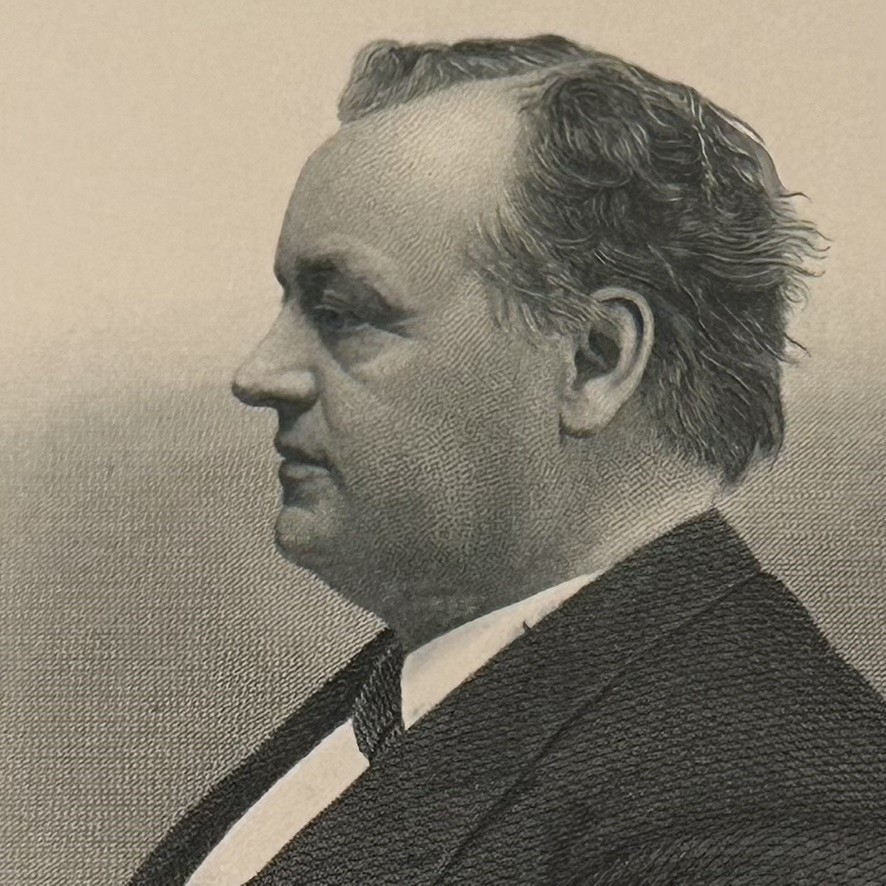
Judge DENNIS NELSON COOLEY was born at Lisbon, N. H., November 7, 1825. His ancestors were Scotch and English and among the first to plant the principles of Protestantism in this country. Some of his ancestors, both paternal and maternal, served in the Revolutionary War. His grandparents were Aaron Cooley and Persis Cleveland. His father died when Mr. Cooley was but two years old, leaving a small property. Early in life he determined to acquire an education, and at fifteen years of age entered the Newberry Seminary in Vermont, supporting himself by teaching in vacation.
He was rich in physical and mental energy, a strong will and a noble purpose to make the most of himself by serving, to the utmost of his ability, the age in which he lived. At first he contemplated a military life, passed an examination, and received an appointment to West Point, but was dissuaded by his mother from the life of a soldier, and selected the law as a profession.
He had prepared himself to enter Dartmouth College, but lack of means compelled him to abandon the idea of a collegiate education. Early in his career he was clerk of the House of Representatives in Vermont, and assisted in editing the ” Woodstock Age.” See Bibliography, Chap. IV. In 1854 he went West and settled at Dubuque, Iowa, where, for twenty years, he enjoyed a law practice regarded as one of the best in the state.
During this period he carried on a large legal practice in Washington, D. C, also. In Iowa he was state senator for two terms. In 1864 he was appointed Commissioner to South Carolina, where he acted as special judge to decide titles to cotton and lands in the city of Charleston and vicinity. He was appointed Commissioner of Indian Affairs by President Lincoln in 1864, and served under him and for a time under President Johnson. He was Secretary of the Union Congressional Campaign Committee in 1864, which largely contributed’ to the second election of President Lincoln.
In 1873 he was appointed Commissioner to the Vienna Exposition. He always took much interest in education, and was prominent in philanthropic and public enterprises. A professorship of civil engineering was founded by him at Cornell College, Iowa, of which institution he was a member of the Board of Trustees for many years. Of the Methodist Church he was a distinguished member. In the General Conferences of that church in 1872 and 1876 he took an active part, and was justly one of the most prominent of the lay delegates. For twenty-one years he was President of the First National Bank of Dubuque, and was one of the first Presidents of the Iowa State Bankers’ Association.
A sketch of his career in its merely public aspect would be inadequate to present him as he was. His personality blended grace and vigor, shrewdness and kindness, persistence and amiability. His love of study, his close application during years of public trust to questions of finance, legislation, social and religious life, his ability to uphold logically his views, his clear perception and expression of thought marked him as a conversationalist of rare power. His knowledge of men and of the world, gained by travel and observation and by his abundant opportunities of mingling with the best minds, together with a personal magnetism of exceptional strength, made friends of rich and poor alike. His life has that highest tribute due it, — success, — because it was lived for others ; because its whole tendency was for good. To his family he was idol and ideal. For his wife and children he devoted himself to the study of everything that could foster and promote their best interest.
Mrs. Clara (Aldrich) Cooley, residence still at Dubuque 1897, subscriber for this Genealogy.