A proposed community-first funding story for ADUT
The $30 Million Down Payment on the American Dream
Before asking a handful of major philanthropists to build the whole institution, invite hundreds of communities to say something first: we want this to exist.
American Dream University of the Trades (ADUT) is a proposed institution. The campus image shown here is conceptual.

They saved a ship.
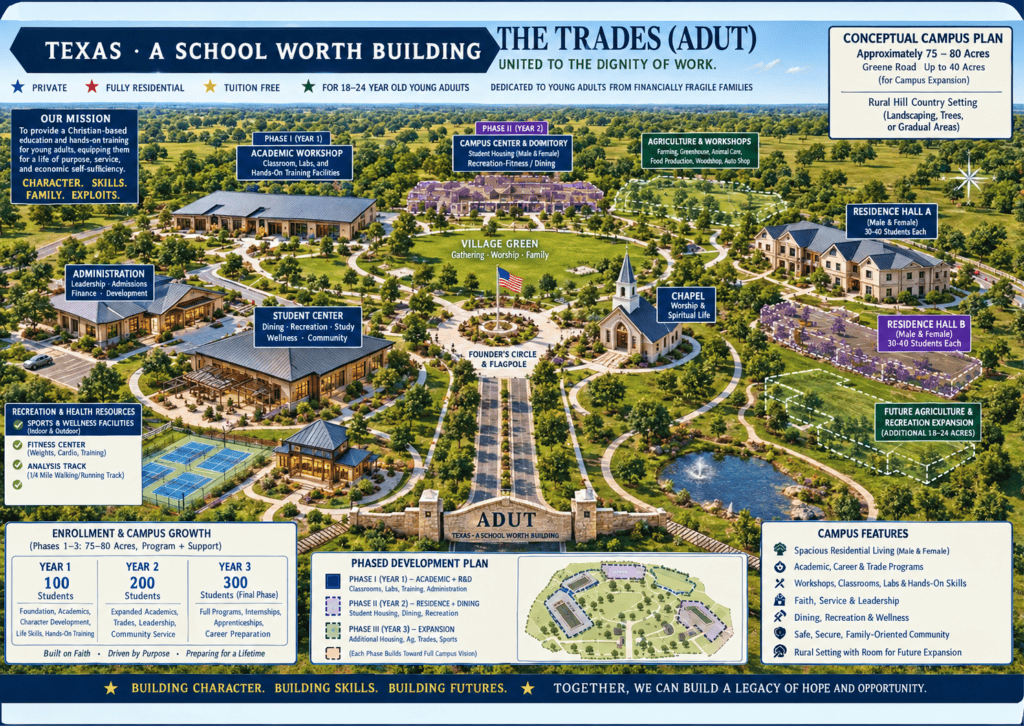
We can build a school.
SAVE OUR SHIP. → BUILD OUR SCHOOL.
In both cases, it begins when communities decide: This matters.
The precedent
It started with children carrying a story home.
In 1961, North Carolina faced a problem that seemed far too large for ordinary families to solve. USS North Carolina, one of the state’s most visible links to World War II, was headed toward the scrap yard.
The state turned to its schoolchildren. They became ambassadors. They carried the story home to parents, grandparents, neighbors and local businesses. Dimes and larger contributions accumulated across the state.
The individual gifts were small. The collective message was enormous.
North Carolina wanted to save its ship.
More than sixty years later, the battleship remains in Wilmington. The lesson for ADUT is not that schoolchildren should be responsible for raising hundreds of millions of dollars. The lesson is much simpler:
Give ordinary people a meaningful way to participate in something larger than themselves.
Every high school is a community
The school is the center of the map. The community is the force around it.
ADUT would invite high-school communities throughout Greater Houston—and ultimately beyond—to become founding partners in creating a new kind of residential university dedicated to skilled-trades excellence.
“High-school community” does not mean the school administration has to collect the money. Districts and individual schools may have different rules. Some may participate directly; some may not. The community can still participate.
Parents and other community leaders can help determine the appropriate structure. Students can carry the idea outward. Parents, alumni, businesses and community organizations can provide the organization. Money can be collected through whatever lawful, transparent mechanism is established for the campaign.
Students
tell the story
Parents & Grandparents
organize and participate
Alumni
reconnect and give back
Local Businesses
support the community
Tradespeople
stand behind the mission
Neighbors & Civic Groups
help carry it forward
ADUT is not asking every high school to conduct a fundraiser.
ADUT is asking every high-school community to decide whether it wants to help build ADUT.
The question everyone will ask
How much are we talking about?
Probably less than most people first imagine.
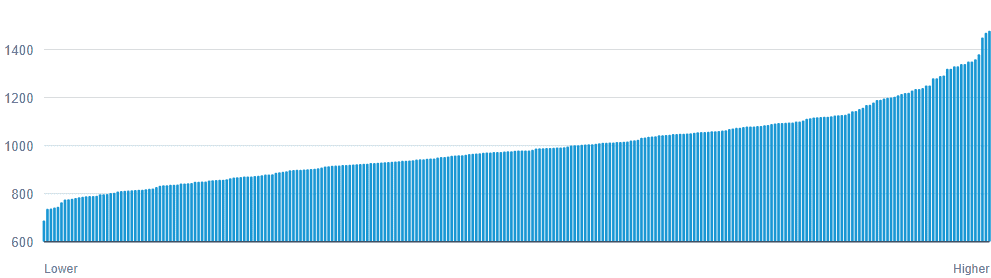
The proposed public-school scale is intentionally easy to understand visually. Most families already have a general sense of where their school falls on SAT performance. Find approximately where the school sits on the first graph—then look straight down.
Greater Houston High Schools — SAT Average
270 schools arranged from lower to higher SAT average. Exact school-by-school values are in the source data; the visual is meant to show the range at a glance.
↓ LOOK STRAIGHT DOWN ↓
Illustrative Community Goal — Per Student
The same ordering produces a visually parallel goal curve. The point is scale, not false precision.
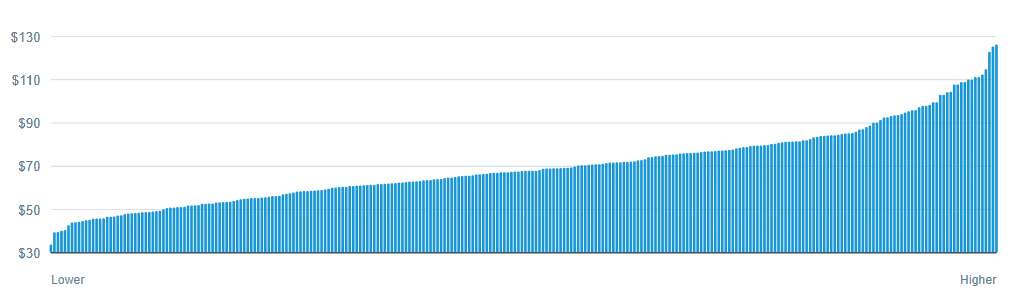
~$34
low end of illustrative public-school scale
~$50–70
many communities fall in a modest middle range
~$90–110
higher-capacity communities carry more
~$126
high end of illustrative public-school scale
Different capacity. Different goals. Equal recognition.
Private-school communities
Keep the private-school idea equally simple.
A proposed benchmark for private-school communities is 1% of one year’s published tuition per student. That immediately tells families the scale without making the request sound larger or more complicated than it is.
$25,000example annual tuition
× 1%
$250 community goal per student
That does not mean every family receives a $250 bill. It is the collective target for the whole community: parents, grandparents, alumni, businesses and other supporters. Some may give $25. Some $100. Some $250. Some more. Some nothing at all.
The goal belongs to the community, not to each family.
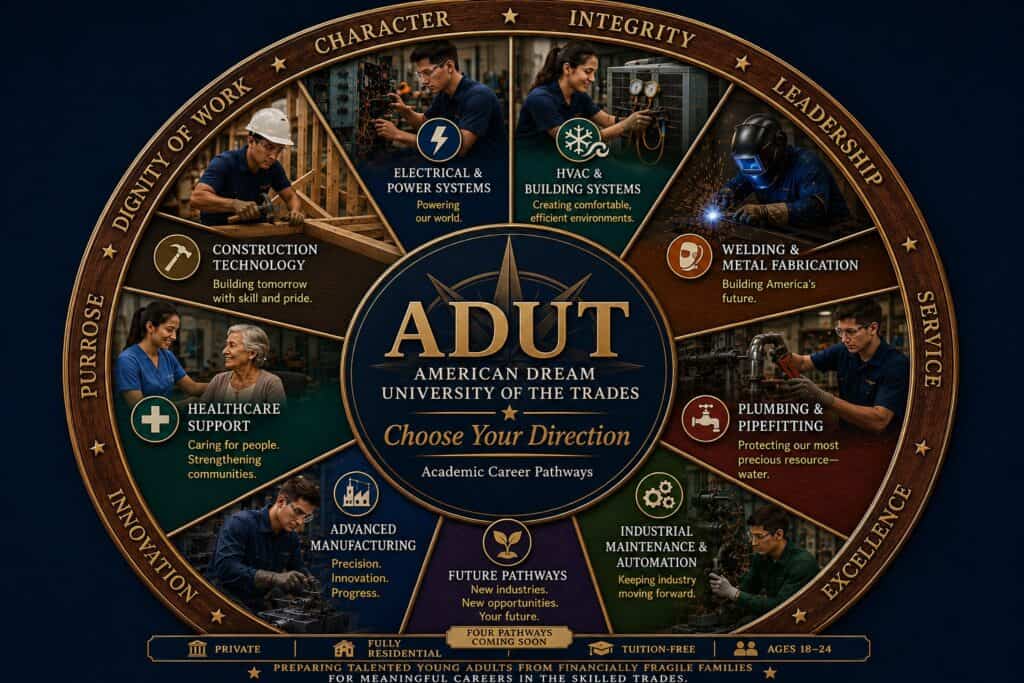
What are we building for?
Not buildings for their own sake. Pathways to skilled, meaningful careers.
The campus is the place. The purpose is the people who will learn there.
When a community reaches its goal
Recognition should be permanent—and equal.
A community whose fair goal is $40 per student should not receive lesser recognition than a community whose goal is $120. A public school should not stand below a private school. The accomplishment is meeting the goal established for that community.
Ideally, the school would display a plaque. If an administration chooses not to, ADUT can still permanently record the community among its Founding Communities.
FOUNDING COMMUNITY
American Dream United School of the Trades
WE HELPED BUILD IT.
Hundreds of communities · thousands of people · one visible commitment
$30M
The first $30 million is not supposed to finish ADUT.
$300M
proposed permanent endowment
$100–150M
estimated campus and facilities
$400–450M
estimated total investment
$30 million doesn't finish it.
It changes who goes first.
Then the conversation changes
The communities went first.
Once approximately $30 million has been raised through broad community participation, ADUT can approach major individuals, foundations, corporations and institutional partners from a very different starting point.
“Before asking you to invest, we asked the public. They responded. Communities contributed the first $30 million. Now we are asking you to help finish what they began.”
~$370–420M
Approximate remaining requirement after a $30 million community first stage, based on the current $400–450 million working total.
3 signals
Demand. People want it.
Validation. They participated.
Momentum. The project did not wait for one donor to create belief from scratch.
The community-raised capital is therefore more than symbolic. It becomes strategic leverage—and a public record showing that the idea survived contact with the people it hopes to serve.