Grover Cleveland
(1837 - 1908)
Page 1782, #8666
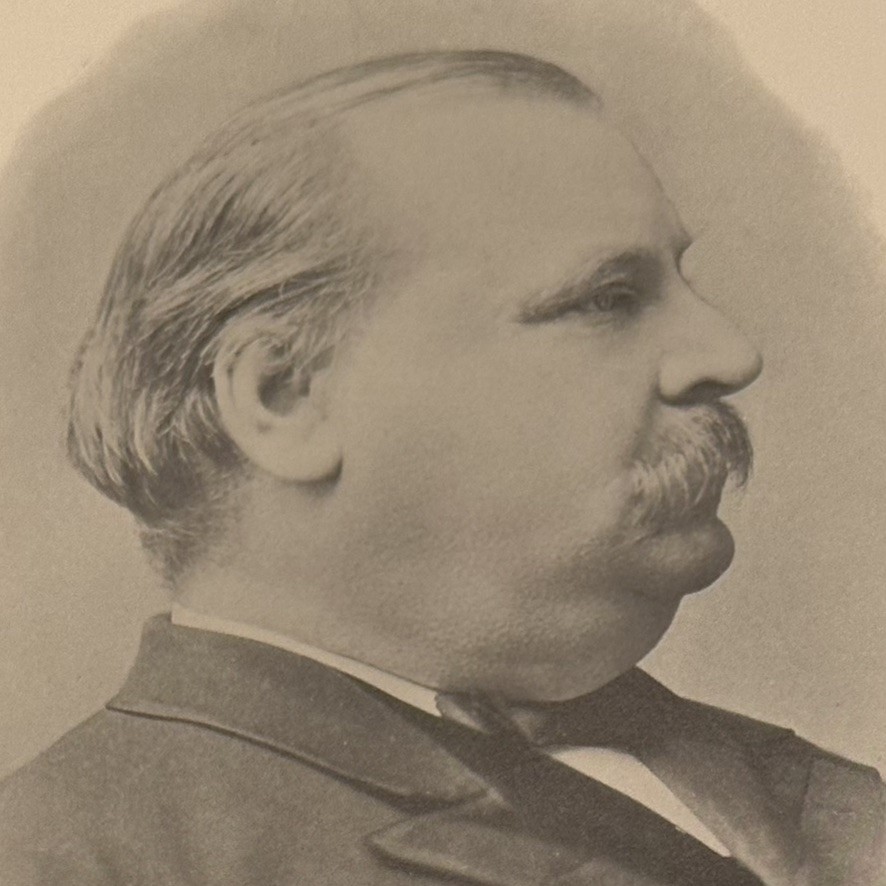
Hon. Grover Cleveland, the only one of the Cleveland name who has filled the high office of Chief Magistrate of our great nation ; and one of the four of Cleveland ancestry who have been governors of States, viz.: Gov. Chauncey Fitch Cleveland of Connecticut, Gov. Jesse” Franklin of North Carolina, Gov. Alvin Petersorf Hovey of Indiana, Gov. Grover Cleveland of New York.
The house in which Grover Cleveland was born, a small two-story wooden building, is still standing. It was the parsonage of the Presbyterian church, of which his father, Rev. Richard Falley Cleveland, at the time was pastor. In honor of his father’s predecessor, Rev. Stephen Grover, he was named Stephen Grover Cleveland, but from childhood, for sake of euphony, he was usually called Grover, and the name Stephen was dropped.
When he was three years old (1841) the family moved to Fayetteville, Onondaga county, N. Y. Here Grover Cleveland lived until he was fourteen years old, the rugged, healthful life of a country boy. His frank, generous manner made him a favorite among his companions, and their respect was won by the good qualities in the germ which his manhood developed. He attended the district school of the village and was for a short time at the academy. His father, however, believed that boys should be taught to labor at an early age, and before be had completed the course of study at the academy he began to work in the village store at fifty dollars for the first year and the promise of $100 for the second year. His work was well done, and the promised increase of pay was granted in the second year.
Meanwhile, his father and family- had moved to Clinton, N. Y., the seat of Hamilton college, where his father acted as agent to the Presbyterian Board of Home Missions, preaching in the churches of the vicinity. Hither Grover came, at his father’s request, shortly after the beginning of his second year at the Fayetteville store, and resumed his studies at the Clinton Academy.- After three years spent in this town, the Rev. Mr. Cleveland was called to the village church of Holland Patent, N. Y. He had preached here only a month, when he was suddenly stricken down and died without an hour’s warning. The death of the father left the family in straightened circumstances, as Rev. Mr. Cleveland had spent all of his salary of $1,000 per year, which was not required for the necessary expenses of living, upon the education of his children, of whom there were nine. Grover was hoping to enter Hamilton College, but the death of his father made it necessary for him to earn his own livelihood. For. the first year (1853-4) he acted as assistant teacher and bookkeeper in the Institution for the Blind in New York city, of which the late Augustus Schell was for many years the patron. In the winter of 1854 he returned to Holland Patent, where the generous people of that place, Fayetteville, and Clinton, N. Y., had purchased a home for his mother, and in the following spring, borrowing twenty-five dollars, he set out for the West to earn his living. Reaching Buffalo, N. Y., he paid a hasty visit to an uncle, Mr. Lewis Falley Allen, a well-known stock farmer, living at Black Rock, a few miles distant. He communicated his plans to Mr. Allen,, who discouraged the idea of the West, and finally induced the enthusiastic boy of seventeen to remain with him and help him prepare a catalogue of blooded short-horn cattle, known as Aliens American Herd Book, a publication familiar to all breeders of cattle. For this work young Cleveland was to receive fifty dollars, and his uncle further agreed to secure a position for him in a lawyer’s office as a clerk or copyist. His ambition had turned toward the law ever since his days in the Clinton Academy, and it was partially in the hope of finding some opportunity to begin the study of the law that “he had first decided to go West.
While he was working on the pedigrees of cattle his uncle visited the law offices of his Buffalo friends and, after several unsuccessful efforts, secured a place for Grover with Rogers, Bowen & Rogers, one of the leading firms in the county. He entered that office, accordingly, in August, 1855, and after serving a few months without pay, was paid four dollars a week — an amount barely sufficient to meet the necessary expenses of his board in the family of a fellow student in Buffalo, with whom he took lodgings. Shortly afterward he took a small room in the attic of the Southern Hotel, then a favorite stopping place with drovers and farmers. Life at this time with Grover Cleveland was a stern battle with the world. He took his breakfast by candle-light with the drovers, and went at once to the office, where the whole day was spent in work and study. Usually he returned again at night to resume reading which had been interrupted by the duties of the day. In this manner the foundations of legal knowledge were laid deep and firm at the same time that habits of industry and close application were acquired. Gradually his employers came to recognize the ability, trustworthiness, and capacity for hard work in their young employe, and by the time that he was admitted to the bar (1859) he stood high in their confidence. A year later he was made confidential and managing clerk, and in the course of three years more his salary had been raised to $1,000. In 1863, he was appointed assistant district attorney of Erie county,. N. Y., by the district attorney, Hon. Cyrenius C. Torrence, in recognition of his abilities and his services to the Democratic party.
Since his first vote had been cast, in 1858, he had been a staunch Democrat, and had enrolled himself among the young men of his ward to do duty at the polls on election day. It may be stated here that until he was chosen Governor, he always made it his duty, rain or shine, to stand at the polls and give out ballots to Democratic voters. During the first year of his term as assistant district attorney, the Democrats desired especially to carry the Board of Supervisors. The old Second ward, in which he lived, was Republican ordinarily by 250 majority, but at the urgent request of the party, he consented to be the Democratic candidate for Supervisor, and came within thirteen votes of an election. The three years spent in the District Attorney’s office were devoted to assiduous labor and the extension of his professional attainments. So vigorously was crime prosecuted and so efficiently did he administer the office, that he was nominated for District Attorney in 1865, with one voice, by the Democrats. The Republicans nominated Mr. Lyman K. Bass, a particular friend of Cleveland’s, in order to divide the young men’s vote, then beginning to be a prominent factor in Buffalo politics. The election was closely contested, but Bass won by about 500 majority, although Cleveland polled more than the party vote in all the city wards. When he retired from the position of Assistant District Attorney, on January, 1866, he formed a law partnership with the late Isaac V. Vanderpoel, ex-State Treasurer, under the firm name of Vanderpoel & Cleveland. Here he soon won a good standing at the bar of Erie county. In 1869, Mr. Cleveland formed a partnership with ex-Senator Hon. Albert Pierce Laning (many years attorney for Canada Southern R. R. and Lake Shore R. R.) and ex-Assistant United States District Attorney, Oscar Folsom, under the firm name of Laning, Cleveland & Folsom. During these years he began to earn a moderate professional income ; but the larger portion of it was sent to his mother and sisters at Holland Patent, to whose support he had contributed ever since i860.
In 1870, at the urgent solicitation of the Democracy and against his own wishes, he consented to be the candidate for sheriff. The election was closely contested, but Mr. Cleveland and the entire Democratic ticket were elected by a good majority. The office of sheriff is the most important position in the county, and its duties were performed in such a manner as to command the approbation and confidence of the community, as was strikingly demonstrated a few years later. At the expiration of his official term as sheriff (Jan. 1, 1874), Mr. Cleveland resumed the practice of the law, associating himself with the Hon. Lyman K. Bass, his former competitor, and Mr. Wilson Shannon Bissell. The firm was strong and popular, and soon commanded a large and lucrative practice. Ill-health forced the retirement of Mr. Bass in 1879, and the firm became Cleveland & Bissell. In 1881, Mr. George J. Sicard was added to the firm, having their office at 284 Main St., cor. of Swan.
In the autumn election of 1881, the Democrats of Buffalo nominated Grover Cleveland for Mayor, on a platform pledging the party to administrative reform and economy in the expenditures of the city. He was elected by a majority of over 3,500 — the largest majority ever given a candidate for mayor — and the Democratic city ticket was successful, although the Republicans carried Buffalo by over 1,000 majority for their State ticket. His administration as Mayor fully justified the confidence reposed in him by the people of Buffalo, evidenced by the great vote he received.
It was his courageous devotion to the interests of the people and his great executive abilities which, in the summer and fall of 1882, gave him prominence before the Democracy of the State of New York as a candidate for Governor. The Democratic State Convention met at Syracuse, N. Y., on Sept. 22, 1882, and nominated Grover Cleveland for Governor on the third ballot. The campaign that followed was auspicious from he beginning, and terminated with a triumphant victory. Cleveland was elected Governor by a majority of 192,000, by far the largest ever given in this State, and the largest ever given in any State in the. Union. He was inaugurated Governor of New York on Jan. 1, 1883, and removed to the gubernatorial Executive Mansion, Albany, N. Y. Resigned the office of Governor, Jan. 6, 1885.
The National Convention of the Democratic party at Chicago, Illinois., nominated July 11, 1884, for President, Grover Cleveland of New York ; for Vice-President, Thomas Andrews Hendricks of Indiana.
The candidates of the other political parties were as follows: Republican party, for President, Hon. James Gillespie Blaine ; for Vice-President, Gen. John Alexander Logan. National (Greenback) party, for President, Gen. Benjamin Franklin Butler. Prohibition party, for President, Gov. John Pierce St. John. The Independent Republican party (” Mugwumps “) supported Cleveland and Hendricks. Election Tuesday, Nov. 4, 1884. Cleveland and Hendricks received, in the Electoral College, the votes of the electors of : Ala. 10, Ark. 7, Conn. 7, Del. 3, Fla. 4, Ga. 12, Ind. 15, Ky. 13, La. 8, Md. 8, Miss. 9, Mo. 16, N. J. 9, N. Y. 36, N. C. 11, S. C. 9, Tenn. 12, Tex. 13, Va. 12, W. Va. 6, total 219; Blaine and Logan those of: Cal. 8, Col. 3, 111. 22, la. 13, Kan. 9, Me. 6, Mass. 14, Mich. 13, Minn. 7, Neb. 5, Nev. 3, N. H. 4, Ohio 23, Ore. 3, Pa. 30, R. I. 4, Vt. 4, Wis. 11, total 182. The joint session of the U. S. Senate and House of Representatives, to count the electoral vote, was held in the chamber of the House at 12 M. Feb. 12, 1885 ; Hon. George Franklin Edmunds, presiding officer of the Senate and of the joint session, announced the result : 219 votes to Cleveland and Hendricks, 182 to Blaine and Logan.
Hon. Grover Cleveland was inaugurated President at Washington, D. C, Mar. 4, 1885, at 1.05 p. m. The platform upon which the ceremony took place was erected over the center stairway of the east front of the Capitol. On the plaza in front extended an imposing multitude from all parts of the Union to witness the resumption of power by the Democratic party after an interval of 24 years. The civil and military procession was large and brilliant, the day was fine
(BREAK – See numerous Biography’s)
The first year of the administration was saddened by the death in office of the Vice-President, Thomas Andrews Hendricks, who was born on a farm in Muskingum co., near Zanesville, O., Sept. 7, 1819, and died at his residence on North Tennesee st, Indianapolis, Ind., Nov. 25, 1885.
During the second year of his term President Cleveland terminated his days of bachelorhood by marriage, the first wedding of a President in the White House. Rev. Byron Sunderland, D.D., performed the ceremony, which occurred at seven o’clock P.M.
The Democratic National Convention at St. Louis, Mo., nominated, June 6, 1888 : For President, Grover Cleveland (unanimously); for Vice-President, Allen Granberry Thurman of Ohio (b. Lynchburg, Campbell co., Va., Nov. 13,-1813).
Election Nov. 6, 1888. The votes (as indicated by the votes for Electors) for the nominees for President were : Total popular vote, 11,388,038. Grover Cleveland, Democrat, 5,540,329; Benjamin Harrison, Republican, 5,439,853. Mr. Cleveland’s plurality, 100,476. Clinton Bowen Fisk of N. J., Prohibition, 249,506; Alson J. Streeter of 111., Union Labor, 146,935: Robert H. Cowdry of 111., United Labor (N. Y. and 111.) 2,818; James L. Curtis of N. Y., American (California), 1,591. [The pluralities of the two great parties in 1872, Rep. 762,991; 1876, Dem. 250,935; 1880, Rep. 7,018; 1884, Dem. 62,683.]
The Republican candidates were elected : President, Benjamin Harrison; Vice-President, Levi Parsons Morton of N. Y. <b. Shoreham, Vt., May 16, 1825).
Residence, March 4, 1885, to March 4, 1889, Executive Mansion, Washington, D. C.; to 1893, in New York, N. Y.; summer seat, “Gray Gables,” Cape Cod. Hon. Mr. Cleveland resumed the practice of law, office in the City of New York, 1889-93.
The Democratic National Convention at Chicago nominated, June 23, 1892 : For President, Grover Cleveland, on the first Fallot, by 617^ of the 910 votes, and then made unanimous. For Vice-President : Adlai Ewing Stevenson of Bloomington, 111 (b. Christian co., Ky., Oct. 23 1835). The Republican National Convention at Minneapolis, Minn., nominated June 10, 1892: For President, Benjamin Harrison; for Vice-President, Whitelaw Reid of N. Y. (b. Xenia, O., Oct. 27, 1837). The Prohibition National Convention at Cincinnati, O., nominated July 1, 1892: For President, John Bidwell of Cal ; for Vice-Pres., James B. Cranfill of Tex. The People’s Party National Convention at Omaha, Neb., nominated July 4, 1892: For President, James B. Weaver of la.; for Vice-Pres., James Field of Va.
Election Tuesday, November 8, 1892. In the Electoral College
Cleveland and Stevenson received the votes of 277, Electors.
Harrison and Reid received the votes of 145 Electors.
Weaver and Field received the votes of 22 Electors.
Total Electoral votes of the forty-four States, 444
The joint session of the U. S. Senate and House of Representatives, to count the Electoral vote, was held in the chamber of the House at 10 a.m., Feb. 8, 1893; Hon. Levi P. Morton, Vice-Pres. of the U. S. and presiding officer of the joint session, announced the result of the election.
Hon. Grover Cleveland was for the second time inaugurated President at Washington March 4, 1893, and the inaugural delivered from the east portico of the capitol in the presence of a mighty multitude. Notwithstanding the snow storm the parade was more imposing in military and civic display than that of any previous inauguration.
(BREAK – See numerous Biography’s)
The U. S. Mint annual Assay Commission medals 1886-9, 1894-7 (sizes : 5 of them 21, 3 of them 48), all bore Pres. Cleveland’s portrait, according to the present custom.
Residence, March 4, 1893, to March 4, 1897: Executive Mansion, Washington; summer seat, “Gray Gables.”
President Cleveland was succeeded in office by Hon. William McKinley of Ohio, born at Niles, O., Feb. 26, 1844, who was inaugurated President Mar. 4, 1897. Hon. Grover Cleveland is, physically, of a large and powerful frame; deliberate and firm, but not slow in his motions. His manner and tone of voice are genial and agreeable. He is broad-minded and liberal in his habits of thought, and in religious matters especially a man of conscience rather than a man of any one sect or creed. All his surroundings and habits are those of Democratic simplicity. His life has been wholly without ostentation. Indeed, the key to his character may be found in the moderation of his wants and the frugality of his living. From such sources spring firmness, courage, clear powers of perception and collected and deliberate judgment and action. In the strongest and truest sense of the words he is a Jeffersonian Democrat, always honest, capable, faithful to the Constitution.
Residence, Westland, Princeton, N. J., (1897-8).
Grover Cleveland is a subscriber to this Genealogy.