Nathaniel Cleveland Moak
(1833 - 1892)
Page 1901, # 10853
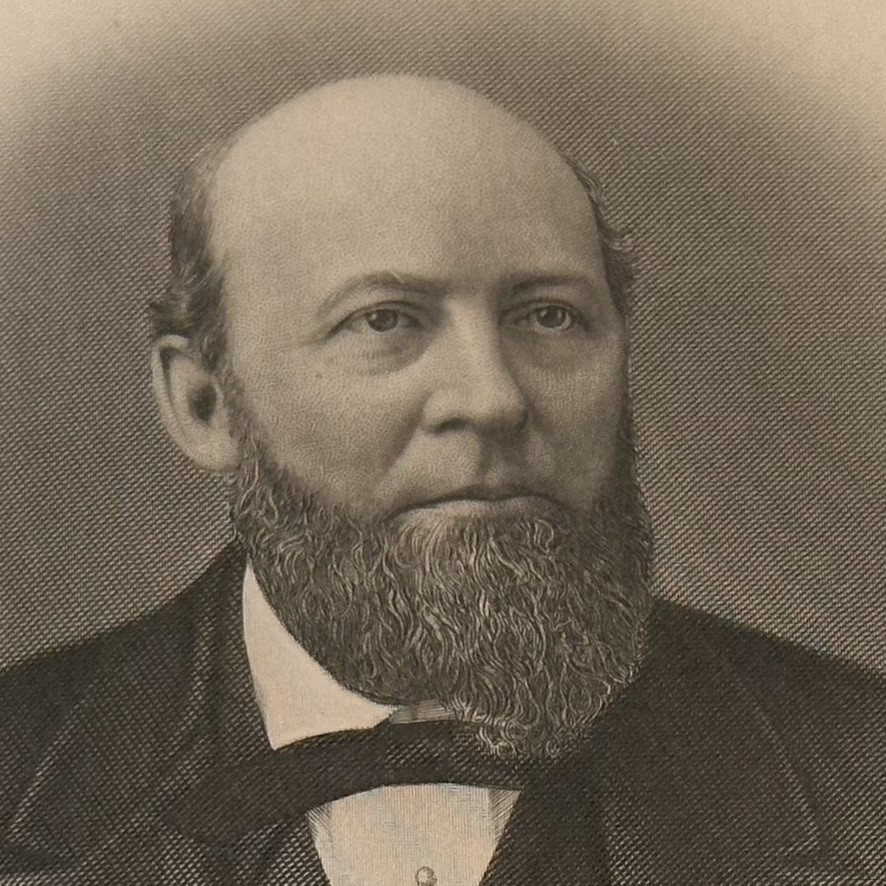
Hon. NATHANIEL CLEVELAND MOAK was born October 3, 1833, in Sharon, New York, the son of Jacob Moak and Amy Cleveland. He worked upon his father’s farm until about 16 years of age, attending district schools in the neighborhood winters. In 1849, he attended 3 terms at the Cherry Valley Academy, after which he earned, by laboring upon a farm, sufficient to pay his expenses for a year at the Cooperstown Academy, under the tuition of John Leach, residing in the family of Dr. Fox, where he studied Anatomy and Physiology, which was of great advantage to him in his profession, being the basis of his great practical knowledge of Medical Jurisprudence. In the winters of 1851 and 1852, he taught district schools. In 1853, he entered the law office of James E. Dewey, at Cherry Valley, as a student, and soon began to practice in justices’ courts, where he obtained the confidence, experience, and skill which were the foundation of his great success in his profession.
He never forgot his early struggles and the hardships young members of the bar are compelled to undergo. No man in the profession was more ready and willing to aid and advise young men, and to furnish them with authorities for use in their cases. The number of letters, asking for such information, he patiently answered during a year, is simply incredible. He was admitted to the bar January, 1856, at Cortlandville. He remained with Mr. Dewey until Nov., 1859, when he formed a copartnership with Edwin Countryman until Jan. 1, 1862, when he became partner with Edwin Clark to Sept., 1865. He removed, fall of 1865, to Oneonta, N. Y., practiced there till fall of 1867, then removed to Albany, N. Y., and became a member of the firm of Smith, Bancroft & Moak, continuing a member until the deaths of Messrs. Smith and Bancroft.
At Albany Mr. Moak found an appropriate field for the exercise of his great industry and ability, and soon found himself retained in most of the cases of importance. Though possessing an encyclopedic knowledge of law, with remarkable quickness in applying its principles to the case on hand, he had equal ability as a trial lawyer. He was one of Mr. Ramsey’s trusted advisers in the famous ” Susquehanna War,” between Ramsey and Fisk and Gould, for the possession of the Albany & Susquehanna Railroad.
Mr. Moak was elected, Nov., 1871, District Attorney of Albany county, entering upon the discharge of his duties Jan. 1, 1872, his term ending Dec. 31, 1874. ‘ The manner in which he discharged the duties of that office added largely to his reputation. He tried and convicted one Emil Lowenstein for the murder of John Weston. His closing address was replete with great research, learning, and ability, and has since been quoted from in almost every important criminal case. He twice tried, on the second trial convicting, several parties (called the Modocs) for swindling an old man from Chenango company by card playing. These and other convictions were affirmed in the highest court.
On retiring from office, Mr. Moak confined himself almost exclusively to civil practice, though he has occasionally accepted retainers in criminal cases. In 1878, and again in 1880, he assisted the District Attorneys of Montgomery county and Saratoga coconut on trials of Jesse Billings, Jr., for the murder of his wife. Though the accused was acquitted, Mr. Moak probably won greater reputation in that case than in any single case he ever tried. His closing addresses were probably the strongest and ablest he ever made. Upon the conclusion of the second trial, his great and generous antagonist, Hon. Wm. A. Beach, remarked that it was the strongest and most impressive he had ever heard in a court of justice. Mr. Moak’s practice was one of the most varied and extensive of any lawyer in the State. He never entered upon a trial, or an argument, without the most thorough preparation it was possible for him to make. He threw his entire energy and strength upon one or two of the strongest points of the case, ignoring all others. His arguments in banc were oral, and rarely did he refer to his brief, except for a citation to, or the most brief extract from, an authority. After a concise but clear statement of the salient facts, his argument upon the law was brief and pointed, seeking only to possess the Court of the points in his briefs, which werealways full and ample, his theory being, as he expressed it, “the Court can read the brief, and that is what it is for.” Of firm Moak & Buchanan, 1886.
He had probably the most extensive private law library in the Union, having all the English, Irish, Scotch, Canadian, Australian, and even the ” Sandwich Island Reports” together with all the reports of every state in the Union, the Federal and all the irregular reports published in the country, with a full and valuable collection of text-books. He was a lover of literature, and at his residence had a large and valuable library of miscellaneous works, containing the most valuable and useful upon every known science, from which he seems to draw, at sight, the learning necessary for every case in which he engages. As an examiner of expert witnesses, he had few equals. We refer elsewhere to Mr. Moak’s literary labors and publications. See Bibliography, Chap. IV. He had an instinctive love of justice and honesty, and was ever ready to do what he could to aid the right in public affairs. Residing at the capital of the State, he drew and aided in the passage of many needed reforms in its laws. As an illustration — Albany Press and Knickerbocker, Nov. 10, 1884 :
“The election law of New York is about the most perfect piece of legal machinery that this country has ever seen. We do not believe that it is an overstatement to say that in no other state in the Union could the result have been so close, comparatively, and have been decided in strict accordance with justice. The plurality there was equivalent to about 300 plurality in Massachusetts. Now, who believes that had the plurality in this state been but 300 either way, and the result of the national contest depending on this state, the count could have been carried out so entirely to the satisfaction of every one as it was in New York State ? And the fault would have been in the law. It leaves altogether too many and too loose opportunities for throwing out and counting in ballots according to the political predilection of the canvassers. Here is a promising field for the new legislature.
“What our esteemed contemporary says about the law of New York is true and deserved ; but this should be added to it : The excellence of the administration of the law in this emergency has depended on democratic vigilance and resolution. As manifest an intent to “raise ” the returns, in a sufficient number of the 1,934 rural voting districts, existed among the Blaine politicians, as was ever made out by evidence. It was headed and frustrated at every point by a party which believes it has been counted out more than once in this state, and which was resolved not to be counted out again.
“The force and efficiency of our laws to prevent and to punish frauds in elections depend largely upon the ‘honest election’ law of 1880, drawn and industriously advocated by Hon. N. C. Moak of this city. This law, which remedied so many existing defects, came very near being defeated in the Assembly, and would have failed there but for the untiring energies and parliamentary tactics of ‘Old Salt,’ (Hon. Thomas G. Alvord of Syracuse), who earnestly
supported Mr. Moak in his endeavors to procure its passage.
“No man in the state more zealously labored for the election of Governor Cleveland than Mr. Moak, and he may well feel a pride in the efficiency of the ‘ honest election’ law on the first great strain to which it has been subjected.
“Mr. Moak’s recent article in the Encyclopedia Americana upon ‘ Bribery,‘ is one of the best, if not the best, epitomes of the provisions, defects, and needs of election laws throughout the United States we know of, and comprises germs for much useful and much-needed legislation.”
Mr. Moak was a pronounced Democrat though not aggressive in the advocacy of his principles. Though prominent in his party, he never sought office. In 1879 he was Chairman of the State Committee of the Anti-Tilden wing of the Democracy. In 1884 he was a warm supporter of Governor Cleveland for the presidency, ” taking the stump and making speeches in all parts of the State. He was one of the most interesting, cogent, and effective speakers of that hard-fought campaign, doing yeoman service in the cause which he so ardently espoused.” His faculty of ” rubbing in a point ” by the narration and application of a telling and appropriate story is remarkable, and adds much to his power as an orator.
He had a high-keyed, rather unpleasant voice, and talked rapidly and loudly; his thoughts were quick, and, at times seemed to be in advance of his expression, making his sentences sometimes seem jerky and unfinished. His great power lies in the labor expended in his cases, his untiring energy and zeal in his capacity to put himself in the place of his client, in the quickness with which he sees and strikes for the salient points of the case, and the remarkable force and conciseness with which he wielded language to express the most condensed and pithy thoughts.
An extended obituary appeared in Albany Times Union, Sept. 17, 1892.
Mrs. Kezia (Holt) Moak still, resides at Albany (1898), and is a subscriber for this Genealogy.