Balfour Cowen
(1832 - 1922)
Page 2295, # 18710
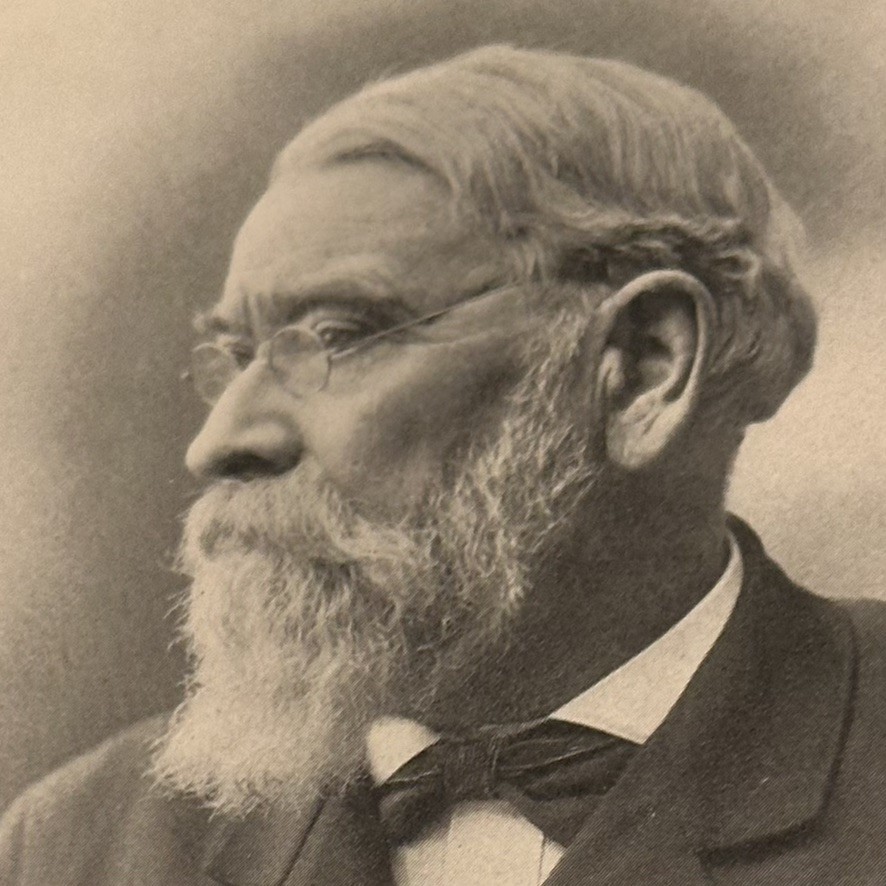
Hon. BALFOUR COWEN, who was born June 30, 1832 in New Hampshire and was the son of Zechariah Cowan and Mary Cleveland, gives the following autobiographical sketch.
I found myself unable to do the work of the farm, and much as I disliked to part with the patrimony I sold out in the fall of. 1857, and the next spring moved to this place, and with my brother Lew commenced in mercantile business ; soon after buying him out and continuing the business alone to spring of 1860, then took in a partner. Continued to Sept., 1862, when I enlisted and was elected Captain of Co. G, I22d Illinois Infantry .
Both my brothers being then in the service with the rank of lieutenant. In December, 1862, I was detached as Provost Marshal of Trenton, Gibson co., Tenn.; was captured Dec, 20, by General Forrest in his raid on the Mobile & Ohio R. R. Having some $300 of government money in my possession, and fearing that I would be robbed when I come to give my rank and position, I made an excuse and got out of sight of my guards and stowed the money in my boots until I was turned over to our forces at Columbus, Hickman co., Ky.
Once during the march to our lines under rebel guard I gave up all hopes of ever again seeing the loved ones at. home, and sitting down on a convenient log leaned forward to receive the shot I felt sure was to end all earthly things with me. ‘Twas just at sundown; the heavy timber where we were was casting a gloom over everything before the shades of night had set in. Our flag of truce had been sent forward and the prisoners were resting after a hard day’s march. We thought we were near our forces, and the flag had gone forward to ascertain if that was true, when a band of rebel cavalry burst on us from the deep woods ; the prisoners took them for our friends, and they took us for Union soldiers.
I saw the mistake at a glance, and saw what had escaped the notice of the others that the rebels were coming with their carbines presented. I tried to stop our men (the prisoners), from their wild shouts which were taken by the rebels as yells of defiance, but my voice was drowned ; there we stood 200 or 300. On came the rebels with furious speed, when just as I had committed my spirit- to Him who gave it, I heard a loud shout from a different direction, and raising my eyes to see what new danger was at hand I espied the Col. in command of our escort running at the top of his speed (for he was not mounted then), and waving his flag of truce, and in thunder tones calling on his friends not to fire, he was coming between us and the advancing host. Instantly every gun was lowered and we were saved.
I made friends with our guards, some of whom were noble fellows. I was in command under them of the prisoners, our senior officers having been sent by another route, or were so disabled that they could not take command, and when we parted with the guard at our lines at Columbus, it seemed like parting with friends. I shook hands with the colonel and corporal and said I hoped we would be able to return the compliment before long.
I came home, and in less than ten days I had the privilege of meeting one of our guards on his way to Camp Butler, a prison camp, he with a number of others having been taken by my own company on the field at ” Parker’s Cross-Roads,” Tenn., Forrest’s adjutant, who signed our paroles, being one of the number. In May, 1862, (if I remember rightly the date), I was exchanged and returned to the field. Some time that fall we started for the Tennessee river by way of luka, Tishomingo county. Miss., my brother ” Lew ” being in the cavalry, and belonging to our corps was with our rear guard and had a skirmish with Forrest’s cavalry who were hanging on our rear. During the fight some of brother’s mengot quite close to the rebels and they talked back and forth. The rebels enquired for Captain Cowen ; of- course they knew Capt. Cowen as he was their captain. But in the conversation that ensued with the ‘ Johnnies ‘ they couldn’t make out how they had learned about him ; and after the skirmish they wanted to know of their captain how he came to be on such intimate terms with the rebels. He was badly puzzled over it until he afterwards met me. I was in the battle at Nashville, and the last battle of the war, ‘ Blakely,’ Alabama, besides several others.
After the war, being out of business, I determined to do what I had long had a desire to do, but which I had never before found the opportunity for, and I at once entered upon the study of .the law. Borrowing a volume of ‘Blackstone’ I began and pursued my studies at home without an instructor, and after finding that I could master its intricacies I purchased books as I needed, and after a year or two was admitted to the bar, and have ever since been engaged in that profession. In 1881, I was nominated by the Republicans of the 40th senatorial district as their candidate for the lower house of our General Assembly, served in the regular and called session of 32d Assembly. Was renominated last fall, but the Republicans put up 2 candidates ; I was defeated by a division of my own party. Was 1883 publisher of local Republican paper, the Virden Recorder, which was started by a stock company 1880.” See Bibliography, Chap. IV.
Judge Balfour Cowen residence at Virden, Illinois to Nov. 14, 1894, then removed to Carlinville, where he intends to remain during his incumbency as judge, and afterward return to Virden, Attorney- at-law. Was elected Nov. 6, 1 894, County Judge of Macoupin co.. Illinois, for the term of four years, beginning the first Monday in December, 1894, County Court at Carlinville.
Judge Cowen is a subscriber for this Genealogy.