Augustus Cleveland
(1754 - 1784)
Augustus Cleveland (1754–1784) was an East India Company administrator in Bengal, known for his work as a Collector of Revenues and Judge of the Dewanny Adawlut of Bhagalpur and nearby districts. Despite his early death at the age of 30, Cleveland made a significant impact on the region, both in his administrative roles and his interactions with local communities.
Cleveland was born into a notable English family. He was the sixth son of John Cleveland of Tapeley, Devon, and his second son by his third wife, Sarah Shuckburgh, who came from a prominent family in Gloucestershire. Cleveland’s connections extended into Indian administration, as he was related to John Shore, the 1st Baron Teignmouth and Governor-General of India.
Cleveland’s career in India was marked by his role as a magistrate and collector in Bhagalpur, Bengal. In a region known for unrest, Cleveland sought to introduce reforms through a policy of conciliation rather than military force. This approach was notably applied to the local hill tribes, particularly the Sonthals. Cleveland learned their language and persuaded them to engage in trade, shifting their relationships with the plains people from hostility to cooperation. His efforts helped the British to exert more influence over the region, particularly in the area known as the Jungleterry.
Despite his relatively progressive policies toward the local tribes, Cleveland’s tenure was not without conflict. During a time of famine in 1777, unrest grew, leading to resistance against the East India Company. Eventually, Cleveland was killed by Tilka Manjhi, a tribal leader who led a rebellion against the colonial administration. Cleveland’s death occurred in January 1784, when he was struck by an arrow while riding his horse.
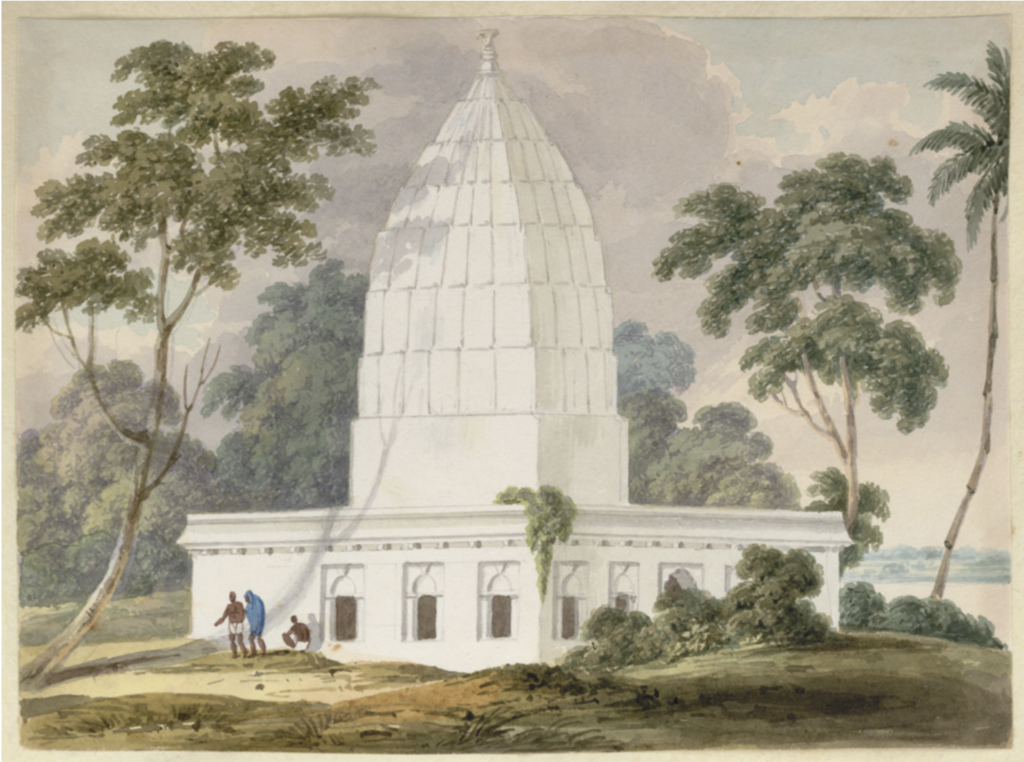
Cleveland’s death was met with significant memorials from the East India Company. Two monuments were erected in his honor—one in Bhagalpur and another in Calcutta (modern-day Kolkata). The memorial in Bhagalpur was commissioned by the company, while the one in Calcutta was sent by the Court of Directors from England. His influence extended beyond his lifetime, with memorials praising his efforts to civilize what they described as the “savage” local populations and praising his diplomacy and reformist initiatives.
Cleveland was buried in South Park Street Cemetery in Calcutta, and his legacy continued to resonate through British accounts of India. The following inscription is located on a small stone chapel at the cemetery topped by an obelisk.
“Here lie the Remains of AUGUSTUS CLEVLAND ESQUIRE, Late Collector of the Revenues; Judge of the Dewanny Adawlut of the Districts of BHAUGULPOOR, MOONGYR, RAJEMEHAL. He departed this Life 12th of January 1784 – at Sea – on Board the Atlas Indiaman, Captain [Allan] Cooper, proceeding to the Cape for the recovery of his Health, aged 29 Years. His Remains, preserved in spirits, were brought up to Town in the Pilot Sloop which attended the Atlas and interred herein, the 30th of the same month. The public and private Virtues of this excellent Young Man, were Singularly eminent. IN HIS PUBLIC CAPACITY, He accomplished, by a System of Conciliation, what could never be effected by Military Coercion. He civilized a Savage Race of Mountaineers who for Ages had existed in a state of Barbarism And eluded every Exertion that had been practiced against them To Suppress their Depredations, and reduce them to obedience. To his wise and beneficent Conduct the English East India Company were indebted for the Subjecting to their Government the numerous Inhabitants of that wild & extensive Country – The Jungleterry. IN HIS PRIVATE STATION, By the amiableness of his Deportment, the Gentleness of his manners, And the goodness & generosity of his heart, He was universally admired, beloved & respected by all who had the happiness of knowing him’
His cousin, John Shore, wrote a monody in his honor, praising his skillful administration and his ability to bring peace to a region that had long resisted outside control. Bishop Reginald Heber and Rudyard Kipling also referenced Cleveland’s work, further cementing his place in colonial history.
Though his methods and legacy are viewed through a colonial lens, Augustus Cleveland remains a significant figure in the history of British India, remembered for his role in consolidating British power in Bengal through policies of diplomacy rather than pure military coercion