Cynthia Eloise Cleveland
(1845 - 1932)
Page 1974, # 12454
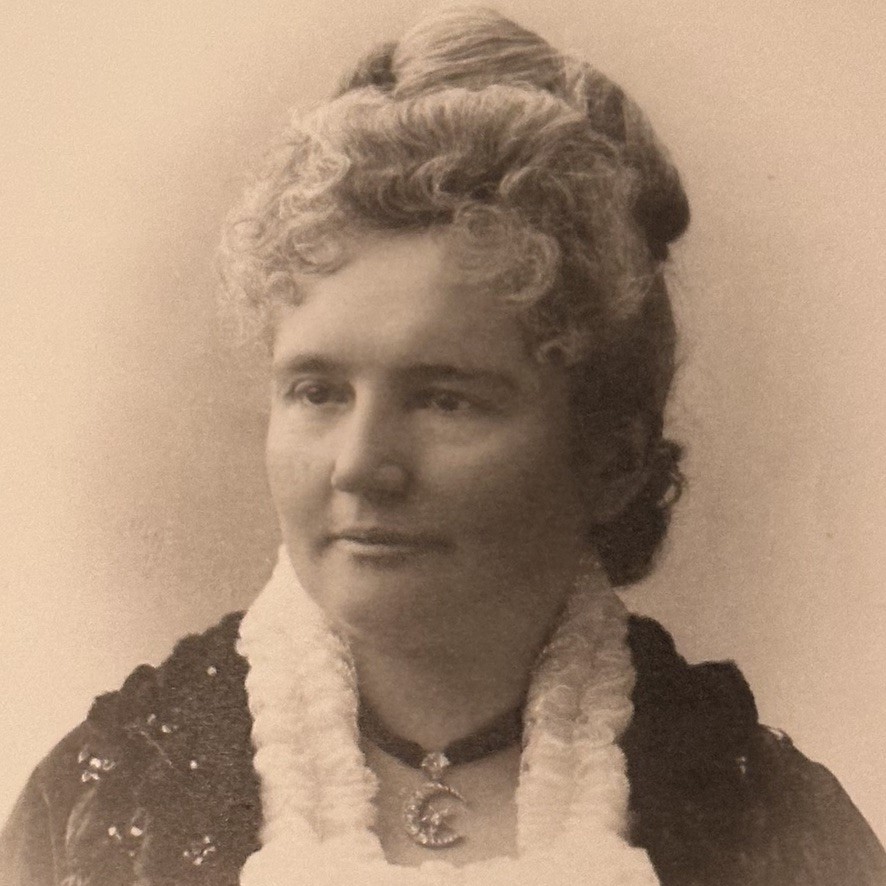
CYNTHIA ELOISE CLEVELAND was four years of age when her father removed to Hartland, Niagara co., N. Y., where he became extensively engaged in the nursery business. Five years later, attracted by the possibilities of the great West, the family removed to Richmond, Mich., where they continued to prosper until the panic of 1857, when they were suddenly reduced from a state of competency to one of penury.
Upon the breaking out of war (1861), Mr. Cleveland enlisted as a private soldier, leaving Cynthia with the care of an invalid mother, and three young brothers. The soldier’s pay was the only means of support for this family of five, and, as often occurred in those early days of the war, this was delayed, leaving them quite destitute. The pride of the mother forbade her acceptance of such aid as the patriotism of the State provided, and Cynthia felt compelled to accept the situation offered her as teacher in a school, where she labored faithfully five days of the week, and on Saturday performed the work of the household for the coming week.
In time the bounty was paid, and Mr. Cleveland’s salary became regular ; he then came home on a furlough and removed the family to Medina, N. Y., securing the educational advantages of the academy there. Cynthia applied herself closely to her studies, but soon found that her strength was inadequate for the double duty devolving upon her (the care of the family and her school work), and, being forbidden by her physician to look at a book, she gave up her studies just as she was entering upon her graduating year.
At this time, feeling the necessity of occupation, she accepted a situation as clerk in a fancy goods store, a branch of an establishment in one of the large cities of the State. She soon made her services’ so valuable to her employer that she was promoted to the superintendency of the business.
While engaged in this position, her employer was arrested for an attempt at arson, the case being- one of the most exciting that ever occurred in that vicinity. Miss Cleveland was an important witness in the case, and through that circumstance became interested in the proceedings of law courts to such an extent that it influenced her whole future life.
Soon after this she again entered school, determined to secure a collegiate education, at all hazards, but her health would not admit of the severe mental and physical strain, and she was obliged to abandon all hope in that direction. Her great disappointment bordered on despair, but, with characteristic determination, the brave girl once more took up the burden of life, and, on the eve of Grant’s first election (1868), left her home in Medina to take charge of the business interests of an Eastern firm in Pontiac, Mich.
Her life in this city (where her family soon followed her) embraced a period of ten years, in the various positions of clerk, superintendent, and proprietor of the store of which she had charge. In the meantime she was diligently reading law with and for a brother whose failing eyesight precluded the possibility of evening study, and this devoted sister became eyes for him that he might attain to a profession for himself.
When the great Red Ribbon temperance wave swept over Michigan, Miss Cleveland was carried along with it, and through great discouragements applied her indomitable will to the purpose of acquiring the power of platform oratory, and then, with a courage and perseverance which was well-nigh marvelous, she did effective work for the temperance cause in that State for more than two years, when Miss Frances Willard, president of the W. N. C. T. U., appointed her temperance organizer of Dakota.
After removing to Dakota (where her father, mother, and brothers had preceded her), she made her home at Pierre, was here admitted to the bar, and divided her time between the practice of law and the superintendency of the Dakota W. C. T. U., to the presidency of which she was soon elected. In the prosecution of this work she penetrated the Black Hills and made her way into every corner of the frontier.
After two years of arduous service she declined a re-election and resumed her practice. Two objects, however, came immediately under her attention, into which she threw herself with her accustomed impetuosity and devotion to the cause of education and patriotism. One of these was the endowment of a Presbyterian university at Pierre, and the other the admission of Dakota to the Union. In pursuance of the first, she made a tour of the Eastern States, presenting the claims of this Western project to the prosperous Presbyterians of the East in so successful a manner that her errand was accomplished and the university secured.
Miss Cleveland had been a lifelong Republican, but circumstances with which this sketch has nothing to do conspired to change her opinions and her politics. Her work for the Pierre University in the State of N. Y. had made her familiar with the political history and administration of Gov. Grover Cleveland, and with rare sagacity and foresight she began to advocate his nomination for the Presidency in 1884. Being convinced of his fitness for this high position, she earnestly and honestly made use of her ability as a writer and speaker to bring about the desired result.
A Western paper thus speaks of her labors in that field : ” At the Chicago convention she worked hard and well in Cleveland’s interest with delegates from the South and West,. and after his nomination she labored untiringly to secure his election, in Indiana and Southern Michigan, but more especially in the counties comprising the 7 th Congressional district of the latter State, where she was a power in the canvass, and, to judge from the tone of the papers, did deadly execution upon the Republican ranks.”
The effectiveness of her work is verified by the deadly enmity of the defeated party toward Miss Cleveland, making it impossible for her to resume her practice in the city of her adoption. She therefore sought temporary employment at the hands of the Government through Civil Service examination, and received an appointment as law clerk in the Treasury Department. Miss Cleveland is the only lady who has ever applied to the Civil Service commission for such examination.
The subject of this sketch is not, in any sense, what is known as a strong-minded woman ; is an opponent of woman suffrage ; is gifted with a straightforward, frank, unselfish nature, and believes that Truth and Right are the prime virtues, while woman’s mission is to serve them faithfully and cheerfully, under all circumstances. Author and contributor — see Bibliography, Chap. IV. Miss Cleveland has been since Mar., 1885, a resident of Washington, D. C. (1898), and was (1891, etc.) in the Sixth Auditor’s office.
A subscriber for this Genealogy.
NOTE : Cynthia EloiseCleveland lived for 32 years after this genealogy was published. If you are a direct relative and have additional data or photos you would be willing to share with others, please contact me using the contact form.