Edmund C. Stedman
(1833 - 1908)
Page 1805, # 8722
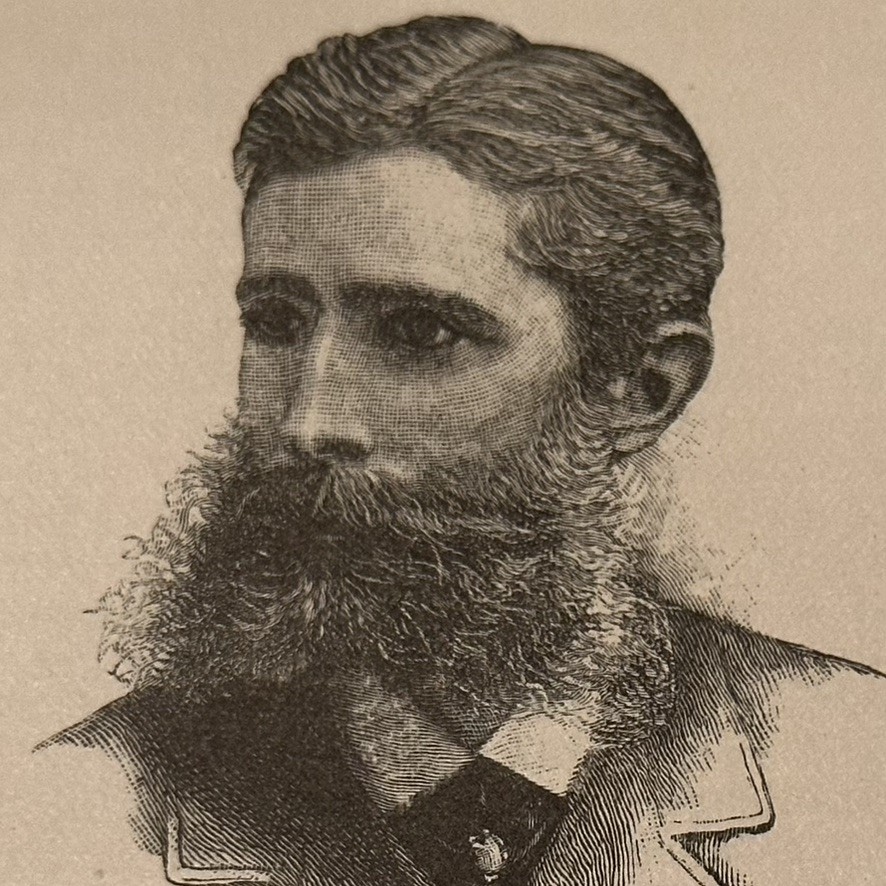
From Literary. Life, Chicago, III., Nov., 1883, IV : 99-100.
EDMUND CLARENCE STEDMAN is the son of William Earle Dodge and Elizabeth Dodge and grandson of Sarah Cleveland. After the four great worthies in American poetry, Whittier, Longfellow, Emerson, and Holmes, comes a second class of writers of which James Russell Lowell and Edmund Clarence Stedman take lead, in prominence, both as regards the quality of their verse and their popularity as poets.
Mr. Stedman was educated for college under the care of his great uncle, James Stedman in Norwich, Conn. He entered Yale college in the autumn of 1849 as a member of the class of 1853. Among other members of the same class were President Andrew D. White (Cornell), Hon. Wayne McVeigh, George W. Smalley, Prof. Charlton T. Lewis, Hon. Randall M. Gibson, Judge E. C. Billings, etc.
While in college Mr. Stedman was suspended for dissipation and irregularities, and at the end of his suspension he did not return, but went into journalism at the age of 19. Long afterwards, in 1871, the corporation of Yale College restored him to his class, and also gave him the degree of A.M. He also received the degree of A.M. from Dartmouth in 1873. He became editor of The Herald, Winsted, Conn., in 1854-55, but in 1855. he removed to N. Y. city.
In 1859 we find him engaged on the staff of the N. Y. Tribune, and in 1860 he joined the editorial staff of The World, N.. Y., was afterward correspondent of the same 1861 to 1863. His published works are numerous. See Bibliography, Chap. IV. His poem of “Westminster Abbey ” (published in the Yale Literary Magazine, 185 1), took first prize. He published ” The Diamond Wedding,” a satirical poem [thrown like a lance at a passing event, attracted much attention] ; also the poem ” How old Brown took Harper’s Ferry,” both in N. Y. Tribune, 1859. The latter was a favorite of Mrs. Browning and R. W. Emerson, and was included in his ” Paranassus.”
His most important works are : “The Victorian Poets” (a complete review of the poets and poetry of Great Britain from the accession of Queen Victoria to the present time) Crown 8°, Boston 1875, London 1876; “Poems, Lyrics, and Idylls” i860 ; “The Battle of Bull Run 7 ‘ 1861 ; “Alice of Monmouth”; “The Blameless Prince”; ” Poetical Works,” collective edition; “Poets of America,” with full notes in margin and careful Analytical Index, a companion volume to the Victorian Poets, published by Houghton, Mifflin & Co., Boston, Oct., 1885.
This is the author’s maturest prose work, and one to which he has devoted many years and his admirable literary resources. It is a complete and critical review of the rise and course of poetry in America. He considers the early and recent conditions and growth of the American school, including the biography and works of William Cullen Bryant, John Greenleaf Whittier, Ralph Waldo Emerson, Henry Wadsworth Longfellow, Edgar Allen Poe, Oliver Wendell Holmes, James Russell Lowell, Walt Whitman, Bayard Taylor, and the outlook for future verse.
In addition to the above very full list of literary activity, Mr. Stedman has edited with a full introduction the edition of the poems of Austin Dobson, pub. 1880. At intervals outside of his regular labors he has delivered poems to audiences as follows : ” Gettysburgh,” read at the Annual Meeting of the Army of the Potomac, Cleveland, O., 187 1 ; “Dartmouth,” an ode read at Dartmouth college, N. H., 1873; “The Monument of Greeley ” delivered at the Dedication of the Printer’s Monument to Horace Greeley at Greenwood Cemetery, 1876; “Meridian,” an old-fashioned poem read in June, 1878, at the 25th Anniversary of the Yale class of 1853; “Hawthorne, “read before the Phi Beta Kappa of Harvard Univ., Cambridge, Mass., June, 1879; “The Death of Bryant” read before the Century Club, N. Y., 1878; “Corda Concordia” read before the Summer School of Philosophy, July, 1881, [series of Lectures on “Nature and Elements of Poetry,” under management of University Faculty of Philosophy of Columbia Coll., N. Y., Nov. 10, 13, 17, 20, 24, 27, Dec. 1, 4, 8, 1891, at Berkeley Lyceum, N. Y.]
During the past 20 years Mr. Stedman has been a contributor to Vanity Fair, Putnam’s, Harper’s, Atlantic, Scribner’s, Century, Independent, JV. A. Review, Galaxy, etc. He has also been engaged at intervals upon a complete metrical translation of Theocritus Bion and Moschus, the Greek Idyllic Poets.
Mr. Stedman is a member of the N. Y. Stock Exchange, member of the Chicago Stock Exchange since it was founded 1882, life member New England Society, the Yale University Club, New Haven [also Vice-Pres. N. Y. Yale Alumni Association], a member and trustee of the Century Club, member of the Yale Alumni Association and Author’s Club. Fortune favored him as a stock broker, and in a few years he was a wealthy man ; but failures in the street, and his aid given brother brokers, turned the tide of his affairs and left him well nigh penniless. He recovered, however, and in a few short months was working successfully to regain his lost fortune. At the present time he is still engaged as a broker on Wall st., and holds daily seances with the bulls and bears.
Mr. Stedman resides in a pleasant home in New York City. His literary work is done at night. His days are spent in Wall st. He is a busy man, and one wonders when he sleeps. In daylight he confines himself to his office, or mingles with the throng in the Stock Exchange, and the quiet hours of midnight find him among his books in his cos)^ library. He is a whole souled, genial man with a kind heart and a lovable disposition, and one can but love him after becoming once acquainted. He is small of stature, and far from strong physically, but his abundant iron-gray beard and sparkling eyes hint of the energy that has kept him up amid his arduous undertakings.
This is neither the time nor place to review at length the poetic work of Edmund Clarence Stedman-, and I can only refer to his critical essay on William Blake, poet and painter, which appears in that dainty volume, ” Essays from the Critic.” His essay is an excellent example of his work in prose, and to my mind it is as fine a fragment of writing in this line as are his verses in the way of exquisite poetry. He is an excellent judge of art, and in his strictures on Blake is led to say : ” If I were asked to name the most grievous thing in modern art, I should say it is the lack of some kind of faith.” When it is considered that Mr. Stedman is actively engaged in business, his extraordinary fecundity in letters is most astonishing. There is no parallel case in Europe where a successful man of business has achieved like fame as a poet and author. To correct a frequent misapprehension I may say he gave up journalism to go into business solely to have time and means for writing prose and poetry of a higher standard. His purely literary work has been chiefly since he joined the Stock Exchange. In his ” Poets of America,” as far as the prospectus goes, he appears with unusual modesty to have left himself unrecorded. His works entitle him to the highest rank in the American Cycle of Poets. w. m. c.
Mr. Stedman was appointed to deliver the opening course of lectures spring of 1886, in the Percy Turnbull Lectureship of Poetry at Johns Hopkins University, the first lectureship of poetry founded in this country.