



Education to Employment – NEW BUILD

===== 1. HERO =====
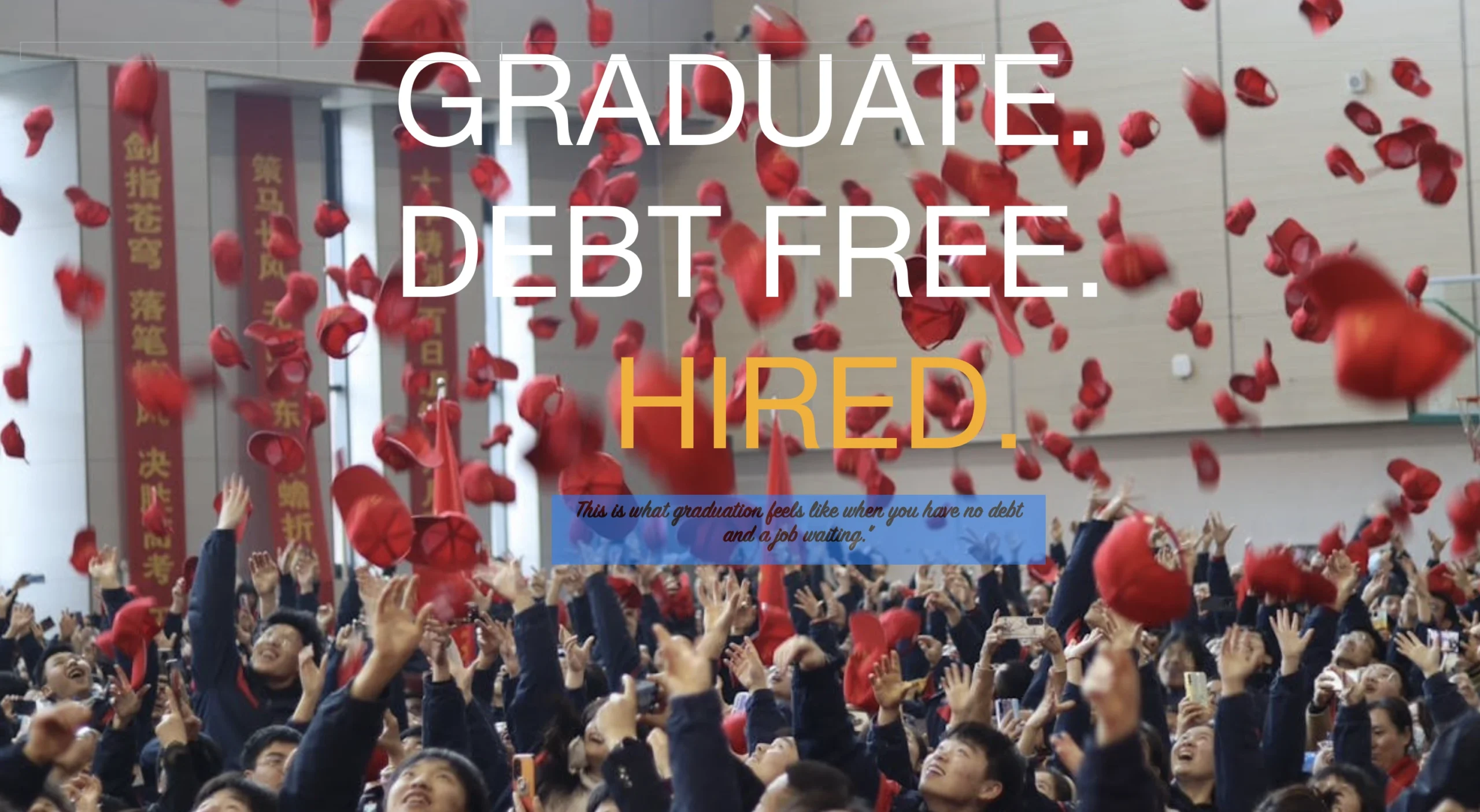
Graduate. Debt Free. Hired. — celebrating graduation with no debt and a job waiting
Claude (Anthropic): A dramatic, celebratory hero image showing hundreds of young graduates tossing bright red caps into the air inside a large ceremonial hall. The crowd stretches across the entire frame, arms raised in jubilation, faces lifted with joy. Over the scene, three words dominate in massive white and gold typography: GRADUATE. DEBT FREE. HIRED. — the word HIRED rendered in bold gold to distinguish it. A blue caption banner reads: 'This is what graduation feels like when you have no debt and a job waiting.' The image captures the emotional payoff of completing an education with a career already secured and no financial burden.
ChatGPT (OpenAI): A powerful full-width hero banner depicting a massive graduation celebration. Hundreds of students in dark uniforms throw red ceremonial caps skyward, filling the frame with movement and color. Bold white text overlaid reads 'GRADUATE. DEBT FREE.' with 'HIRED.' highlighted in gold, communicating a clear three-part promise: credential, financial freedom, and employment. A semi-transparent blue text box anchors the bottom center with the tagline about debt-free graduation and a waiting job offer.
Gemini (Google): High-energy graduation scene serving as a website hero banner. The photograph shows an enormous crowd of young people celebrating, with dozens of red caps suspended mid-air above them. The typographic overlay uses a high-contrast hierarchy: white bold caps for GRADUATE and DEBT FREE, then gold for HIRED — deliberately sequencing the viewer's eye through the three promises of the program. The overall composition conveys mass momentum and collective aspiration.
Copilot (Microsoft): Website hero image for American Dream University of the Trades (ADUT) featuring a euphoric graduation ceremony. A large gathering of young people in dark clothing celebrate by tossing red academic caps into the air. Large white and gold sans-serif text states the program's core value proposition: Graduate without debt. Graduate hired. A blue banner with italic script text provides an emotional caption about the feeling of graduating free from financial burden with employment secured.
Grok (xAI): Full-bleed opening banner of an education-focused website. Packed crowd of young graduates in a gymnasium-style space launch bright red caps skyward en masse — motion blur on the caps contrasts with sharply focused upturned faces below. Three-word typographic statement commands the upper half: GRADUATE. DEBT FREE. HIRED. The first two lines in white, the third in gold — a color shift that signals the ultimate outcome. Below, a translucent blue box holds a first-person-style caption reinforcing the emotional promise.
Llama (Meta): Full-width hero banner image for a trades education institution. The scene captures the moment of graduation celebration — a large indoor crowd of students throwing red academic caps high into the air. The visual is anchored by three bold words in oversized typography across the center of the image: GRADUATE in white, DEBT FREE in white, HIRED in gold — each on its own line, building to the employment outcome as the climactic word. A caption block below delivers the emotional premise of the program: graduating with no debt and a job already waiting.
===== 2. WORK TEXAS / DIGNITY OF WORK BANNER =====
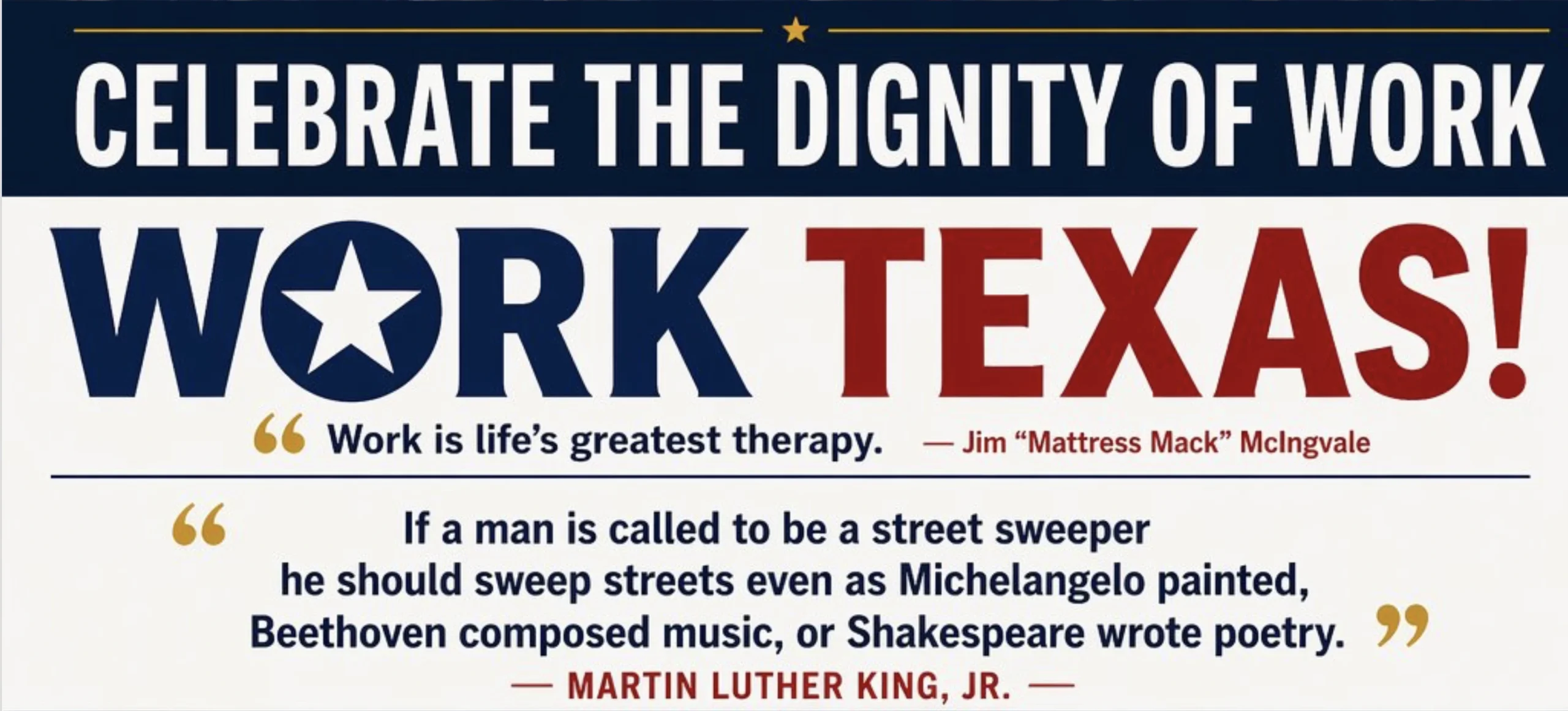
Celebrate the Dignity of Work — Work Texas! — quotes from Jim McIngvale and Martin Luther King Jr.
Claude (Anthropic): A bold patriotic graphic on a cream background featuring Texas-themed typography and two landmark quotes about the dignity of work. At the top, a navy blue banner reads 'CELEBRATE THE DIGNITY OF WORK' with a gold star centered above it. Below, the words 'WORK TEXAS!' are set in massive type — WORK in deep navy blue with a Texas lone star embedded in the O, and TEXAS! in dark crimson red. Two quotes follow: Jim 'Mattress Mack' McIngvale's 'Work is life's greatest therapy' in medium weight, and Martin Luther King Jr.'s full street sweeper quote in larger centered italic text with gold quotation marks, attributed formally beneath.
ChatGPT (OpenAI): A patriotic graphic combining Texas pride imagery with two of America's most powerful statements about the value of work. The design uses a cream/off-white background with a navy header bar. The centerpiece typography 'WORK TEXAS!' uses a Texas flag star inside the letter O of WORK, with TEXAS! in bold red — evoking civic pride. Below, two attributed quotes frame the dignity-of-work theme: one from Houston businessman Jim McIngvale and one from Dr. Martin Luther King Jr., both rendered in high-contrast type with gold decorative elements.
Gemini (Google): Typographic poster design emphasizing the dignity of work through Texas identity and historic quotation. The layout moves from an institutional navy header banner down through the playful patriotic 'WORK TEXAS!' logotype — navy and crimson with a star motif — to two carefully chosen quotes that span the cultural spectrum from Houston civic life to the American civil rights tradition. Gold accent elements (star, quotation marks, dividing lines) provide visual continuity throughout.
Copilot (Microsoft): A values-forward graphic for the American Dream University of the Trades campaign, presented on a light background with strong typographic hierarchy. The header establishes the program's core value: celebrating the dignity of work. The 'WORK TEXAS!' display type functions as a rallying call, visually integrating the Texas lone star. Two quotations from prominent Americans — entrepreneur Jim McIngvale and civil rights leader Dr. Martin Luther King Jr. — ground the visual in both business philosophy and moral tradition.
Grok (xAI): Campaign graphic anchoring the Dignity of Work theme to Texas identity. Cream background. Navy bar at top: CELEBRATE THE DIGNITY OF WORK. Below it, oversized two-color display type: WORK in navy with a lone star in the O, TEXAS! in deep red. Then two quotes stacked vertically — McIngvale's terse aphorism about work as therapy, followed by MLK's extended street sweeper metaphor in centered italic with oversized gold open-quote marks. The pairing of a Houston businessman and a civil rights icon is deliberate and powerful.
Llama (Meta): Bold graphic combining Texas civic pride with two of the most quoted statements on the intrinsic value of labor. A navy header announces the Dignity of Work theme. Below, the words WORK TEXAS! dominate the frame in oversized patriotic typography — navy blue for WORK with a Texas star in the O, crimson for TEXAS! — followed by two foundational quotes: Jim McIngvale's belief that work is life's greatest therapy, and Dr. King's famous street sweeper passage comparing skilled work to the artistry of Michelangelo, Beethoven, and Shakespeare.
===== 3. BE SOMEONE HIGHWAY =====
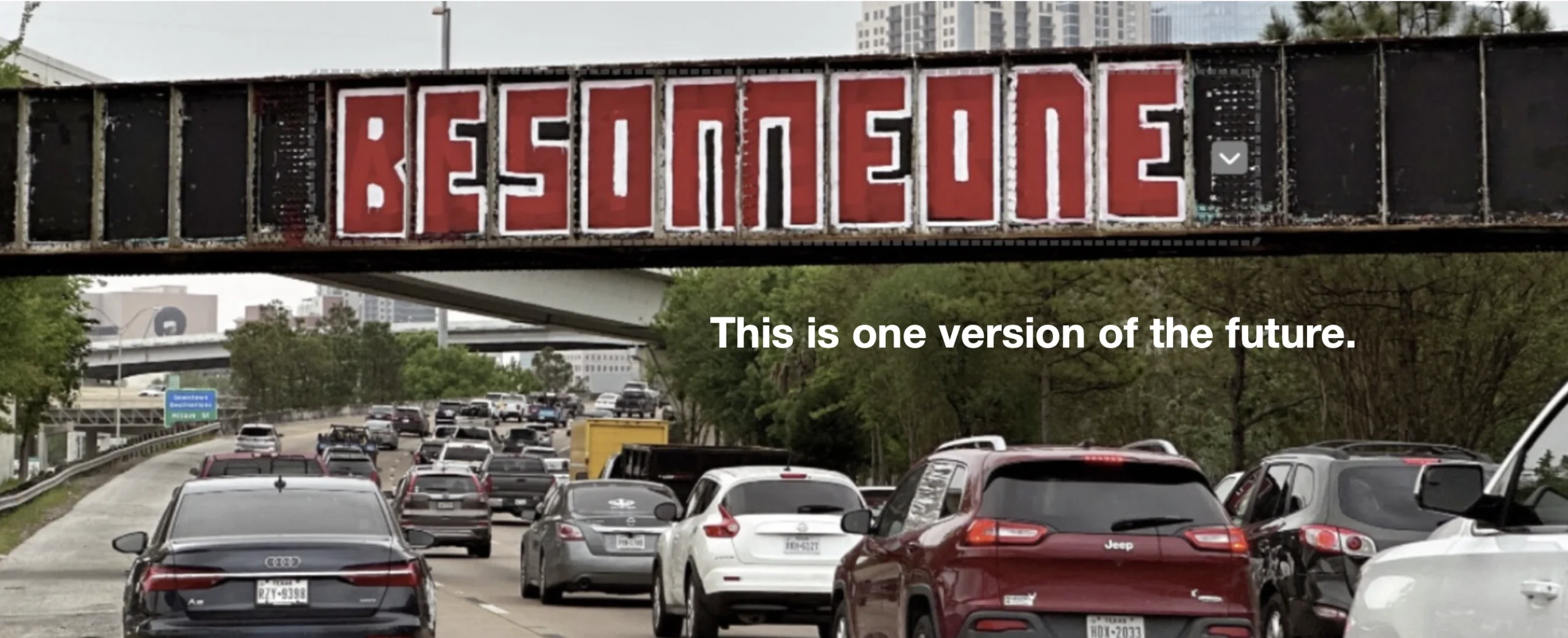
Houston highway overpass BE SOMEONE graffiti — This is one version of the future
Claude (Anthropic): A wide-format photograph of a Houston highway overpass bearing large block-letter graffiti that reads 'BE SOMEONE' in red and white on a rusted black metal bridge. Below the bridge, bumper-to-bumper traffic stretches toward a downtown Houston skyline visible in the distance. Trees line the highway median. White overlay text in the lower right reads: 'This is one version of the future.' The image functions as a visual provocation — the graffiti is famous in Houston, and pairing it with the caption reframes traffic-bound urban anonymity as a choice, not a destiny.
ChatGPT (OpenAI): A photograph of one of Houston's most recognized pieces of street art — the 'BE SOMEONE' graffiti painted in oversized red block letters on a railroad overpass above a congested freeway. The gridlocked traffic below, the gray urban sky, and the visible downtown skyline in the background create a scene of everyday struggle and ambition simultaneously. White bold text overlaid on the lower portion of the image reads: 'This is one version of the future.' — framing the image as a contrast or warning against a life without direction or skilled work.
Gemini (Google): Iconic Houston street photography used as a thematic visual essay. The 'BE SOMEONE' overpass graffiti is one of the city's most photographed landmarks — here it appears above a heavily congested freeway, with downtown towers barely visible through a hazy sky. The caption 'This is one version of the future' transforms the image from local color to an editorial statement: the future without skills, without career, without purpose is this — stuck in traffic, anonymous, unremarkable.
Copilot (Microsoft): Wide-angle photograph of Houston's famous 'BE SOMEONE' highway overpass, with bumper-to-bumper freeway traffic below. The graffiti — large red block letters on a weathered steel bridge — is a well-known Houston landmark that has appeared on national media. The page uses this image editorially, pairing it with the caption 'This is one version of the future' to contrast the aspiration of the graffiti against the stagnation of the scene beneath it, creating a visual argument for the trades education pathway ADUT offers.
Grok (xAI): Street-level Houston freeway photograph centered on the city's iconic BE SOMEONE overpass graffiti. The image is panoramic, capturing the full scale of rush-hour traffic beneath the rusted railroad bridge where the red and white block lettering appears. Downtown Houston is faintly visible ahead. The photograph is used rhetorically — the caption 'This is one version of the future' turns a landmark of local aspiration into a question: Is this the future? Or is there another path?
Llama (Meta): A wide photographic image of downtown Houston freeway traffic shot from ground level, dominated by the iconic 'BE SOMEONE' graffiti on the overhead railroad bridge. The red and white block letters are large enough to fill the width of the bridge span. Cars sit at a standstill in multiple lanes below. The caption overlaid at bottom right — 'This is one version of the future' — uses the image as a narrative device: this is where a life without direction leads. The image implicitly sets up the alternative the ADUT program represents.
===== 4-8. SPEAKER BLOCK (tight unit) =====
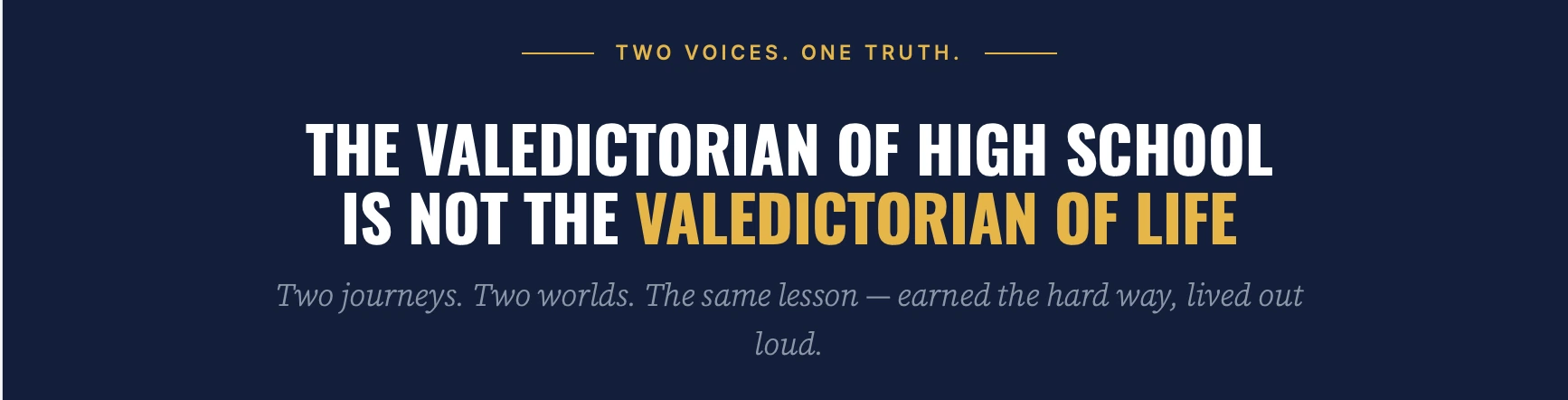
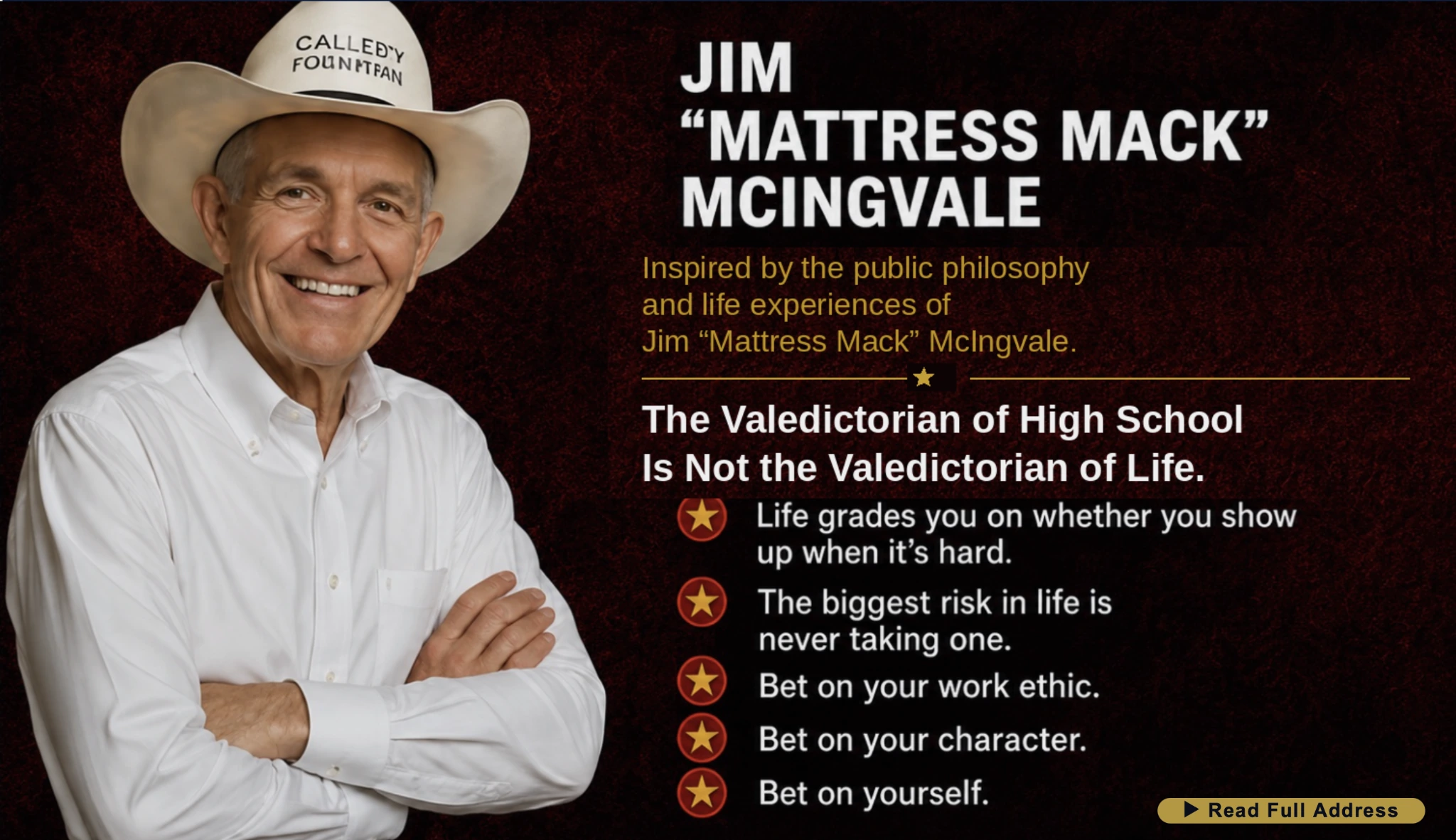
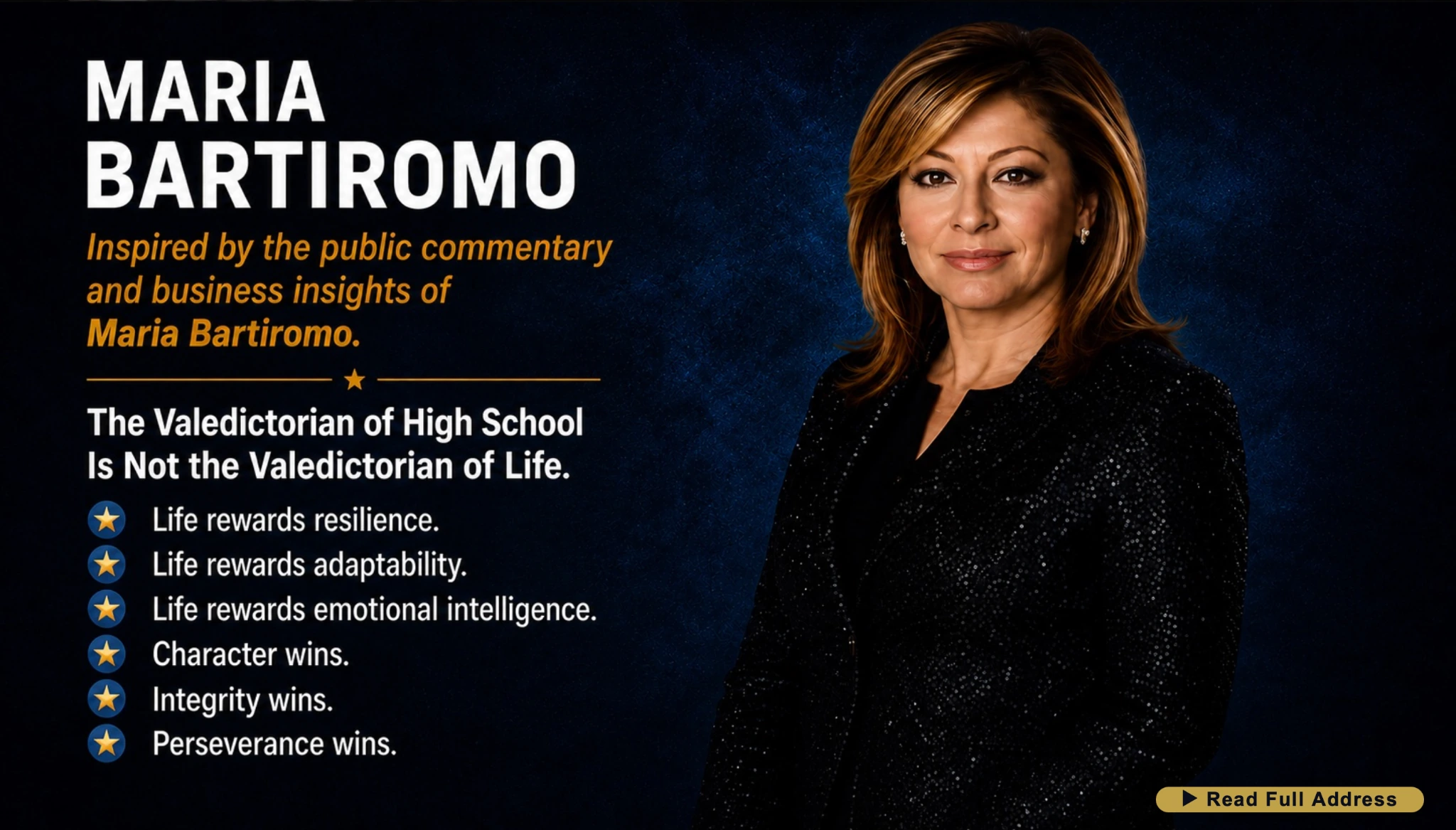
Two Voices. One Truth. The Valedictorian of High School Is Not the Valedictorian of Life.
Claude (Anthropic): A wide banner graphic on a deep navy blue background that introduces the two-speaker section of the page. Small gold all-caps text at the top reads 'TWO VOICES. ONE TRUTH.' flanked by horizontal gold rules. Below it, a massive white and gold headline states the shared thesis: 'THE VALEDICTORIAN OF HIGH SCHOOL IS NOT THE VALEDICTORIAN OF LIFE' — with 'VALEDICTORIAN OF LIFE' rendered in gold to emphasize the contrast. A gray italic subtitle beneath reads: 'Two journeys. Two worlds. The same lesson — earned the hard way, lived out loud.'
ChatGPT (OpenAI): Section header graphic introducing the paired speaker profiles of Jim McIngvale and Maria Bartiromo. On a rich navy background, the design uses three typographic levels: a small gold eyebrow text ('TWO VOICES. ONE TRUTH.'), a large bold headline stating the central shared argument about high school achievement not predicting life success, and a descriptive italic subtitle framing the two figures as having arrived at the same truth by very different paths.
Gemini (Google): Introductory banner for the dual-speaker section of the page, using minimal design to maximum rhetorical effect. 'TWO VOICES. ONE TRUTH.' functions as a section label and argument simultaneously. The main headline — spanning two lines in white and gold — states the thesis both speakers share. The subtitle beneath adds narrative texture: these are two different journeys that converge on one lesson.
Copilot (Microsoft): A clean, typographically focused section divider on navy blue, designed to frame the upcoming profiles of Jim McIngvale and Maria Bartiromo as a unified argument rather than separate testimonials. The gold and white color treatment, the use of 'TWO VOICES. ONE TRUTH.' as an organizing premise, and the italic subtitle all work together to position the reader before encountering the individual speaker cards.
Grok (xAI): Section-opening banner on dark navy. Three typographic tiers descend the frame: gold small caps eyebrow text with flanking rules; oversized white headline with 'VALEDICTORIAN OF LIFE' in gold; gray italic explanatory subtitle. The design is restrained and confident — it lets the words carry the weight. The key rhetorical move is framing two very different American stories (Houston furniture entrepreneur, Brooklyn journalist on Wall Street) as arriving at identical truth.
Llama (Meta): Wide header banner on deep navy blue serving as the introduction to the two paired speaker profiles. The hierarchy moves from a small gold section label ('TWO VOICES. ONE TRUTH.') to a large two-line headline making the shared argument, to an italic subtitle framing both speakers as having earned the same lesson by entirely different means. Gold typography is used selectively — for the label and for 'VALEDICTORIAN OF LIFE' — to guide the eye to the key contrast.
Jim Mattress Mack McIngvale — click to read full address
Maria Bartiromo — click to read full address
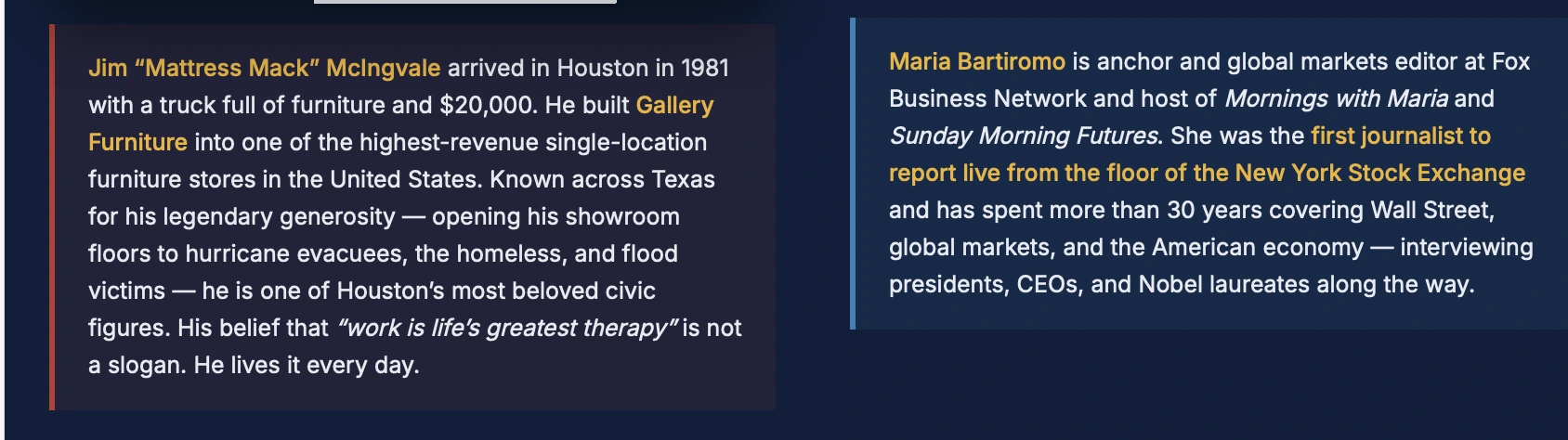
Jim McIngvale and Maria Bartiromo biographical profiles — two American success stories built on work ethic and character
Claude (Anthropic): A two-column biographical panel on a dark navy background with thin vertical accent lines — orange-red on the left, blue on the right — separating each bio from the adjacent white space. The left column contains Jim McIngvale's biography in gold and white text, detailing his 1981 arrival in Houston with $20,000 and a truck of furniture, his building of Gallery Furniture into one of the highest-revenue single-location stores in the country, his legendary generosity to hurricane evacuees and flood victims, and his core philosophy that work is life's greatest therapy. The right column presents Maria Bartiromo's biography, noting her roles at Fox Business, her pioneering presence on the NYSE floor, and her thirty-year career interviewing presidents, CEOs, and Nobel laureates.
ChatGPT (OpenAI): Side-by-side biographical information panel for the page's two featured voices, presented on dark navy with contrasting left and right accent bars. Left side: Jim McIngvale's story from his $20,000 beginning in Houston to Gallery Furniture's national stature and his identity as a beloved civic figure. Right side: Maria Bartiromo's career from Brooklyn to Wall Street pioneer to Fox Business anchor. Both bios are presented in the same typographic style — gold for names, white for body text — establishing parity between the two figures.
Gemini (Google): Two-column biographical panel using a dark navy background and accent color bars (warm red-orange left, cool blue right) to visually differentiate the two subjects while maintaining design consistency. The copy for each person emphasizes the gap between their origins and their achievements — McIngvale from a truck full of furniture to Texas legend; Bartiromo from Brooklyn to the NYSE floor. Both are positioned as proof that the path to significance runs through work, not credentials.
Copilot (Microsoft): Paired biographical section presented as a two-column layout on a deep navy background. Each column uses a thin vertical accent bar in a different color to subtly differentiate the two subjects. McIngvale's bio emphasizes his civic generosity, the scale of Gallery Furniture's success, and his philosophy of work as therapy. Bartiromo's bio emphasizes her pioneering journalism career, her historic role on the NYSE floor, and the breadth of her three-decade career. Both are framed as living proof of the page's central thesis.
Grok (xAI): Dark-background two-up biographical panel. Left column: McIngvale bio with warm accent bar — traces his 1981 Houston arrival to Gallery Furniture's national prominence and his reputation as one of Houston's most generous civic figures. Right column: Bartiromo bio with cool accent bar — traces her Brooklyn origins to her historic role as first live NYSE floor reporter and her career interviewing world leaders. No photos here — just text, designed to let the facts of each life make the argument.
Llama (Meta): Companion biographical text panel that follows the two speaker profile cards, providing factual grounding for both figures. The two-column layout on navy uses accent color bars to distinguish the columns while keeping the typographic treatment identical, reinforcing the 'two voices, one truth' framework. McIngvale's column covers his origin story, Gallery Furniture's success, and his civic generosity. Bartiromo's covers her Brooklyn-to-Wall Street arc and her pioneering career on the NYSE floor.
What Jim McIngvale and Maria Bartiromo agree on: Work Hard, Stay Humble, Keep Learning, Take Smart Risks, Treat People Right, Never Stop Growing
Claude (Anthropic): A horizontal black banner with a gold top rule and centered gold star that lists six shared principles McIngvale and Bartiromo hold in common. Each principle is presented as a two-word phrase in white bold all-caps, paired with a gray icon: a barbell for WORK HARD, clasped hands for STAY HUMBLE, an open book for KEEP LEARNING, a mountain with flag for TAKE SMART RISKS, a person silhouette for TREAT PEOPLE RIGHT, and an upward bar chart for NEVER STOP GROWING. The six items are evenly spaced across the full width of the banner, creating a visual manifesto of shared values.
ChatGPT (OpenAI): A dark horizontal banner graphic summarizing the six principles that both Jim McIngvale and Maria Bartiromo share, despite coming from entirely different worlds. The six two-word imperatives — Work Hard, Stay Humble, Keep Learning, Take Smart Risks, Treat People Right, Never Stop Growing — are each paired with a simple icon and presented in white bold type on a black background with gold accent lines. The visual functions as a philosophical manifesto distilled from both speakers' life experiences.
Gemini (Google): A principles banner using a dark background with gold decorative rules to frame six universally applicable life principles shared by both featured speakers. The icon-plus-text pairing system (barbell, handshake, book, mountain, person, chart) makes the principles immediately scannable and memorable. The banner works as a page-level synthesis — after presenting two very different life stories, it extracts what both have in common and presents it in the most direct format possible.
Copilot (Microsoft): Black horizontal full-width banner listing the six shared values of Jim McIngvale and Maria Bartiromo, each accompanied by a simple gray icon. The visual design is minimal and direct — gold rules frame the top, a centered gold star anchors the header, and the six principles fill the frame left to right in equal visual weight. This serves as the page's philosophical synthesis: despite different industries, backgrounds, and paths, these two figures agree completely on what creates a successful life.
Grok (xAI): Synthesis banner following the dual profiles. Black background with gold horizontal rule at top, centered gold star as title icon, then six two-word principle phrases spread across the full width: WORK HARD / STAY HUMBLE / KEEP LEARNING / TAKE SMART RISKS / TREAT PEOPLE RIGHT / NEVER STOP GROWING. Each phrase has a small contextual icon above it. The design says: we've heard two stories; here is what both stories agree on. Clean. Final. Actionable.
Llama (Meta): A horizontal full-width summary banner on black with gold accents, presenting the six principles shared by both Jim McIngvale and Maria Bartiromo. The layout uses equal horizontal spacing with icon-plus-text pairs for each principle: a barbell for work hard, clasped hands for stay humble, an open book for keep learning, a mountain for take smart risks, a figure for treat people right, and a growth chart for never stop growing. The banner functions as a convergence point — two different American stories, six identical conclusions.
end speaker-block ===== 9. ADUT INTRO =====
American Dream University of the Trades ADUT — Your Future. Your Legacy. Be Someone. — Learn more. Get involved. Support the mission.
Claude (Anthropic): A wide two-panel institutional introduction banner on a light gray/cream background. On the left, the ADUT shield logo in red, white, and blue — an American flag-styled crest with the letters ADUT and a star — sits beside a block of descriptive text explaining the institution: a fully-funded three-year residential trades university in Greater Houston dedicated to the Dignity of Work, serving ages 18–24 from financially fragile families, privately financed with no government money accepted and a 501(c)(3) application forthcoming. A thin vertical divider separates this from the right panel, which features bold dark navy typography: 'YOUR FUTURE. YOUR LEGACY. BE SOMEONE.' — with 'BE SOMEONE.' in large crimson red — followed by the call to action: 'Learn more. Get involved. Support the mission.'
ChatGPT (OpenAI): A two-part institutional identity banner introducing American Dream University of the Trades. The left section pairs the ADUT patriotic shield logo with a factual description of the institution — its residential model, age range served, private financing commitment, and nonprofit status in formation. The right section delivers the emotional call to action with bold typography in the page's established color palette (navy, red, cream), climaxing in 'BE SOMEONE.' in large red text — connecting directly to the Houston highway graffiti image earlier in the page.
Gemini (Google): Institutional introduction graphic for ADUT on a light background. The design splits the panel into informational (left) and inspirational (right) halves. Left side uses the patriotic ADUT crest logo and factual paragraph copy covering the program's key attributes: residential, three-year, fully funded, ages 18–24, privately financed, 501(c)(3) forthcoming. Right side uses bold typographic statement 'YOUR FUTURE. YOUR LEGACY. BE SOMEONE.' in navy and crimson — echoing the Houston 'BE SOMEONE' overpass image from earlier in the page and closing a visual loop.
Copilot (Microsoft): Two-panel ADUT institutional introduction on a light gray background. Left panel: the American-flag-themed ADUT shield logo beside a concise factual description of the university's model — fully funded residential trades education for financially fragile young adults in Greater Houston, with no government funding accepted. Right panel: bold emotional call to action — 'YOUR FUTURE. YOUR LEGACY. BE SOMEONE.' with BE SOMEONE in red, echoing the Houston street art image and completing a visual narrative arc across the page.
Grok (xAI): Light-background institutional banner introducing ADUT in two balanced panels. Left: patriotic red-white-blue shield crest with ADUT lettering, beside descriptive text covering the program's full specification (three-year, residential, fully funded, ages 18–24, financially fragile families, private financing, nonprofit pending). Right: 'YOUR FUTURE. YOUR LEGACY. BE SOMEONE.' — the first two lines in bold navy, BE SOMEONE in large crimson — then the three-part call to action: Learn more. Get involved. Support the mission.
Llama (Meta): Introductory institutional panel for American Dream University of the Trades (ADUT), presented in a two-column layout on a light background. The left column anchors the ADUT patriotic crest logo — featuring American flag colors, a star, and the institution's initials — beside comprehensive program description text. The right column delivers the motivational tagline in large bold type, culminating in 'BE SOMEONE.' in red, which connects thematically to the Houston highway graffiti image earlier in the page and frames the entire page's narrative arc.
===== 10. ADUT FULL BANNER =====
American Dream University of the Trades — 100% Scholarship No Tuition No Debt, Residential Campus, 3-Year Program Paid Internships — Built to restore dignity through work
Claude (Anthropic): A full-width institutional banner on deep navy blue featuring the ADUT seal — a circular crest with an American flag shield, laurel wreath, and stars — beside the full institution name in large white and gold typography. Below, three equally spaced columns present the program's three core attributes using gold icons: a graduation cap for 100% SCHOLARSHIP (No Tuition. No Debt.), a building icon for RESIDENTIAL CAMPUS (Live. Learn. Grow.), and a calendar icon for 3-YEAR PROGRAM (Paid Internships. Placement-Driven.). At the bottom, a full-width gold text line states the institution's founding purpose: 'BUILT TO RESTORE DIGNITY THROUGH WORK — AND CONNECT EDUCATION DIRECTLY TO EMPLOYMENT.'
ChatGPT (OpenAI): The primary institutional identity banner for American Dream University of the Trades. Deep navy background. Circular ADUT seal in gold and white on the left, full institution name in large type beside it. Three program pillars are displayed below in a three-column icon layout: scholarship coverage, residential campus model, and three-year timeline with internships. The bottom gold tagline — 'BUILT TO RESTORE DIGNITY THROUGH WORK' — states the institution's founding mission in the clearest possible terms.
Gemini (Google): Full-width dark navy institutional identity banner for ADUT. The design uses the seal-plus-name combination standard to higher education identity systems, then breaks down the program into three scannable pillars. Each pillar has an icon, a headline attribute, and a brief descriptor. The banner is the most information-dense single image on the page, covering logo, name, program structure, financial model, and founding mission in one unified graphic.
Copilot (Microsoft): Primary brand banner for American Dream University of the Trades, presented in the institution's navy and gold color scheme. The left side anchors the ADUT institutional seal — a formal circular crest incorporating American flag imagery and laurel wreath. The three-column section below uses icon-plus-text pairs to communicate the program's three defining attributes: full scholarship, residential living, and a three-year placement-driven curriculum. The bottom tagline states the institution's purpose in direct, unambiguous language.
Grok (xAI): Deep navy institutional identity banner — ADUT's most complete self-description in a single image. Left: circular crest with American flag shield, gold laurel wreath, stars. Center-right: full institution name in large white and gold type. Below: three-column program breakdown with gold icons and two-tier text for each pillar (headline + two-line descriptor). Bottom: full-width gold all-caps mission statement. This banner could stand alone as a complete institutional summary.
Llama (Meta): Primary institutional banner for American Dream University of the Trades on a deep navy blue background. The ADUT seal — circular with American flag crest, laurel wreath, and star elements — anchors the left side beside the full institution name. Below, three program pillars are presented in a horizontal icon-grid layout: 100% scholarship coverage, a residential campus, and a three-year paid internship program designed for job placement. A gold all-caps baseline statement completes the banner: built to restore dignity through work and connect education directly to employment.
===== 11. PROMISE / PATHWAY / WARNING =====
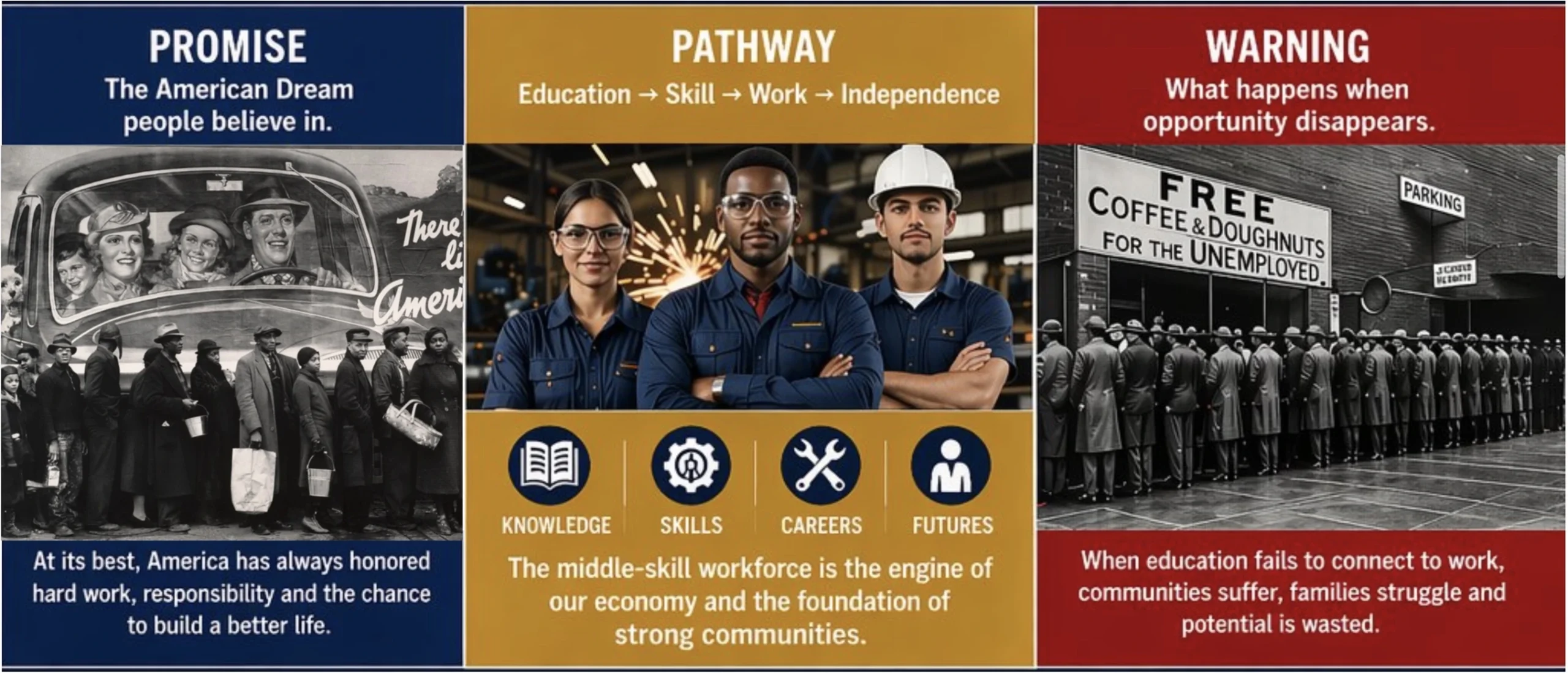
The American Dream — Promise Pathway Warning — Education to Skill to Work to Independence — the middle-skill workforce is the engine of our economy
Claude (Anthropic): A three-panel graphic presenting three frames through which to understand workforce development: Promise, Pathway, and Warning. The left panel, on navy blue, shows a vintage black-and-white American Dream image (a family traveling, echoing 1940s aspirational advertising) above a line of people waiting — evoking the gap between the American promise and reality. Caption: 'At its best, America has always honored hard work, responsibility and the chance to build a better life.' The center panel, on gold/amber, shows three diverse young tradespeople in work gear standing together in an industrial setting, above four icons for Knowledge, Skills, Careers, and Futures. The right panel, on crimson, shows a historical Depression-era photograph of men lined up outside a building offering free coffee and doughnuts for the unemployed — a stark warning of what happens when education fails to connect to work.
ChatGPT (OpenAI): A triptych graphic establishing the full context for trades workforce education. Three panels use contrasting colors (navy, gold, crimson) and contrasting imagery (vintage aspiration, modern skilled workers, Depression-era unemployment) to frame ADUT's mission. The left panel invokes the American Dream as a promise. The center panel presents the pathway — Education to Skill to Work to Independence — with diverse young tradespeople as its embodiment. The right panel provides the cautionary historical warning of what societies look like when that pathway breaks down.
Gemini (Google): Three-column editorial graphic using historical and contemporary imagery to contextualize the ADUT mission. Left panel (Promise) uses a vintage American Dream advertisement juxtaposed with a breadline photograph to show the gap between aspiration and reality. Center panel (Pathway) presents the solution — modern skilled tradespeople and a four-step framework (Education, Skill, Work, Independence) with four icon categories. Right panel (Warning) uses a Great Depression-era unemployment photograph to show the consequences of failing to connect education to employment.
Copilot (Microsoft): Triptych framing graphic presenting three perspectives on workforce opportunity. The Promise panel (navy) invokes America's foundational belief in work and self-determination. The Pathway panel (gold) visualizes the solution through modern tradespeople and a clear four-step pipeline from education to independence. The Warning panel (red) uses historical unemployment imagery to underscore what is at stake when that pipeline fails. Together the three panels make ADUT's mission argument visually and emotionally.
Grok (xAI): Three-panel grid on a unified background with distinct color-coded panels: navy blue (Promise), gold (Pathway), crimson (Warning). Each panel pairs a photograph with a headline, a caption, and supporting imagery or icons. The historical range is striking — a 1940s American Dream advertisement, a 2020s modern trades team, and a 1930s Depression-era unemployment line — spanning nearly a century of the same fundamental tension: the gap between America's work ethic promise and the institutional failure to deliver the pathway.
Llama (Meta): Three-panel thematic graphic framing the American workforce development challenge through three lenses. Left (Promise, navy): vintage American Dream imagery paired with the founding national belief in work and opportunity. Center (Pathway, gold): contemporary tradespeople and a four-step framework — Education, Skill, Work, Independence — supported by Knowledge, Skills, Careers, Futures icons. Right (Warning, crimson): historical Great Depression unemployment photography with caption about the cost of failing to connect education to employment. A complete argument in three images.
===== 12. POWER OF WORK =====
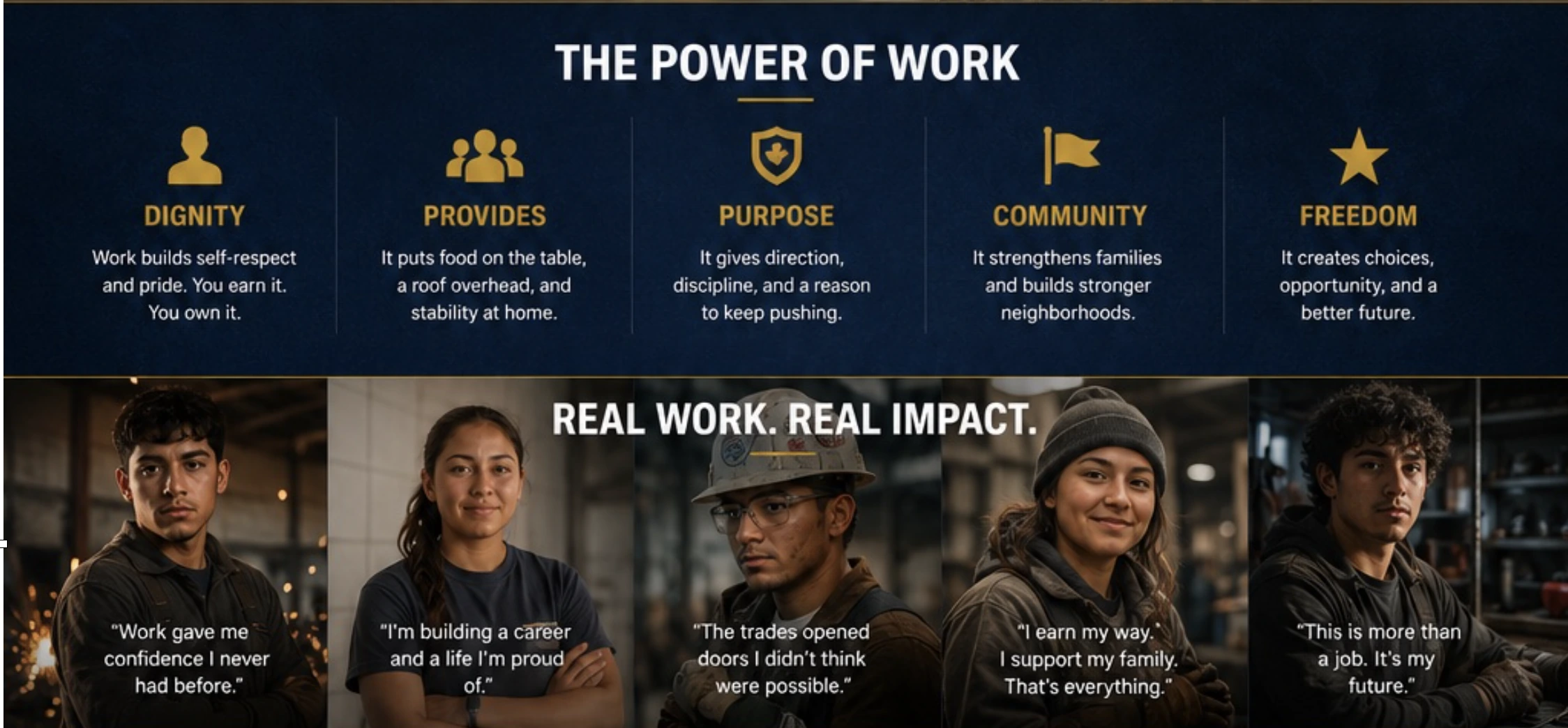
The Power of Work — Dignity Provides Purpose Community Freedom — Real Work. Real Impact. — student testimonials from trades workers
Claude (Anthropic): A large two-section image. The top half is a navy blue infographic panel titled 'THE POWER OF WORK' with a gold underline, listing five gold-icon pillars in equal horizontal columns: DIGNITY (person icon, self-respect and pride), PROVIDES (group icon, food and shelter and stability), PURPOSE (shield icon, direction and discipline), COMMUNITY (flag icon, family and neighborhood strength), and FREEDOM (star icon, choices and opportunity). The bottom half transitions to a warm photographic panel featuring five diverse young tradespeople — a young Latino man, a young Latina woman, a Latino man in hard hat and safety glasses, a young woman in a knit cap, and a young Latino man — each with a first-person quote in white text beneath their portrait. The header 'REAL WORK. REAL IMPACT.' appears across the center of the row.
ChatGPT (OpenAI): A composite image combining an infographic section and a portrait photography section. The upper navy panel presents the five-pillar 'Power of Work' framework with gold icons and brief descriptors for each pillar. The lower warm-toned panel features five portraits of diverse young people who appear to be tradespeople or students, each paired with a first-person quote about how work has changed their life — building confidence, career, pride, independence, and future. The composite communicates both the intellectual case and the human reality of work's transformative power.
Gemini (Google): Dual-register image combining data visualization and human testimony. The top register: a structured five-column infographic on navy blue, using gold icon-plus-label-plus-description sets to articulate why work matters beyond economics — dignity, provision, purpose, community, freedom. The bottom register: five individual portrait photographs of young tradespeople with direct first-person quotes about what work has meant to their lives. The design move from abstract principle to personal testimony is the visual logic of the image.
Copilot (Microsoft): Two-part composite presenting the philosophical case for work (top) and the human evidence for it (bottom). The top panel uses a structured infographic layout with five gold pillars and icons — each naming a different dimension of work's value in a person's life. The bottom panel shifts to portrait photography, with five diverse young workers each speaking in their own voice about what skilled work has given them: confidence, pride, opportunity, family support, and future. The combination makes an emotional and rational argument simultaneously.
Grok (xAI): Split-register composite. Top half: THE POWER OF WORK header on navy, five-column gold-icon framework (Dignity, Provides, Purpose, Community, Freedom), each with a brief explanatory sentence. Bottom half: REAL WORK. REAL IMPACT. overlaid across five portrait photographs of young diverse tradespeople — warm industrial lighting, arms crossed or at sides, direct gazes — each paired with a quote about personal transformation through work. The design juxtaposes the programmatic and the personal, the institutional and the individual.
Llama (Meta): A large composite graphic divided horizontally into two distinct registers. The upper half presents the five pillars of work's value — Dignity, Provides, Purpose, Community, Freedom — in a structured navy-and-gold infographic format with icons and brief explanatory text. The lower half presents five portrait photographs of young people who appear to be in or near the trades, each with a brief first-person testimonial quote about how work has affected their life. The graphic makes both the structural argument for trades education and the human case simultaneously.
===== 13. MISSION PILLARS =====
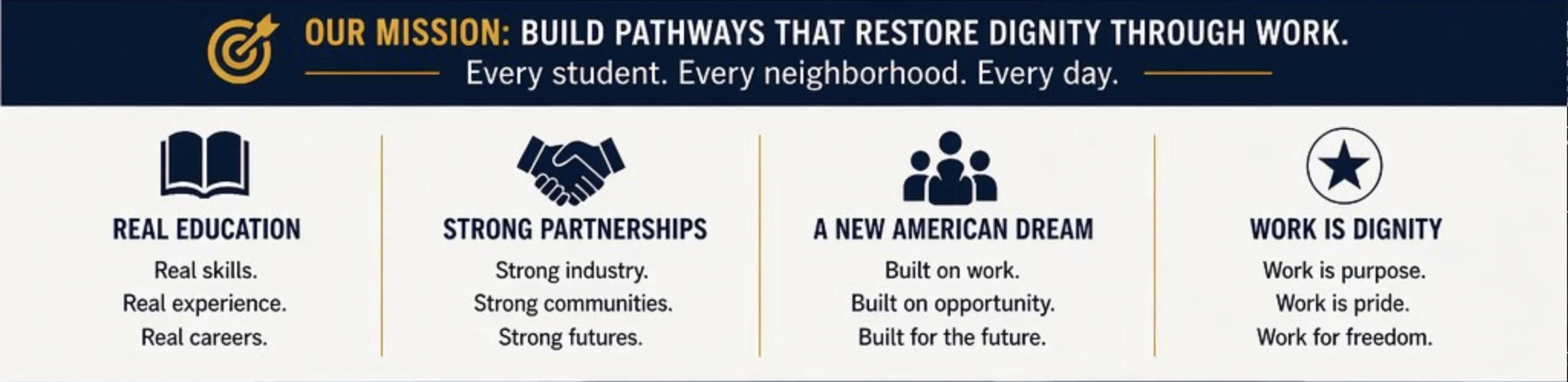
ADUT Mission — Build Pathways That Restore Dignity Through Work — Real Education, Strong Partnerships, A New American Dream, Work Is Dignity
Claude (Anthropic): A wide mission statement banner on a cream/light background with a dark navy header bar. The header contains a gold target/goal icon and reads: 'OUR MISSION: BUILD PATHWAYS THAT RESTORE DIGNITY THROUGH WORK. Every student. Every neighborhood. Every day.' Below the header, four equally-spaced columns each present a pillar of the ADUT mission using dark navy icons and text: an open book for REAL EDUCATION (Real skills. Real experience. Real careers.), clasped hands for STRONG PARTNERSHIPS (Strong industry. Strong communities. Strong futures.), a group figure for A NEW AMERICAN DREAM (Built on work. Built on opportunity. Built for the future.), and a star-in-circle for WORK IS DIGNITY (Work is purpose. Work is pride. Work for freedom.).
ChatGPT (OpenAI): A four-pillar mission statement graphic for American Dream University of the Trades on a light background. The navy header bar with gold target icon delivers the full mission statement and its scope statement. Below, four equally sized columns use icon-plus-headline-plus-three-line-descriptor formatting to articulate the institution's commitments: real education leading to real careers; strong partnerships with industry; a new American Dream built on work; and the foundational belief that work is dignity. The design is clean, formal, and institutional.
Gemini (Google): Institutional mission statement graphic using a four-column pillar format on a cream background with navy accents. The full mission statement appears in the dark header bar with a goal icon, then breaks into four parallel columns below. Each column uses a simple navy icon, a bold headline, and three parallel noun-phrase descriptors. The layout communicates institutional seriousness while remaining accessible — this is ADUT explaining what it is committed to, in the clearest possible structure.
Copilot (Microsoft): Mission statement and values graphic for ADUT, formatted as a four-column pillar layout on a light background. The navy header bar delivers the mission in direct terms: building pathways that restore dignity through work for every student and neighborhood. The four columns below expand on four dimensions of that mission — educational rigor, industry partnerships, reimagining the American Dream, and the foundational belief that work itself carries dignity. Clean, professional, and complete.
Grok (xAI): Four-pillar mission statement banner on cream with navy header. Header: gold icon target, full mission text, scope statement (Every student. Every neighborhood. Every day.). Four columns below: each a dark icon plus headline plus three-part parallel descriptor. Columns cover: education quality, partnership strength, American Dream redefinition, and the dignity-of-work core value. The repetition of 'Real / Real / Real' and 'Strong / Strong / Strong' and 'Built on / Built on / Built for' and 'Work is / Work is / Work for' uses anaphora to make each pillar memorable.
Llama (Meta): Mission statement graphic for American Dream University of the Trades in a formal four-column layout on a light background. A navy header bar with gold target icon presents the full ADUT mission statement and its universal scope. Below, four pillars expand on the mission's components: real education, strong partnerships, a new American Dream, and the core conviction that work is dignity. The three-line descriptor beneath each headline uses parallel grammatical structure to create a rhythm that makes the content easy to absorb and remember.
===== 14. WHEN YOU WORK =====
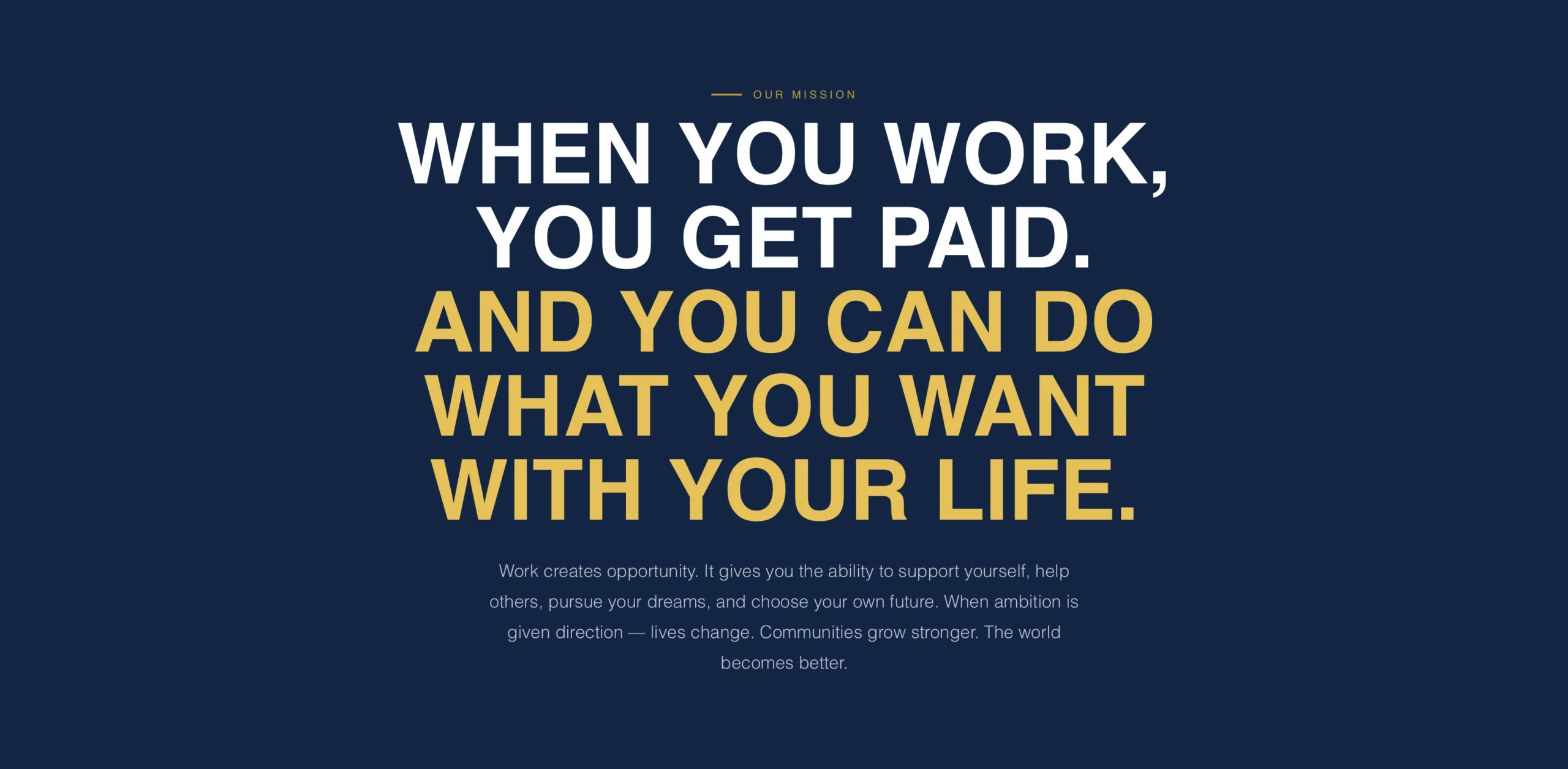
When You Work You Get Paid. And You Can Do What You Want With Your Life. — Work creates opportunity and freedom.
Claude (Anthropic): A full-width typographic impact panel on a deep navy blue background. Small gold all-caps 'OUR MISSION' appears at the top with a short gold rule. Below it, three lines of oversized bold text state the mission's practical promise: 'WHEN YOU WORK, YOU GET PAID.' in white, followed by 'AND YOU CAN DO WHAT YOU WANT WITH YOUR LIFE.' in large gold type. A paragraph of smaller white italic text beneath provides the philosophical expansion: work creates opportunity; it enables self-support, helping others, pursuing dreams, and choosing your future; when ambition is given direction, lives change, communities grow stronger, and the world becomes better.
ChatGPT (OpenAI): A typographic mission statement panel using the contrast between white and gold large-format type on a deep navy background to make a simple, powerful argument for work as the source of life autonomy. The first line establishes economic reality (you get paid), the second expands to life freedom (you can do what you want with your life). The smaller italic paragraph beneath provides the broader social framing — work multiplied across individuals creates community improvement and a better world.
Gemini (Google): Full-bleed navy typographic panel making the practical case for work in two sentences. 'WHEN YOU WORK, YOU GET PAID.' — white, large, plain. 'AND YOU CAN DO WHAT YOU WANT WITH YOUR LIFE.' — gold, large, expansive. Below: a paragraph of smaller italic white text connecting individual economic empowerment to collective social improvement. The design strips away all imagery and ornamentation to let the words land with maximum force.
Copilot (Microsoft): A stark, typography-only mission statement panel on deep navy blue. The layout uses a clear two-level argument: the immediate practical truth (working = getting paid) followed by the ultimate human freedom that enables (doing what you want with your life). The color shift from white to gold marks the transition from economic fact to life aspiration. Supporting text below expands the argument to community and societal scale — individual work creates collective progress.
Grok (xAI): Pure typography on navy. No photography, no icons, no illustration — just words on a dark field. 'WHEN YOU WORK, YOU GET PAID.' in white. 'AND YOU CAN DO WHAT YOU WANT WITH YOUR LIFE.' in gold. Both in the same heavy sans-serif, both at the same large scale, color alone distinguishing the economic premise from the life-freedom payoff. Supporting paragraph below in white italic carries the argument from individual to community to world.
Llama (Meta): Full-width typographic statement panel on deep navy — one of the most visually minimal and rhetorically direct images in the page. The mission is stated in two sentences: the first in white (the economic reality of work), the second in gold (the personal freedom work creates). Below, a smaller paragraph in white italic text expands the argument outward — from individual to community to world — establishing that work's power is not only personal but civilizational.
===== 15. SALARY CHART =====
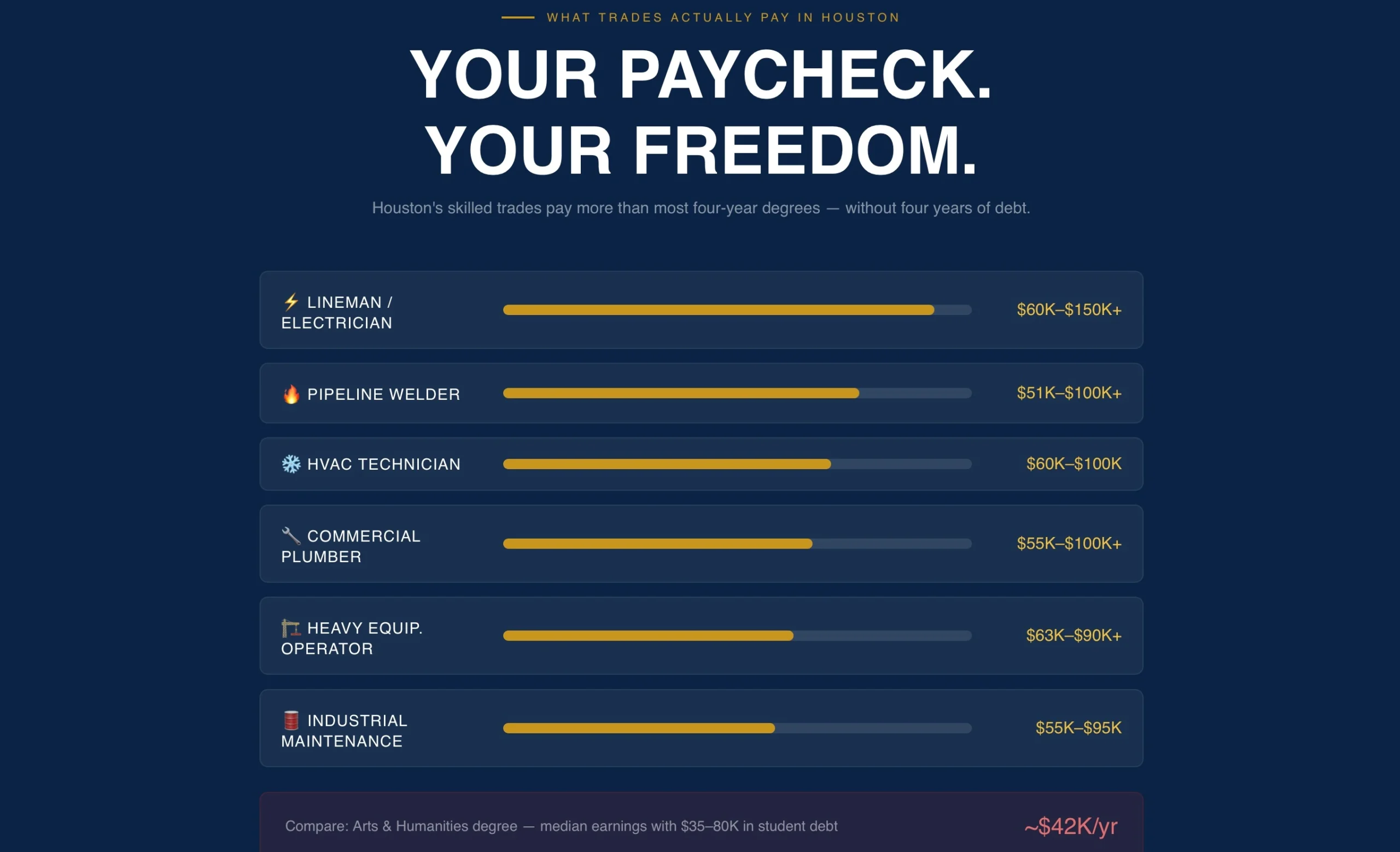
What Trades Actually Pay in Houston — Your Paycheck. Your Freedom. — Electrician $60K-$150K, Welder $51K-$100K, HVAC $60K-$100K, Plumber $55K-$100K, Heavy Equipment $63K-$90K, Industrial Maintenance $55K-$95K
Claude (Anthropic): A dark navy salary data visualization titled 'YOUR PAYCHECK. YOUR FREEDOM.' presenting actual Houston-market compensation ranges for six skilled trades professions. Each trade is presented in a rounded dark card with an emoji icon, the profession name, a horizontal gold-and-gray progress bar showing the salary range visually, and the dollar range on the right: Lineman/Electrician ($60K–$150K+), Pipeline Welder ($51K–$100K+), HVAC Technician ($60K–$100K), Commercial Plumber ($55K–$100K+), Heavy Equipment Operator ($63K–$90K+), and Industrial Maintenance ($55K–$95K). At the bottom, a darker comparison card presents the contrasting benchmark: an Arts & Humanities four-year degree yielding approximately $42K/year in median earnings — with $35–$80K in student debt attached.
ChatGPT (OpenAI): A data visualization graphic presenting Houston-market salary ranges for six skilled trades careers in a horizontal bar chart format on a dark navy background. The title 'YOUR PAYCHECK. YOUR FREEDOM.' frames the data in terms of financial autonomy. Six trade categories are shown with icon-identified profession names, gold progress bars, and salary ranges — all of which meet or substantially exceed the comparison benchmark at the bottom: an Arts & Humanities degree paying approximately $42K/year with significant student debt. The visualization makes the financial case for trades education visually and concisely.
Gemini (Google): Salary comparison infographic on deep navy background, titled 'YOUR PAYCHECK. YOUR FREEDOM.' Six skilled trades professions in the Houston market are presented with horizontal gold bar chart elements and salary range labels, followed by a summary line noting that Houston's skilled trades pay more than most four-year degrees without the associated debt. A comparison benchmark at the bottom — Arts & Humanities degree, median ~$42K/year with $35–$80K in student debt — provides the contrast that makes all six trades ranges appear compelling by comparison.
Copilot (Microsoft): Data visualization graphic presenting the economic case for skilled trades education in the Houston market. Six professions — lineman/electrician, pipeline welder, HVAC technician, commercial plumber, heavy equipment operator, and industrial maintenance — are shown with emoji icons, horizontal gold-and-gray progress bars, and salary ranges. The headline 'YOUR PAYCHECK. YOUR FREEDOM.' connects financial data to personal autonomy. The bottom comparison card establishes the baseline: the alternative four-year degree path yields lower income with significant debt.
Grok (xAI): Dark navy salary data graphic. Eyebrow text: WHAT TRADES ACTUALLY PAY IN HOUSTON. Headline: YOUR PAYCHECK. YOUR FREEDOM. Subtitle connecting trade wages to debt-free graduation. Six trade career cards stacked vertically, each with: emoji icon, trade name, gold horizontal progress bar (filled portion shows salary proportion), dollar range right-justified. Bottom comparison card in darker background shows Arts & Humanities degree benchmark — approximately $42K median with $35–$80K debt. The data speaks for itself.
Llama (Meta): Salary data visualization for the Houston skilled trades market, presented on a deep navy background with the headline 'YOUR PAYCHECK. YOUR FREEDOM.' Six trades occupations are displayed in individual rounded cards with profession names, horizontal gold progress bar charts, and salary range labels — all ranging from $51K at the low end to $150K+ at the high end. The bottom comparison card presents the alternative path: an Arts & Humanities four-year degree with approximately $42K median annual earnings and substantial student loan debt, providing the economic contrast that frames the ADUT mission.
===== 16. FOR MORE INFORMATION / URL =====
For more information: FindingTheCleveland600.com — Learn More. Get Involved. Change Lives. Work Texas — Celebrating the Dignity of Work — American Dream University of the Trades
Claude (Anthropic): A horizontal footer banner on deep navy blue featuring a globe-with-cursor icon on the left, followed by the call to action 'FOR MORE INFORMATION GO TO:' and the website URL 'FINDINGTHECLEVELAND600.COM' in large bold gold typography. On the right side, a QR code provides mobile-accessible navigation to the site, beside three lines of white text: 'LEARN MORE. GET INVOLVED. CHANGE LIVES.' A thin darker bottom bar runs the full width with the tagline: 'WORK TEXAS! — CELEBRATING THE DIGNITY OF WORK — AMERICAN DREAM UNIVERSITY OF THE TRADES.' The URL 'Finding the Cleveland 600' references the mission of identifying and serving the population of young people the program is designed to reach.
ChatGPT (OpenAI): A website footer/call-to-action banner in navy blue and gold, directing visitors to FINDINGTHECLEVELAND600.COM. The left section uses a globe icon and direct URL text. The right section pairs a QR code with a three-line call to action (Learn More / Get Involved / Change Lives). A thin bottom bar carries the full brand tagline combining the 'Work Texas!' campaign, the Dignity of Work theme, and the institution's full name. The URL references the program's mission to identify and enroll a specific population of deserving young Houstonians.
Gemini (Google): Footer call-to-action banner directing visitors to FINDINGTHECLEVELAND600.COM — a URL that encapsulates the program's mission in its name. Navy blue with gold typography. Globe-with-cursor icon on the left. URL in large gold bold type center-left. QR code on the right for mobile users. Three-line action call: LEARN MORE. GET INVOLVED. CHANGE LIVES. Bottom bar carries the full campaign and institutional tagline. The 'Cleveland 600' name references the specific population the program aims to find, educate, and employ.
Copilot (Microsoft): Page footer graphic anchoring the page with a direct website referral and institutional branding. The navy blue banner uses a globe icon and large gold URL text to direct visitors to FINDINGTHECLEVELAND600.COM. A QR code on the right provides mobile access. The three-part call to action (Learn More, Get Involved, Change Lives) summarizes the three types of engagement the organization is seeking. The bottom bar completes the institutional identification with the campaign name, core value statement, and full university name.
Grok (xAI): Closing banner of the page. Navy background. Left: globe-cursor icon plus URL prompt text plus FINDINGTHECLEVELAND600.COM in large gold type. Right: QR code plus LEARN MORE. GET INVOLVED. CHANGE LIVES. in white. Bottom bar: full campaign-plus-mission-plus-institution tagline in gold. The domain name 'FindingTheCleveland600' carries the program's mission in its URL — finding the specific population of young Houstonians who need exactly what ADUT offers.
Llama (Meta): Full-width footer banner on navy blue providing the primary website referral and call to action. The URL FINDINGTHECLEVELAND600.COM is displayed prominently in gold bold type, accompanied by a globe icon on the left and a scannable QR code on the right. Three lines of white text provide the engagement options: Learn More, Get Involved, Change Lives. A dark bottom bar carries the institution's full tagline connecting the Work Texas campaign, the Dignity of Work value, and the American Dream University of the Trades name.
===== 17. BODY TEXT — moved here as closing argument before Brookwood =====

The Dignity of Work

Every Job Has Value. Not Every Job Has the Same Value.

And That's Okay.

Some jobs are necessary. Trash collection keeps cities healthy. Medicine keeps people alive. Both matter deeply. They don't pay the same. Both carry dignity.

Some jobs are rare. Few people rise to the very top of their field. That is true in music, in business, in medicine, and in the trades.

That's not unfair. That's honest. And honesty is where real choices begin.

Your Path Is Yours.

One person earns a PhD at MIT and designs the chips inside every phone on earth.

One person becomes an electrician, starts his own business, and builds something that lasts.

One person trains at Juilliard and moves audiences without saying a word.

One person learns to sell furniture, earns trust, builds relationships, and creates a business that serves a whole community for decades.

Different paths. Different markets. All real work. All real dignity.

And Then There's Juan.

Juan Hernandez got hired at SpaceX as a welder in 2015. They offered him $10,000 in company stock. "It wasn't a big deal," he said at the time. "I didn't know it was gonna be this big." On June 12, 2026, SpaceX went public in the largest IPO in history. Juan Hernandez is now a millionaire. He was not alone. The SpaceX IPO created 4,400 millionaires. Several came from the trades.

Juan Hernandez CBS interview video thumbnail ▶ Watch Juan's Story
Opens the CBS interview on YouTube in a new tab.

Excellence Is Recognized.

Juan is the central example here: a skilled welder whose work opened a door most people never see. Taylor Swift and Houston-raised Beyoncé make the supporting point from a different field.

Juan’s story demonstrates the Dignity of Work in the skilled trades. The same principle can be seen in music, athletics, medicine, engineering, business, and countless other professions: preparation, discipline, skill, reliability, persistence, and the ability to do something well enough that others recognize its value.
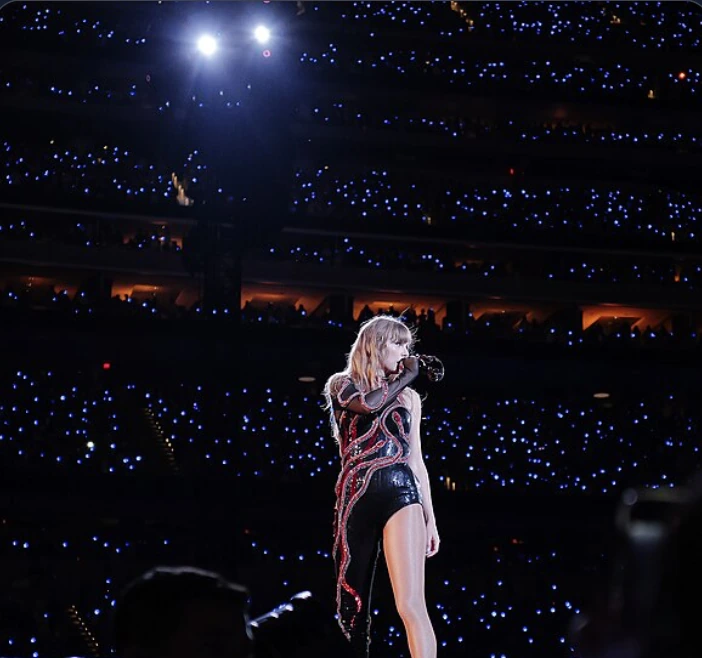
Taylor Swift performing alone on a brightly lit stadium stage before a large audience holding blue lights
Taylor Swift Years of discipline.
Exceptional performance.
Excellence rewarded.
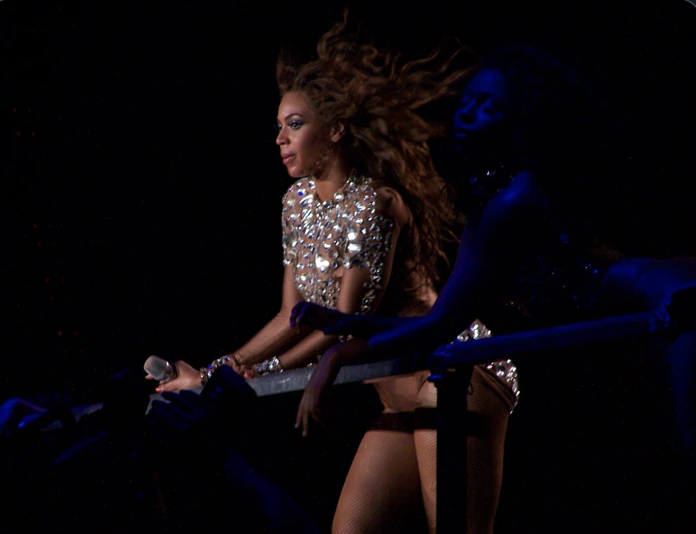
Houston-raised Beyoncé performing energetically on a dark concert stage with a microphone in hand
Houston-raised Beyoncé Talent developed through relentless work.
Mastery earned over years.
Excellence rewarded.
Different careers. Same principle.
Excellence is rewarded.

The Dignity of Work celebrates people who devote themselves to becoming exceptionally good at what they do—whether on a concert stage, in a welding shop, on a construction site, in a hospital, in a classroom, or in countless other professions that strengthen our communities.

Performance photographs supplied for this page.

The Only Question That Matters:

What are you going to do with what you've been given?

Dr. Martin Luther King, Jr. answered it this way: "If a man is called to be a street sweeper, he should sweep streets so well that all the hosts of heaven and earth will pause to say — here lived a great street sweeper who did his job well."

The Army said it differently. Be all you can be. Don't measure your life against someone else's path. Master yours.

One Man in Houston Already Knows This.

"Work is life's greatest therapy."

— Jim "Mattress Mack" McIngvale

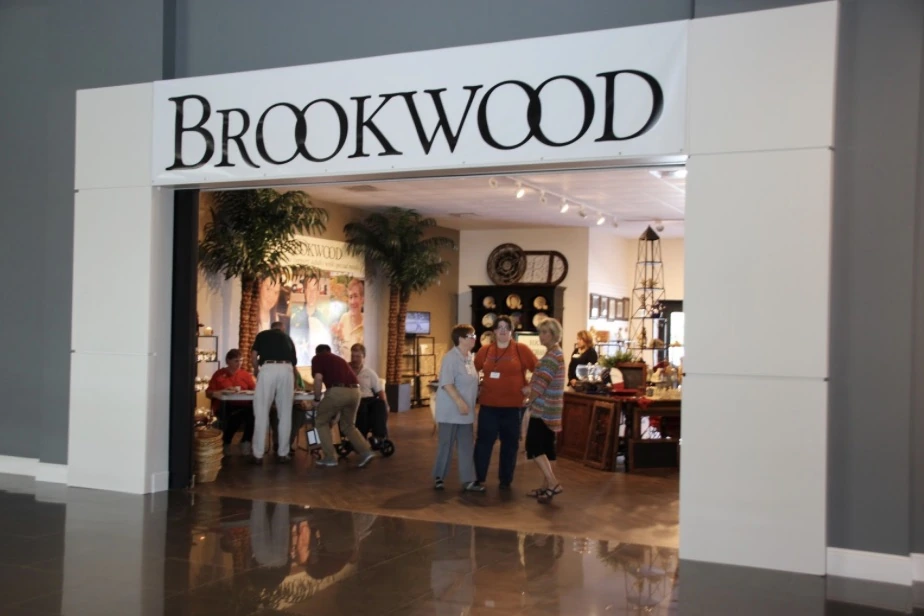
He believed it so deeply he gave Brookwood Community a store inside Gallery Furniture — free of charge — so that adults with disabilities could experience exactly what he meant.

Real work. Real paycheck. Real dignity.
===== 18. BROOKWOOD STORE (closing proof) =====
Brookwood Community store inside Gallery Furniture Houston — the living expression of the dignity of work
Claude (Anthropic): A photograph of the Brookwood Community retail store located inside the Gallery Furniture showroom. Seen through a large open archway with a clean white frame bearing the word 'BROOKWOOD' in elegant black serif lettering, the store interior is warmly lit with track lighting, tropical plants, wooden furniture displays, and decorative items. Several visitors and staff members are visible inside — some browsing merchandise, some in conversation. The store has a welcoming, boutique-retail atmosphere. This is the physical embodiment of Jim McIngvale's belief in work as therapy: he gave Brookwood — a faith-based community serving adults with intellectual disabilities — a free retail space inside his flagship furniture store so they could experience real work, real paychecks, and real dignity.
ChatGPT (OpenAI): A photograph looking into the Brookwood Community store through an archway inside Gallery Furniture. The store is branded with 'BROOKWOOD' in large serif type above the entrance. Inside, the warmly lit retail space displays home décor, furniture pieces, and gifts, with several people engaged in shopping or conversation. The image documents one of the most concrete expressions of the Dignity of Work philosophy on the page: Jim McIngvale donating retail floor space in his flagship store to a community of adults with intellectual disabilities — enabling them to work, earn, and experience dignity firsthand.
Gemini (Google): Interior retail photograph of the Brookwood Community shop located within Gallery Furniture in Houston. The entrance archway with the 'BROOKWOOD' sign frames the shot, giving the photograph a natural compositional focus. Inside, the store is active with visitors and merchandise — plants, décor, crafts. The image serves as the closing visual evidence of the page's thesis: this is what the Dignity of Work looks like in practice, not in theory. Jim McIngvale didn't just believe in work as therapy — he created a space where the most overlooked members of the community could prove it.
Copilot (Microsoft): Photograph of the Brookwood Community store inside Gallery Furniture, Houston. The 'BROOKWOOD' sign above the archway entrance is the focal point of the shot. Through the entrance, the store appears warm, well-stocked, and welcoming — a functioning retail environment with staff and customers. The image represents the Dignity of Work in its most tangible form: a prominent Houston businessman providing free retail space to a residential community serving adults with intellectual disabilities, so they could experience what real employment feels like.
Grok (xAI): Documentary photograph of the Brookwood Community retail store inside Gallery Furniture. Camera is positioned in the showroom corridor looking in through the arched white entrance with 'BROOKWOOD' lettered above. Store interior: warm, active, merchandise-rich. People visible — some browsing, some talking, some working. The photograph closes the page on a concrete image of its central argument. The Dignity of Work is not an abstraction. Mattress Mack didn't write about it. He made space for it — literally — on his showroom floor.
Llama (Meta): An interior retail photograph of the Brookwood Community store, located inside Gallery Furniture in Houston. The camera frames the shot through the store's archway entrance, where 'BROOKWOOD' is written in clean serif typography on a white surround. The store interior is visible through the opening — warm track lighting, tropical plants, handcrafted items, wooden furniture, and several people in motion. This photograph is the page's closing evidence: Jim McIngvale's belief that work is life's greatest therapy was expressed not only in words but in action — by giving the Brookwood Community a real store, inside his flagship location, where adults with disabilities could work, earn, and live with dignity.
===== MODALS =====
Scroll to Top