General Moses Cleveland
(1754 - 1806)
Page 367, # 716
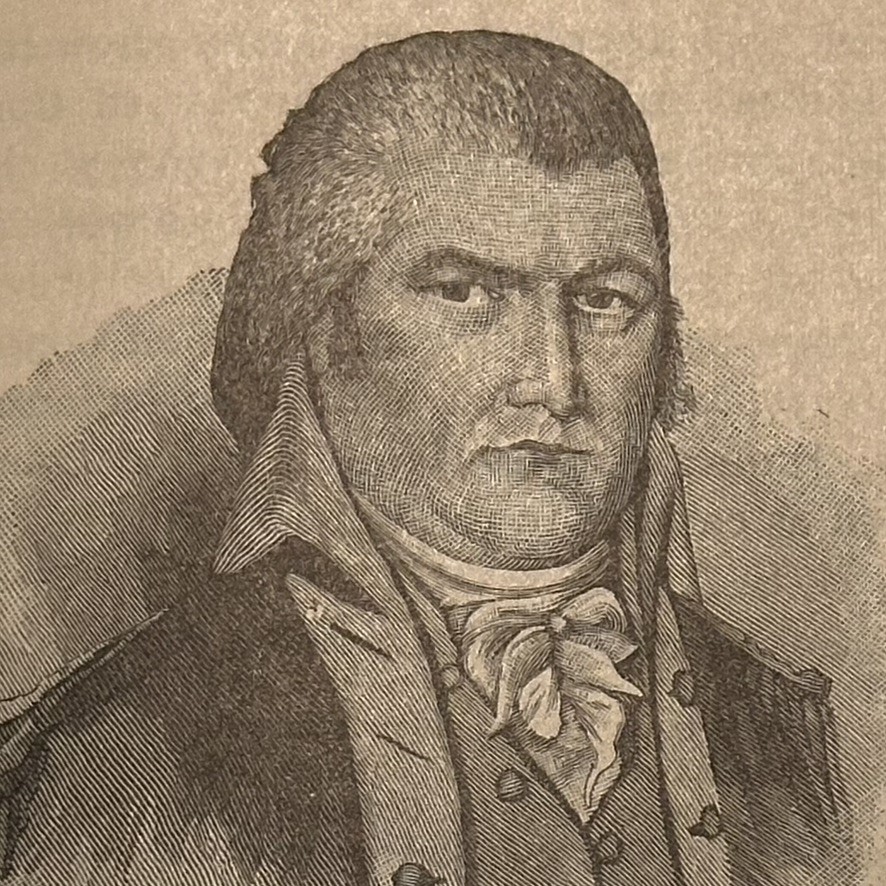
GENERAL MOSES CLEAVELAND, the founder of the city of Cleveland, Cuyahoga co., Ohio, and in honor of whom the city was named, dwelt at Canterbury, Conn., an eminent lawyer. The homestead farm embraced a portion of the original purchase of Lt. James Bradford (see +232) of 300 acres extending to Quinebaug river and Mt. Nunkatum, with a steep declivity in the E. of ab. 300 ft. It adjoined the farms of Capt. John 5 Adams +672, Dea. Cornelius 6 Adams +674, Isaac Morgan (see -\-2j.$o), and Lot Morgan (see +782). The farm has often changed ownership, and now is owned by Dea. Thomas Clark, s. Allen.
Connecticut State Library — Minutes, p. 50. “At a meeting of Governor [Jonathan Trumbull] and council of Safety, holden Thurs. 2d Nov. A.D. 1775, His Hon. also moved for advice recommending Mr. MOSES Cleveland to General Washington for an officer &c & ye matter is referred to His Honor’s Discretion.”
Records of the Revolutionary Army show that Moses entered the service spring of 1777, as Lt. 2d Conn. Reg., Col. Charles Webb, commission dated Jan. 1, 1777. He graduated Yale Sept., 1777, but probably none of the class were present at the exercises, for all were permitted to leave previously for the army, being commissioned officers. The 2d Conn, was engaged in Pa. Dec, 1777, wintered at Valley Forge, and was at Monmouth, N. J., June 28, 1778. Was detached from his reg. and commissioned as captain in the newly-formed Corps of Sappers and Miners, U. S. A. :
” The United States of America in Congress assembled. To Moses Cleveland, Esquire, Greeting:
We, reposing- especial trust and confidence in your patriotism, valor, conduct, and fidelity, do by these presents constitute and appoint you to be a captain in the companies of sappers and miners in the Army of the United States, to take rank as such from the second day of August, 17713. You are, therefore, carefully and diligently to discharge the duty of a captain, by doing and performing all manner of things thereunto belonging. And we do strictly charge and require all officers and. soldiers under your command to be obedient to your commands as captain. And you are to observe and follow such orders and directions from time to time as you shall receive from this or a future Congress of the United States, or committee of Congress for that purpose appointed, a committee of the States, or commander-in-chief for the time being of the Army of the United States, or any other superior officer, according to the rules and discipline of war, in pursuance of the trust reposed in you. This commission to continue in force until revoked by this or a future Congress, the committee of Congress before mentioned, or a committee of the States.
Entered in the war office, and examined by the board. Attest. Witness : His Excellency Samuel Huntington, Esq., President of the Congress of the United States of America, at Philadelphia, the fourteenth day of February, 1780, andin the fourth year of our independence.
Sam. Huntington, President.
Ben. Stoddert, Secretary of the Board of War. Captain Cleveland is hereby, at his own request, discharged from the service of the United States.
His service was continuous for at least four years. He was a member of the Cincinnati Society [adm. July 7, 1784]. [See Record of Conn. Men in Revolution, 158, 298, 385.] An excellent Biography of Gen. Moses Cleaveland, by Hon. Harvey Rice, appeared in the Magazine of Western History, 145, St. Clair st., Cleveland, O., I, 170-6, Jan., 1885, from which following is quoted :
” In attempting to solve the problem of life, General Moses Cleaveland had a purpose and lived for a purpose. In his career, though controlled by circumstances, he manifested an unusual degree of wisdom and foresight. Among other achievements he founded a city — the beautiful city that inherits his name and cherishes his memory with a pride that approaches reverence.
He adopted the legal profession, and commenced the practice of law in his native town with marked success. The abilities of the young lawyer soon attracted public attention. Congress recognized his merits by appointing him, in 1779, capt. of a co. of sappers and miners in the army of the United States. He accepted the commission, and remained in the service for several years, when he resigned and resumed the practice of law. He was also a prominent Mason, and held the position of Grand Marshal of the Grand Lodge of Connecticut. [ See Bibliography, Chapter IV.]
He was several times elected a member of the State Legislature, and in this capacity acquired an enviable reputation as a statesman. He m. Esther Champion, a young lady of rare accomplishments. [Canterbury rec. — ” Colchester, Conn., Mar. 21, 1794. I married Col. Moses Cleaveland of Canterbury to Miss Esther Champion of Colchester. Certified fm Henry Champion, Junior., Justice of Peace. The above is a true Record. Test., Gideon Wells, Town Clerk.”]
Early in 1796, after having risen rapidly through the subordinate military grades, he was advanced to the generalship of the Fifth Brigade of the State militia.
In regard to the subsequent career of General Cleaveland, it should be remembered that Connecticut, when a colony, acquired by grant of King Charles II of England, in 1662, a vast tract of territory lying between the same parallels with the colony, and extending west from ” sea to sea,” or from the Atlantic to the Pacific Ocean. When Connecticut was admitted into the Union as a state, she claimed this territory as her rightful domain. In adjusting this claim, Congress allowed her to retain only that part of the territory now known as the ” Western Reserve.” This she accepted in full discharge of her claim.
The Western Reserve embraces the northeastern part of Ohio, and contains 3,800,000 acres. In 1792 the state donated 500,000 acres of this land, since known as the ” Fire-lands,” to citizens who had suffered by fire in the Revolution; and, in 1795, authorized a sale of the remaining part of the reserve and appointed a committee to effect the sale. This remainder was sold within a few months for $1,200,000, which the state appropriated as a permanent fund for the support of her common schools. The purchasers of the land were wealthy citizens known as the ” Connecticut Land Co.”
[Early History of Cleveland, Ohio, Including Original Papers and other matters relating to the adjacent country, with Biographical Notices of the Pioneers and Surveyors. By Col. Chas. Whittlesey. Cleveland, 0., 1867, p. 163. — Sep. 2, 1795, the bargain was concluded. Their respective proportions are here given: Joseph Howland and Daniel L. Coit $30,461, Elias Morgan $51,402, Caleb Atwater $22,846, Daniel Holbrook $8,750, Joseph Williams $15,231. William Love $10,500, William Judd $16,256, Elisha Hyde and Uriah Tracey $57,400, James Johnston $30,000, Samuel Mather, Jr., $18,461, Ephraim Kirby, Elijah Boardman, and Uriel Holmes, Jr., $60,000, Solomon Griswold, $10,000, Oliver Phelps and Gideon Granger, Jr., $80,000, William Hart $30,462, Henry Champion, 2d, $85,675, Asher Miller $34,000, Robert C. Johnson $60,000, Ephraim Root $42,000, Nehemiah Hubbard, Jr., $19,039, Solomon Cowles $10,000, Oliver Phelps $168,185, Asahel Hathaway $12,000, John Caldwell and Peleg Sanford $15,000, Timothy Burr $15,231, Luther Loomis and Ebenezer King, Jr., $44,318, William Lyman, John Stoddard, and David King, $24,730, Moses Cleaveland $32,600, Samuel P. Lord $14,092, Roger Newberry, Enoch Perkins, and Jonathan Brace $38,000, Ephraim Starr $17,415, Sylvanus Griswold $1,683, Jacob Stocking and Joshua Stow $11,423, James Bull, Aaron Olmsted, and John Wyles $30,000, Pierpoint Edwards $60,000. Total, $1,200,000.”]
The individuals comprising the. company, with a view to convenience in the transaction of business, conveyed their respective interests to three trustees, John Cadwell, John Morgan, and Jonathan Brace. In accordance with articles of agreement entered into by the land company, the general management of its affairs was confided to a board of seven directors, Oliver Phelps, Henry Champion, Moses Cleaveland, Samuel W. Johnson, Ephraim Kirby, Samuel Mather, Jr., and Roger Newbury. The following commission was issued by the board of directors to Moses Cleaveland: • .
To Moses Cleaveland, Esq., of the County of Windham and State of Connecticut, one of the directors of the Connecticut Land Company, Greeting:
We the Board of Directors of said Company, having appointed you to go on to said land as superintendent over the agents and men sent to survey and make locations on said land, and to make and enter into friendly negotiations with the natives who are on said land, or contiguous thereto, and may have any pretended claim to the same, and secure such friendly intercourse amongst them as will establish peace, quiet, and safety to the survey and settlement of said lands not ceded by the natives under the authority of the United States.
You are hereby, for the foregoing purposes, fully authorized and empowered to act and transact all the above business in as full and ample a manner as we ourselves could. do; to make contracts on the foregoing matters in our behalf and stead, and make such drafts on our treasury as may be necessary to accomplish the foregoing object of your appointment. And all agents and men by us employed and sent to survey and settle said lands, to be obedient to your orders and directions ; and you are to be accountable for all moneys by you received, conforming your conduct to such orders and directions as we may from time to time give you, and to do and act in all matters according to your best skill and judgment, which may tend to the best interest, prosperity, and success of said Connecticut Land Company, having more particularly for your guide the Articles of Association entered into and signed by the individuals of said company. Dated at Hartford this 12th day of May, 1796.
Directors.
- Oliver Phelps,
- Henry Champion,
- Roger Newbury,
- Samuel Mather, Jr., j
Thus commissioned, General Cleaveland led the first surveying and exploring party into the wilds of the Western Reserve, or ” New Connecticut,” as it was then called. The entire party consisted of General Cleaveland, agent of the Land Company; Augustus Porter, principal surveyor; Seth Pease, astronomer and surveyor; Moses Warren, Amos Spafford, John M. Holley, and Richard M. Stoddard, assistant surveyors; Joshua Stow, commissary; Theodore Shepard, physician; Joseph Tinker, boatman, and Seth Hart, chaplain, accompanied by 37 employes and a few immigrants. There were but 2 women in the party. They were married women who came with their husbands. The whole party numbered just fifty. They brought with them 13 horses and several head of horned cattle.
The individuals composing the expedition concentrated at Schenectady, N. Y., early in June, 1796. A few took charge of the horses and cattle and proceeded by land through the interior wilds of the state to Buffalo, while the others procured boats and ascended the Mohawk River, and when they reached Fort Stanwix, now Rome, transferred their boats from the Mohawk over the portage to Wood Creek, passed down the creek to Oneida Lake, thence across the lake and its outlets, and down the Oswego River to Lake Ontario. From this point they coasted along the south shore of Ontario to the mouth of the Niagara River, thence up that river to Queenstown, and after crossing the ” seven mile ” portage reached Chippewa, and from thence pursued their way along the Niagara River and shore of Lake Erie to Buffalo, where they were met by the detachment having charge of the horses and cattle. Here Gen. Cleaveland found a delegation of Seneca and Mohawk Indians, headed by Red Jacket and Colonel Brant, who had been awaiting his arrival, with a determination to oppose the further progress of the expedition to the Western Reserve, claiming that it was territory which rightfully belonged to them. The Indians consented to hold a “talk” with the general, who succeeded in quieting the claim by making them a donation of goods, valued at twelve hundred dollars. The expedition then continued westward along the southeastern shore of Lake Erie, and landed, on the fourth of July, 1796, at the mouth of Conneaut Creek, in the Western Reserve, and on landing gave ” three deafening cheers ” and christened the place ” Port Independence.”
It was a pleasant day. The party felt patriotic, and resolved to celebrate not only the day but the event. They flung the American flag to the breeze. Tables were extemporized and made to groan under the weight of a superabundance of baked pork and beans and other luxuries, all of which were partaken of with a keen relish. Salutes were fired by platoons of musketry, speeches were made and several pails of grog were drank in response to the following toasts or sentiments: I. ” The President of the United States.” 2. ” The State of New Connecticut.” 3. ” The Connecticut Land Company.” 4. ” May the Port of Independence and the fifty sons and daughters who have entered it this day be successful and prosperous.” 5. ” May these fifty sons and daughters multiply in 16 years 16 times 50.” 6. ” May every person have his bowsprit trimmed and ready to enter every port that opens.”
The celebration was prolonged until the stars appeared. It was the first of the kind that ever occurred in the Western Reserve. At its close the hilarious ” fifty ” retired to their boats and tents in as good order as could be expected. The next day was devoted to the erection of a log structure or two, designed for the immediate accommodation of the party and their supplies. The Indians in the vicinity now became inquisitive, and demanded to know why it was the white men encroached upon their domains. A council was called and the central seat assigned to General Cleaveland, as the great white chief. Proceedings were commenced by gravely smoking the •” pipe of peace.” Cato, the son of the old Indian Chief, Piqua, then addressed the Great White Chief, who, in his reply, conciliated the Indians by giving them a few glass beads and a keg of whiskey. The surveys were then allowed to proceed. The general assigned to each detachment of surveyors their special work, and told them where to commence it.
In the course of two weeks after this General Cleaveland left Conneaut in company with a select few of his staff, and coasted in an open boat along the southeastern shore of Lake Erie until he came to the mouth of a river, which he took to be the Cuyahoga. He ascended the stream for some distance, amid many embarrassments arising from sandbars and fallen trees, when he discovered his mistake, and found that it was a shallow river of minor importance and not noted on his map. This perplexity and delay so chagrined him and his staff that he named the river ” Chagrin,” a designation by which it is still known, and, continuing his voyage, entered the mouth of the veritable Cuyahoga on the twenty-second of July, in the same ever memorable year of 1796, and landed on its eastern bank near its entrance into the lake. He at once with his staff ascended the steep bank, and beheld for the first time an elevated plain of surprising beauty that extended far away to the east, west, and south of him, and that was clad with a luxuriant growth of graceful forest trees. The scene charmed his eye, and the spot where he stood, skirted as it was by the Cuyahoga River on the west and by Lake Erie on the north, suggested to him that, with these natural advantages, the locality was destined, at no distant day, to become the site of a great commercial city.
Note: There are too man additional pages to display. To read the additional pages, see to the genealogy online.