Henry Bacon
(1818 - 1893)
Page 1374, # 4768
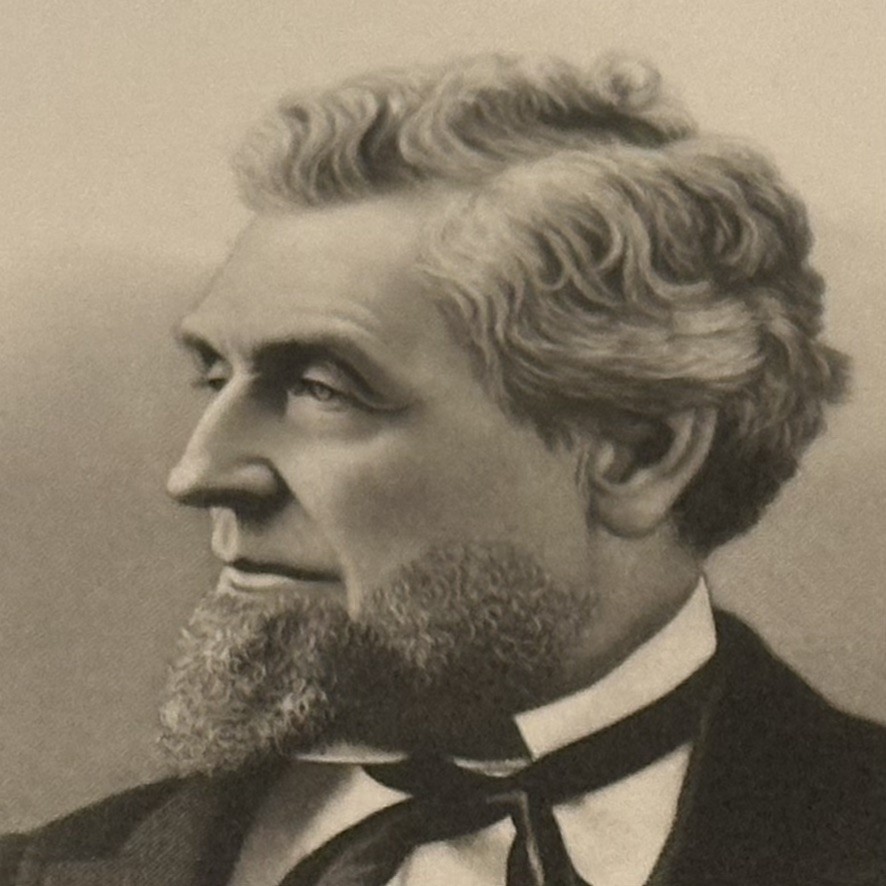
Hon. HENRY DOUGLASS BACON, born May 3, 1818, the son of Joseph Bacon and Abigail Cleveland, was a resident of E. Granville to 1833, Hartford, Conn., to 1835, St. Louis to 1865, spending many months in N. Y. city and Europe; San Francisco, Cal., to 1868, and since 1868 at Oakland. From Richard Edwards’ History of St. Louis, 1860, p. 132, the following accompanied by his portrait.- —
HENRY D. BACON.
There are some men whose characters are so nobly planned by nature and so plentifully adorned with those virtues which ennoble humanity that it is a duty and a pleasure to write their biographies and hand them as memorials to posterity for its benefit and instruction. For some time Henry D. Bacon assisted his father, but the sphere of the farmer was too circumscribed. Wishing to move to a place where he could have access to a good library, that he might improve his education, which had not been as liberal as he wished, he went to Hartford and entered a commercial house, in which he remained but a short time, and emigrated to St. Louis 1835, bearing the highest testimonials of character and capacity. He was soon engaged as partner in one of the most respectable drygoods firms in the city. He then entered into the iron trade, which he pursued successfully to 1844, when he became associated with Daniel D. Page in the flour business.
In 1848 the banking house of Page [Daniel D.] & Bacon [Henry D.] was organized, which, in a few years, so won the confidence of all classes of people that it did the heaviest banking business in the whole of the western country. A branch was established in Cal.,1850, and in 1854 the exchanges reached the almost staggering amount of $80,000,000. Mr. Bacon was the active partner, and so readily and cordially did he at all times respond to the wants of the commercial community that, to this day, many of our leading citizens feel under a debt of gratitude to him for his accommodating liberality at that period. The house of Page & Bacon was remarkable for its enterprise, and, in 1853, knowing how fraught with advantages to St. Louis would be a direct communication to the East through the rich American bottom of Illinois, they advanced the immense means necessary for building the greater part of the Ohio & Miss. R. R. This drew out an immense capital from their business, and, a pressure shortly after taking place in the money market, the firm was compelled, Jan., 1855, to suspend payment.
The suspension caused, for a short period, almost a stagnation in business, as the house was the financial source from which a large portion of the business world drew the elements of their vitality. In the crash which he could not avoid, and which must have torn with anguish his sensitive organization, Mr. Bacon gave way to no despondency, to no selfish grief, but bent all of his powers to complete the railroad which had ever been one of his darling schemes, and which had to stop its operations at his failure. He went to N. Y., where he was well known, and induced Eastern capitalists to advance sums requisite for its completion. This road, which now forms one of the main arteries of the prosperity of St. Louis, owes its existence to his efforts.
We have now to speak of Mr. Bacon in the retired walks of life, disconnected with business pursuits. When the Mercantile Library was in its infancy he stood its powerful friend, and to-day it is one of the most cherished ornaments and institutions of our city. The members have not been guilty of ingratitude, for they have graced the walls with a splendId portrait of their early benefactor. The splendid building known as the Union Presbyterian. Church, in which Rev. Wm. Holmes officiated, he built and furnished, and donated to the church- $80,000 of the immense expense he had incurred. The Webster College and House of the Friendless are beneficiaries ; and his daily charities have relieved a plenitude of suffering. He has ever been the friend of humanity, and is looked upon as the soul gf honor and of human uprightness.
In James Dunwoody Brownson De Bow’s Review for 1855 Pastor Holmes of St. Louis furnishes facts of H. D. Bacon up to then.
Dr. Charles M. T Blake writes us, January 9, 1886 : “The last 25 years of the life of Hon. Henry D. Bacon are quite as full of interest. He spent some time in Europe, brought home vast quantities of paintings, statuary, and virtu; built Art Building at Berkeley, University of California, cost $40,000, and presented, with his collection, to the University 1881, — a noble gift to the youth of California.
[See Addresses at Inauguration of W. T. Reid as Pres. of University of Cal., and the dedication of the Bacon Art and Library Building, Berkeley, Aug. 23, 1881, pp. 79-100. — Address delivered by H. D. Bacon.]