John Cleveland (The Poet)
(1613 - 1658)
Page 2229, # 17717
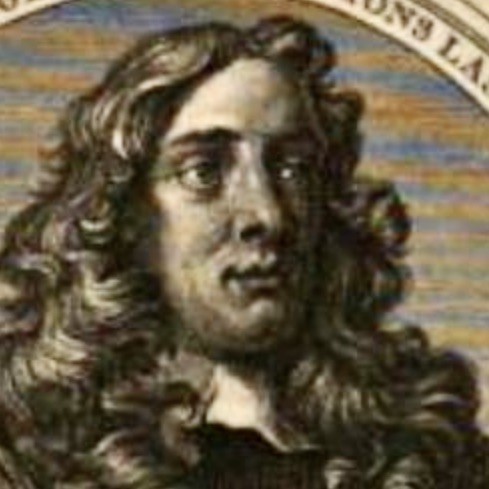
John Cleveland was educated at Hinckley under Rev. Richard Vines or Vynes, a noted Puritan ; adm. of Christ’s Coll., Cambridge, Sept. 4, 1627; took degree B.A. 1631. Then removed to St. John’s Coll., same University, being elected Fellow Mar. 27, 1634, M.A. 1635. He continued for many years the delight and ornament of the house in which he was a tutor. Being excused from going into holy orders, became their rhetoric reader, usually drew up all epistles and addresses for that Society, being much admired for the purity and terseness of his Latin style. He also became celebrated for his occasional poems in English, especially on the breaking out of the civil wars, where he is said to have been the first champion that appeared in verse for the royal cause — Athen. Oxon., by Anthony a Wood, 2d ed., II : 274.
In 1642, John’ had the honor of speaking an oration before the king, Charles I, and prince, at -St. John’s college, with which, Winstanley [ William] says, the king was so well pleased that he sent for him, gave him his hand to kiss, ordered a copy to be sent after him to Huntingdon. When Oliver Cromwell was in election to be member fori Cambridge, as John’ engaged all his friends and interests to oppose it, iso when it was carried but by one vote, he cried out with much passion, “that that single vote had ruined church and kingdom,” such fatal events did he presage from the success of Oliver. See London Post, No. 23, Feb. 11, 1644-3, when John Cleveland is brought to London for libelling. When the opposite party prevailed, he retired to the king at Oxford, and was, in his absence, ejected from his fellowship, Apr. 8, 1644 (or ejected by the earl of Manchester, Feb. 13, 1644) — see Walker’s Sufferings, II: 149.
In Newark Castle, the garrison which so long supported the king’s declining cause, he was Judge- Advocate under Gov. Sir Richard Willis. There he drew up a gallant return to the summons of the besiegers. After the surrender, 1646, by the express command of the King, then a prisoner with the Scottish army, Cleveland followed the fates of distressed loyalty, concealed for some years, till, in Nov., 1655, he was seized at Norwich as a person of great abilities adverse and dangerous to the reigning government — State Papers, by John Thurloe, IV : 184-5. He lay many months in prison at Yarmouth, till, addressing the Protector, Oliver Cromwell, he was by his order set at liberty. His petition (which he signs J. Cleiveland) begins :
” May it please your highness : Rulers within the circle of their government have a claim to that which is said of the Deity ; they have their centre everywhere and their circumference is nowhere” ; it is remarkable for the address with which the writer employs such moving topics as might neither do violence to his conscience nor betray his cause.
John’ Cleveland was contemporary with the poet John Milton. The Bibliographer’ s Manual of English Literature. By William Thomas Lowndes, 1873, p. 480; Retrosp. Rev., XII : 123-42 — While the first edition and sheets of Paradise Lost were slowly struggling through the mists of bigotry and party prejudice into public reputation, the Poems of Cleveland were poured forth in innumerable impressions. The reverse is now the singular contrast ; and Cleveland has had the fate of those poets, described in Life of Abraham Cowley, by Dr. Samuel Johnson, who, ” paying their court to temporary prejudices, have been at one time too much praised, and at another too much neglected.”
Mr. John Cole, the antiquary, mentions an extract from The Kingdomes Weekly Intelligencer, ‘May 2j, 164^, No. 101, p. 811.
Clievelandi Vindicice 1677 The Works of Mr. John Cleveland, 1687 — After many intermediate Stages (which contended as emulously for his aboad, as the 7 cities for Homer’s birth), Gray’s Inn was his last, which, when he had ennobled with some short residence, an intermitting fever siezed him, whereof he dyed. Worthies in Leicester, by Thomas Fuller — His body was brought to Hunsdon House and was interred May i, 1658, in Parish Church of St. Michael Royal, College Hill, London. Cleveland’s Works — To which, being attended by many Persons of Learning and Loyalty, Mr. Edward Thurman performed the Office of Burial, and the Reverend and Learned Dr. Pearson (now [1677] Lord Bishop of Chester) Preached his Funeral Sermon, and made his Death Glorious. And now there wanteth nothing but a Monument for him : and in this Book he hath erected one to himself, which Envy may repine at, but cannot reach. See Memoirs of persons who suffered for Charles I, by Dr. David Lloyd, 1668-1677, p. 261, 604-18.
Soon after his decease there were published several elegies on him. One a broadside, Upon the most ingenious and incomparable Musophilist of his Time, Mr. John Cleaveland, written by PhilCleaveland. Printed. London, 1658. Phil-Cleaveland signifying Lover of Cleiveland. — Wood Fast., 1 : 274. Another, An Elegy upon the death of the most excellent poet, Mr. John Cleveland, by Francis Vaux, a servitor in Queen’s College, Oxford. Another : A Memoriall at the Tomb of the incomparable Mr. John Cleveland, by T P., 1662.