Parker Cleaveland
(1780 - 1858)
Page, 858, #2240
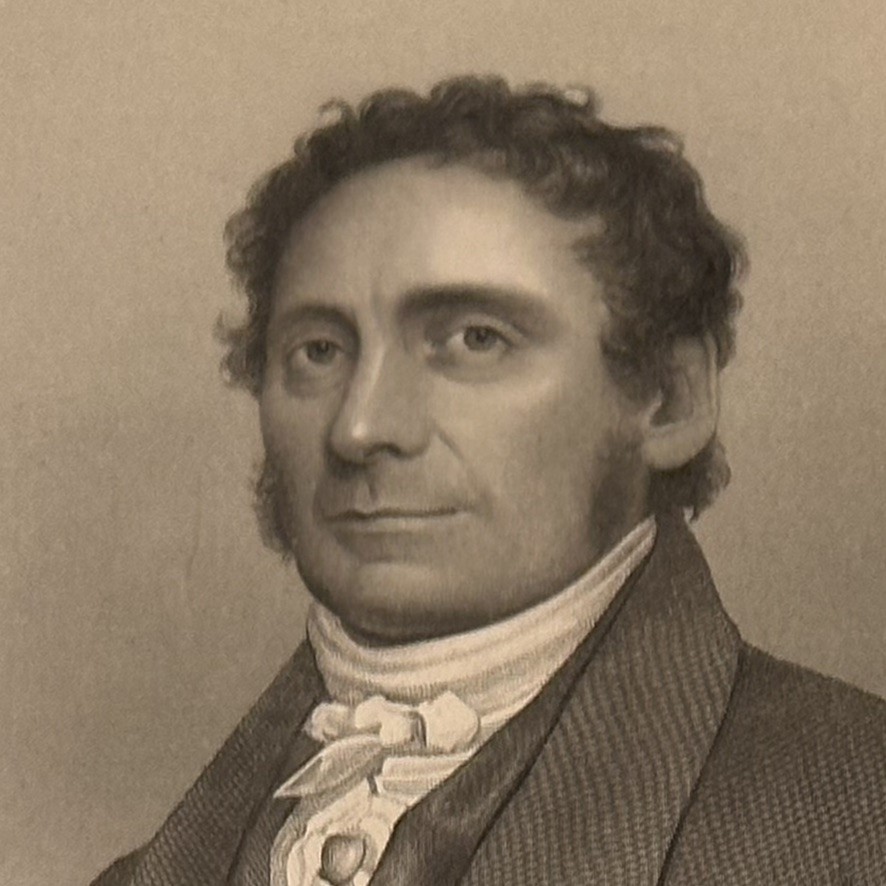
Prof. Parker” Cleaveland, M.D. (Dart., 1823), LL.D. (Bowdoin, 1824), the eminent mineralogist and author. See Bibliography, Chapter IV. Professor of Chemistry, Materia Medica, Mineralogy, and Natural Philosophy in Bowdoin College, Brunswick, Me., from Oct. 23, 1805, until decease. He was called ” the father of American mineralogy.” History of Bowdoin College. By Nehemiah Cleaveland and Alpheus Spring Packard., 1882, p. 126 — A fine steel plate of Parker Cleaveland and biographical sketch :
Parker Cleaveland was born Jan. 15, 1780, a winter long afterwards remembered in New England for the depth of its snow and severity of its cold. He was prepared for college in Byfield, at the old Dummer school, and was sent to Cambridge by its amiable and learned preceptor. Rev. Isaac Smith. His first essay in teaching was made in Boxford, Mass., during a winter vacation. He afterward taught a district school in Wilmington, Middlesex co., Mass. In 1799 he graduated [at Harvard] with a high reputation for ability, and went immediately to Haverhill, Mass , where he took charge of the town school. At the same time he entered his name in the law office of Ichabod Tucker. After a few months in Haverhill as schoolmaster and law student, he went to York, York CO., District of Maine, and took charge of the central town school, where he taught for 3 years with marked success.
During this period, still having in view the legal profession, he assisted Mr. Daniel Sewall, clerk of the courts, in his official duties. In 1803, he was summoned to Cambridge as a tutor. Two years later his reputation as a scholar and instructor had reached the curators of the young college in Maine, and he was appointed its first professor of mathematics and natural philosophy. He went to Brunswick in the autumn of 1805, and entered on that routine of active duty and punctual efficient performance which, down to his last hour, experienced no intermission.
The sciences of chemistry and mineralogy, then almost in their infancy, soon arrested his attention and gradually became the chief objects of his pursuit. In 1816, he brought out his work on mineralogy : a work which was warmly welcomed through all the domains of science and education, and which made the college, as well as the author, far more widely known than before. The 2d edition of this work has long been out of print ; but a 3d edition, though promised and much desired and impatiently waited for, did not appear.
In the winter vacation of 1818, Prof. Cleaveland gave a course of chemical lectures in Hallowell, Kennebec county, Maine. During the 3 succeeding winters he gave 2 courses in Portland and 1 in Portsmouth, N. H. These lectures were attended by the best society in those towns. No better test of the lecturer’s peculiar ability could perhaps be given than the fact that, though highly scientific and instructive, these exercises commanded throughout the undivided and gratified attention of those large and popular audiences. His fame as a lecturer soon brought him applications from other places, but they were all declined. The establishment of the medical school in 1820, added largely to Mr. Cleaveland’s official labors, and fortunately increased somewhat his pecuniary means. At this time he was invited to a professorship at the College of William and Mary in Virginia.
Soon after, the chair of chemistry and mineralogy at Cambridge was tendered him,— a far more alluring offer. For a time the supervisors and friends of Bowdoin college were alarmed at the prospect of such a loss, and did what they could to retain him. The question was finally decided in favor of Brunswick. During the long; period of his connection with the college, Mr. Cleaveland instructed every class that received its honor.s. About 2,000 young men, graduates of the academic and medical departments, have attended his recitations and lectures. As a lecturer, Mr. Cleaveland has been eminently distinguished ; always clear, exact, concise. The subject ever prominent. His illustrations, whether addressed to the eye or the ear, always appropriate. Invariably methodical, skillful, cautious, his experiments never fail. Mr. Cleaveland has received many degrees of honor and certificates of membership from learned bodies abroad and at home. Unlike some of his brother and contemporary savants, he is eminently a •’ keeper at home.'” So far from venturing: across the Atlantic, he would not cross a river except by bridge, and then only after a careful investigation of its strength. As to steamboat and railway travel, he is innocent of it. These well-known facts show, in part at least, why he has won no fame on the broad but dangerous field of geological survey, and why his name has never figured in the doings and sayings of scientific convocations.
The following- passage from the report of Dr. Wood’s address at his funeral, in the Christian Mirror, Oct. 26, 1858 :
“A few years since there appeared to be a momentary failure of his powers; but he soon rallied and from that time till within a few weeks his physical and mental powers have been in such perfect action that he seemed to have taken a new lease of life, and almost to have begun a new career of duty. Within a few weeks past more alarming symptoms began to appear. But though his years, by reason of strength, had become almost fourscore, he still kept on, and walked to his laboratory to hear his recitations ; and after his disease had become so far developed as to require him to stop several times on the way to rest himself and get breath, when his limbs had become swollen and his chest suffused, and his sight almost gone, and he could no longer walk, he would ride. After further failure, and he could not get out before breakfast to hear his class, the hour was changed to a later one. At last, when he could not hear the whole recitation, he persisted to hear what he could, and went as far with the exercise as his strength allowed.
Though thus driven from one resort to another, he did not quit the ground, but still kept on. The day before his death he was prevented from attending recitation, for the third time only since the term began. After a night of comparative rest he was getting ready to go to his recitation, when his discharge came from the only power from which he could accept it. He died with his harness on. ‘ Well done’ will be the verdict of the thousand graduates of this college. ‘ Well done, good and faithful servant,’ we cannot doubt, has been already the verdict of that higher tribunal before which he has .gone to appear.”
Necrologv of Alumni of Harvard College. By Joseph Palmer, 1864 p- 220 — 1799. Parker Cleaveland … In the middle of the year 1800 he began teaching a school at York, Maine; and, at the same time, was clerk in the office of Daniel Sewall, Esq., clerk of the Supreme Court; was with him at the courts and continued the study of law. Here he remained until the autumn of 1805; when he was appointed tutor in mathematics at Harvard, which office he held until Commencement, 1805, when he resigned it to fill a professorship in Bowdoin, the college then having been in operation but a single year. The duties of this professorship, together with those of lecturer on chemistry and mineralogy, he discharged with distinguished ability until 1828, when it was deemed expedient to separate the departments of mathematics and natural philosophy, and establish a distinct professorship of chemistry and mineralogy. Mr. William Smyth, the distinguished professor of mathematics, was raised to that department, and Mr. Cleaveland was installed in the new professorship of chemistry, mineralogy, and natural philosophy.
This position he occupied until his death, having acquired a world-wide reputation, and a success seldom attained by a scientific instructor. . . . He spent 6 hours a day in his laboratory, recitation, and lecture room, and was frequently engaged for 16 of the 24 hours. The college never bought any minerals. James Bowdoin gave about 500 specimens, the rest have been collected either by Prof. Cleaveland’s personal labor, or by the exchange of specimens which he obtained, and they now amount to upwards of 7,000.
He became widely known in the U. S., in Great Britain, and Europe by his great work on mineralogy and geology. He had contemplated publishing a 3d edition ; but his eyesight, which had failed by incessant application, deprived him of the honor, and the world of the benefit of his increased learning and experience from the proposed work. His high reputation as a lecturer is spread all over the country by a succession of graduates of the college, who will transmit the praise of his learning and eloquence, and will rise up with one accord and bless his name and memory. August 9, 1809, Mr. Cleaveland was elected a fellow of the American Academy of Arts and Sciences ; Sept. 9, 1814, a corresponding member of the Academy of Natural Sciences in Philadelphia; April 17, 1818, a member of the American Philosophical Society at Philadelphia ; November 10, 1818, an honorary member of the Literary and Philosophical Society of Newcastle-uponTyne; January. 30, 1819, an honorary member of the Mineralogical Society of Jena; October 4, 1819, an honorary member of the Mineralogical Society of Dresden ; Apr. 26, 1823, a member of the Society of Natural Science at Halle, Germany ; December 16, 1823, a member of the Mineralogical Society of St. Petersburg; June 11, 1834, an honorary member of the Literary and Historical’Society at Quebec. He was also a fellow of the Wernerian Natural History Society of Edinburgh, and an honorary member of the Geological Society of London. He was for many years the corresponding secretary of the Maine Historical Society.
He was also a member of the American Geological Society; corresponding member of the Linnaean Society of New England ; honorary member of the Lyceum of Natural History of New York ; an honorary member of the .Smithsonian Institution.
American Cyclopedia by George Ripley and J Charles A. Dana, N. Y., D. Appleton & Co., 1873, p. 658 — Cleaveland, Parker, Grad. Harvard 1799, and then taught 3 years in Haverhill, Mass., and York, Maine. Being in York also postmaster and clerk of the courts. Connected with Bowdoin from its infancy. He devoted himself especially to mineralogy and traversed the surrounding country as far as the White mountains, formiing a valuable cabinet. His mineralogy earned for him the name of father of American mineralogy, and did much to associate this country with the scientific labors of older nations. It was upon the general system of Bronghiart and Haiiy, and was chiefly distinguished by the original information which it gave of the new localities of minerals. The correspondence of Prof. Cleaveland was now solicited by the most eminent scientific men, by Sir Humphrey Davy, Sir Daniel Brewster, Cuiver, &c. In 1839 the presidency of the college was offered him, but he declined. During 53 years of his connection with Bowdoin he failed attending only 3 recitations ; and kept a meteorological journal, noting weather 3 different hours every day.
Address at Opening of the Cleveland Cabinet of Bodwin College, July 10, 1873 By Nehemiah Cleaveland, 25, — Appendix. At a meeting of this committee Aug. 12, 1872, Mr. P. \V. Chandler of Boston presented a plan which he was prepared to carry out at his own expense. He explained his object and desire to be to preserve Massachusetts Hall and at the .same time to erect a memorial hall or gallery to the late Prof. Cleaveland, by fitting up the 2d and 3d stories as a cabinet for those departments of natural science to which the life of the Prof, was mainly devoted. * The sides of this hall are divided into 2 stories by a light, open gallery, which runs all round it, and which is reached by 2 spiral staircases in diagonally opposite corners of the room. Around the hall, upon the main floor, are 14 alcoves, lighted by 3d story windows. [The first minerals in this collection were all contained in a few little boxes ; now one of the best cabinets in the country.] * Of the corner alcoves, on the main floor, one is to be used as a curator’s room, while the other will contain manuscripts, &c., of Prof. Cleaveland. The small 1-story projection on the eastern side has been enlarged and contains a fine staircase to the cabinet. The floor is laid in marble tiles. The stairs are finished in hard wood. A memorial stone tablet is set in the wall of the staircase, and bears the inscription : —
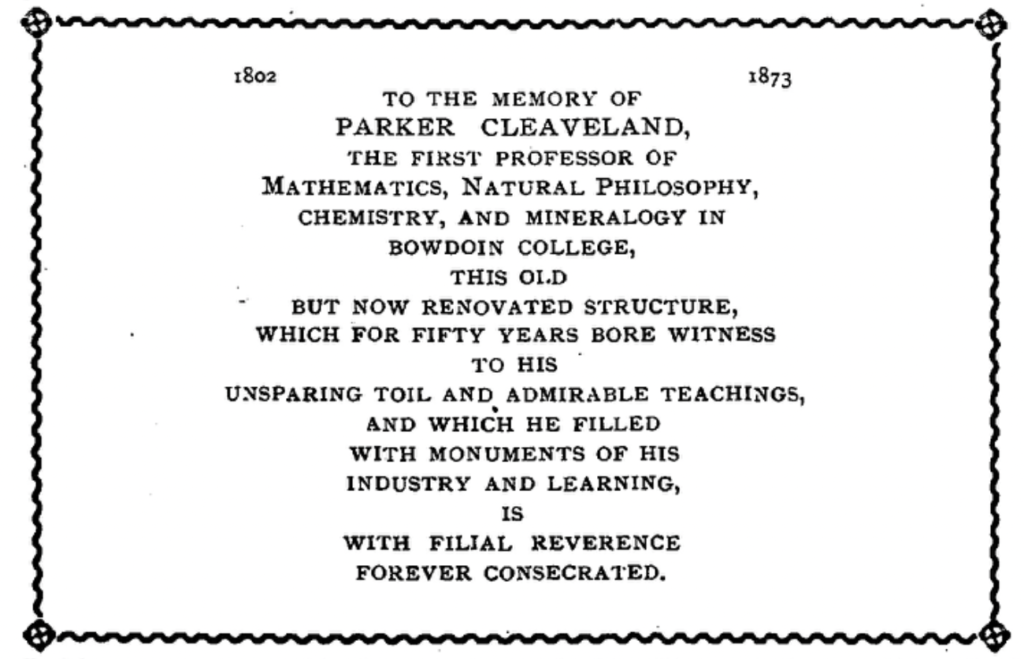
In his arrangements with the committee, Mr. Chandler made it a condition that the new Hall shall be called the CLEAVELAND CABINET.
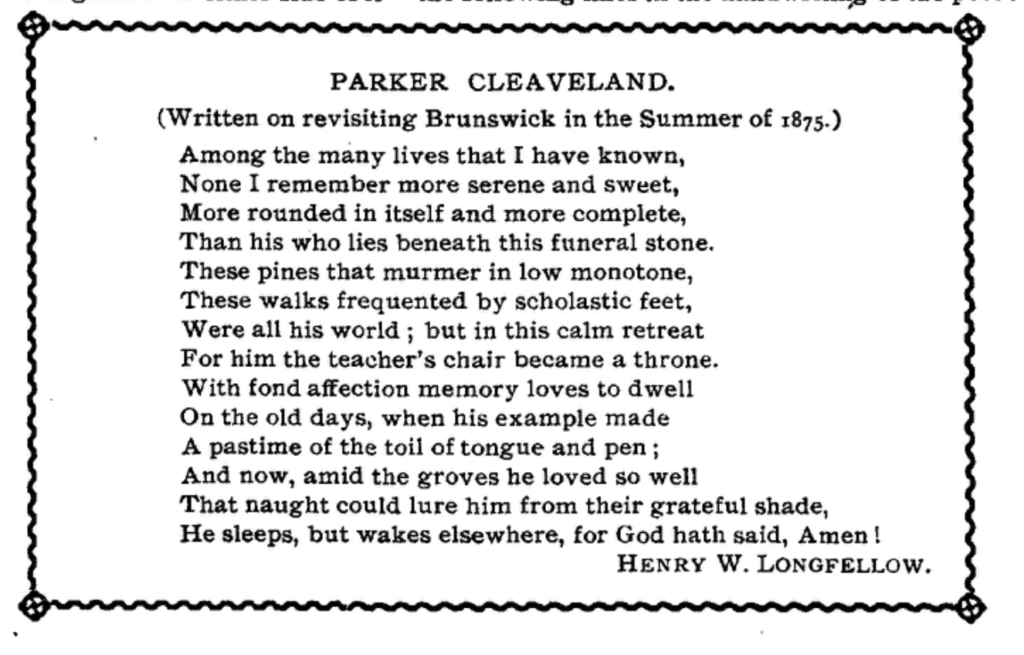
New York Times, Sept. 4, 1879 — Cleaveland and Longfellow. * Cleaveland Cabinet. On the opposite walls hangs a frame containing — the portraits of Prof. Cleaveland and Longfellow on either side of it — the following lines in the handwriting of the poet :
Noah Webster, LL. D., says in his American Dictionary of the English Language: Author’s preface to the edition of 1828 — I do not, indeed, expect to add celebrity to the names of FKANKliN, WASHINGTON, ADAMS, JAY, MADISON, MARSHALL, RAMSAY, DWIGHT, SMITH, TRUMBULL, HAMILTON BELKNOP AMES, MASON, KENT, HARE, DILLIMAN, CLEAVELAND WALSH, IRVING, and manv other Americans distinguished by their writings or by their science ; but it is with pride and satisfaction that 1 can place them, as authorities, on the same page with those of HOOKER, MILTON, DRYDEN, ADDISON, RAY, MILNER, WOWPER, DAVY, THOMPSON, Ana JAMESON.
Webster’s Unab. Die, 238 — Cleavelandite. n. [From Prof. Cleaveland] (Min.) A variety of albite, white and lamellar in structure. Dana. Verba Nominalia or words derived from proper names by Richard Stephen Charnock — Cleavelandite. A mineral called also siliceous felspar or albite named after Prof. Cleaveland. Scribner’s Monthly, XII, May, 1876, p. 47 — Bowdoin College by George Thomas Packard, with illustrations of Prof. Parker Cleaveland portrait, Prof. Cleaveland’ s fire place ; Prof. Cleaveland on the lecture path.
The American Journal of Science and Arts conducted by Prof . B. Silliman, B. Silliman.fr., and James D. Dana, with Prof. Asa Gray of Cambridge, Prof. Louis Agassiz of C, Dr. Wolcott Gibbs of N. Y, XXVI, Nov., 1858, p. 44S — Obituary of Prof: Parker Cleveland [by the editor, Prof. B. Silliman of Yale].This eminent author and teacher has been long known as one of our most distinguished and useful professors of science. * He was graduated with high honors in Harvard, 1799. Among his distinguished classmates were Hon. Samuel D. Parker and Gen. William H. Sumner.
His moral character was pure, his social disposition amiable and genial, and his manners affable, warm, and winning — Boston Advertiser. Prof. Cleveland was for a long course of years a member of the Congregational church, Brunswick, and a firm believer in divine revelation. The senior editor of this Journal first became acquainted with Prof. Cleveland in 1814. His reputation for zeal, industry, and learning, and his success in the cultivation and diffusion of science were even then conspicuous. His Mineralogy was constructed upon the plan of the Treatise of Alexandre Brongniart of Paris, and like that admirable work it was lucid in statement, rich in facts, attractive in style. His natural ardor and activity were very great ; they were tempered by an excellent judgment and a chastened taste, rendering his writings models of a pure English style. It is much to be regretted that such a man should have been so much withdrawn from original research by the exhausting toil of incessant college duty. Prof. Cleveland was well able to have filled a more extended sphere. His talents as a lecturer and a teacher were of a high order. He left a name which will be long honored and revered. Three eminent professors have departed almost together : Dr. Robert Hare in Philadelphia, Prof. Ira Young of Dartmouth, and Prof. Cleveland. B. s. Memoir of Prof. Parker Cleveland, Maine Historical Soc. Coll , VI : 575— Grad. Harvard 1799, tutor there 1803, mathematics and natural philosophy, prof, of same Bowdoin, 1808, became the standard authority in mineralogy and geology in the U. S., prof, of chemistry 1808, and of Materia Medica of the Maine Medical School 1820.
The decease of Prof. Parker’ Cleaveland was noticed by the press generally throughout the civilized world.
Crosby’s Annual Obituaries, 1858 : N.E. His. Gen. Reg., XI: 31 ; XIII: 86-7 obituary: XIV: 181 : XXXVII : 322 ; Address on the Life and Character of Parker Cleaveland, LL.D., delivered in Augusta, January 19, 1850, before the Maine His. Soc, By Leonard Woods, D.D., Pres. Bowdoin Coll., Pub. by vote of Trustees of Bowdoin Coll., and of the Maine His. Soc, 1850, pp. 60, 1st ed. ,■ i860, pp. So, with portrait, 2d ed. : Bowdoin Catalogue, 1805-58; Our Alma Mater Address before the Alumni of Bowdoin by Alpheus S. Packard, Aug.5, 1858; First Annual Reunion of Bowdoin Alumni Association of N. Y., at Delmonico s, January 19, 1871. Reported by M. T. Kelly — Dexter A. Hawkins, Pres. ; Report Regents Smithsonian Inst., 1857, &*c; Allen, 235″ ; Drake, 195 ; Child genealogy, 808.