Rev. Charles Morris Blake
(1819 - 1893)
Page 1154, # 3410
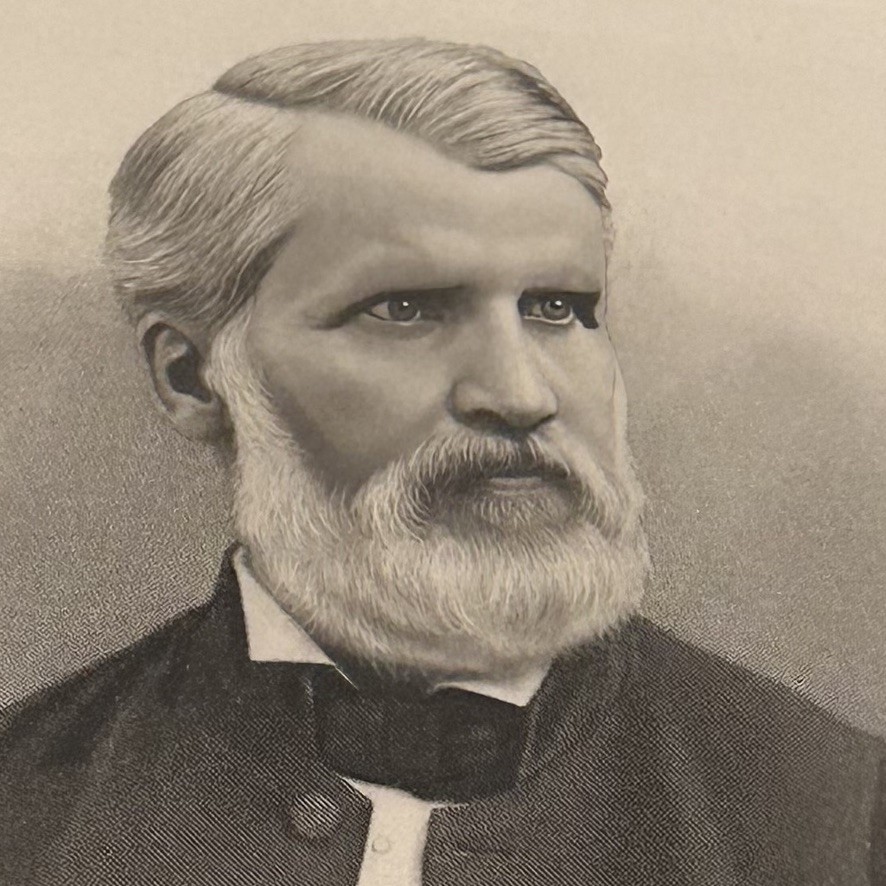
Rev. CHARLES MORRIS BLAKE, A.M., M.D., Chaplain U. S. A. since 1861. Dr. Blake was born in the wilds of Maine the grandson of General John Blake and great great grandson of Sarah Cleaveland; was named for Commodore Charles Morris, U. S. N. His youth was spent in the severe toils of the farm, the lumber yard, and the mill, attending a few weeks of winter the district school until Sept., 1836, when he entered the High School, Bangor, Me., under David Worcester, A.M., with whom, and at the Classical Institute with Rev. Samuel H. Shepley, A.M., he made rapid progress in his studies.
Entered Bowdoin college, Brunswick, Me., Sept. 26, 1838 (Prof. Parker Cleaveland + 2240 was his teacher), where he was graduated with high honors, in 1842. He taught school every winter from 1837, to enable him to bear the expenses of his course of study, in which he was liberally aided by his father, whom he afterwards repaid, and by the American Education Society. He removed. to Philadelphia, Nov., 1842, where he studied medicine at Jefferson college, 1842-1845 ; he studied theology with Rev. Albert Barnes and other clergy of the Presbyterian church, in which he was adm. as licentiate, 3d Pres., Phila., April, 1845. He received the degree A.M. from his honored alma mater, 1845, and M.D. at University of California, 1876.
Taught his select school for boys in Philadelphia, 1 843-1849, in which he gained a high reputation. Among his pupils were Prof. Fairman Rogers, now of University of Pa. ; Horace Howard Furness, editor Variorum Shakespeare; Johnson Brown, Jos. T. Bailey, Jos. S. Lovering, Jr., and many other well-known citizens of Philadelphia. Feb. 1, 1849, with 39 other Philadelphia gentlemen, Rev. C. M. 7 Blake started for California, via Tampico, Mexico.
With ample means and a thorough knowledge of Spanish and agreeable traveling companions, the journey was a grateful pastime. In his mess were Rev. Daniel B. Woods, s. Rev. L. Woods, D.D., of Andover, Mass., Robert Thompson, and Thos. G. Spear, the Poet of the Pioneers, a quartette which were named the Amity and Enterprise company. Mr. Woods took with him from Rev. Bishop Kendrick, R. C, of Philadelphia, a letter in Latin to the bishops and clergy of Mexico, and which proved an open sesame to the hearts and homes of Mexico.
No one vessel could be found at San Bias or Mazatlan which could take all the party. The Cruise of the San Blasena has been made classical by sketches in the Pacific News, pub. San Francisco, 1850; and by the polished pen of Dr. J. D. B. Stilltnan, in the Overland Monthly, Sept., 1874. Chaplain Blake left this vessel, with 10 others, at Cape San Lucas, May 19, 1849, reaching San Diego, Cal., after an arduous journey over the peninsula of Lower California on foot and on horseback of 84 days, Aug. 11, 1849.
From there he went in the steamship Panama, Capt. Bailey, with Bayard Taylor, whom he found on board, and reached San Francisco Aug. 18, 1849. Thence he went to the mines at Rose’s Bar, on the Yuba, where he laid with his own hands the stone foundations of the celebrated ” Yuba Dam.” And this he did against the protests of all the men of the prairie in the company, who insisted that the length of the stone should be laid across the current of the stream.
He returned from the mines Mar., 1850, and after an excursion to Merced, Merced co., Cal., and Mariposa, Mariposa co., Cal., in which he first heard and wrote of Yosemite, and after a short tarry in Stockton, San Joaquin co., Cal., in which he organized the first school there, he settled in San Francisco, as associate editor with his maternal cousin, Jonas Winchester, of the Pacific News, daily, the second newspaper (established 1849) in San Fran. In Oct., 1851, Chaplain Blake brought his family, via Panama, to Cal., and after a short stay in Grass Valley, and an exploration in Oregon, he located, 1852, at Benicia, and there established the Collegiate Institute, a fine school for boys, in which he gathered some of the best youth of the Pacific, and laid the foundations of St. Augustine Coll., which now occupies the same building erected 1853-4 by Chaplain Blake.
In 1855, the family, leaving the graves of the 2 younger children, went to Chili, S. A., where he labored as a missionary to 1857, when he went to Pa., and became pastor of Presbyterian church, Center co., remaining to 1861. During a portion of 1859 and i860, being on duty in the interest of the Pres. church in Tenn. and Va., and becoming convinced that a war between the States was imminent, in the hope that he might be instrumental in averting the disaster, went to Washington, D. C, at his own expense, and labored unremittingly to that end until the beginning of hostilities. Then, realizing that there could be no peace and no union until achieved by force of arms, he entered the military service, April, 1861, at Camp Curtin, Pa., as chaplain and in organizing troops.
From Aug. 13 to Dec. 12, 1 86 1, he was with Gen. John C. Fremont’s army in Missouri (most of the time on the general’s staff), where he was chaplain of 13th Missouri. Vols., Col. Crafts J. Wright commanding. From that time until the war closed he was on active duty in W. Va., S. C, Fla., and Tenn., serving throughout with an honorable record. After Gen. Fremont was superseded, he was placed on duty by President Abraham Lincoln in vicinity of Washington, and subsequently commissioned as hospital chaplain, and sent by the President to Charleston hospital, W. Va. It was during these 6 months of 186 1-2 in Washington, crowded with cares for the sick and dying, that Chaplain Blake was able, from his extensive acquaintance with the Pacific coast and its needs, and with members of Congress, the President, and heads of depts., to say much in favor of the trans-continental railroad, just then looming up in importance, and with no motive but the public good, he made constant appeals for a railroad from the Missouri to San, Francisco.
His wife was nurse in the hospitals of which he was chaplain. During the battle of Gettysburg he was assisting in arming, etc., the 1st and 2d U. S. Colored Regts. at Washington, and later the 3d and 6th U. S. C. at Camp William Penn, near Phila., Pa. He was appointed Captain in 3d U. S. C. I., July, 1863, and in front of Charleston, S. C, was senior captain and acting major and Ieiut -col. of the regiment (which was brigaded with 2d S. C. and 54th Mass., Col.), and he performed gallant service. While in battle, Aug., 1863, near Fort Wagner, Morris I., he was wounded in the head by the bursting of a shell. From this injury he has never entirely recovered. At Chattanooga, Tenn., where he ministered to Sherman’s sick and wounded from Oct., 1864, to May, 1866.
He was appointed chaplain Regular U. S. A., and ordered, Aug., 1866, to Camp Whipple, n. Prescott, Arizona T., as post chaplain, remaining to August, 1867, when ordered to Camp McDowell, Arizona, where, in 1868, he was completely prostrated from results of his wound, and deprived of his reason. While in this condition, in Dec, 1868, he wrote the Sec. of War, complaining of certain imaginary evils, declaring that if redress was not given he would resign. This letter was construed as a resignation and accepted, and a successor appointed, July 2, 1870.
His insanity continued to 1874, when he recovered his reason, and realized that he was no longer an officer. He was restored to the service May 14, 1878, by Pres. Hayes, who examined the evidence, regarded the resignation as void, and regretted that he had not the power to restore the pay during the interval. Chaplain Blake applied to the Court of Claims for pay from Apr. 28, 1869, to May 14, 1878, but was decided against (the statute of limitations being pleaded) by this court and by the U. S. Supreme Court. President Garfield, therefore, reappointed Chaplain Blake, May 20, 1881. An Act was passed by Congress, 1884, restoring the pay, 1878-1 881, and he petitioned Congress, 1885, etc., for the amount due 1869-1878. Chaplain Blake was placed on the retired list, U. S. A., May 12, 1883.
In 1875-6, he taught school in Napa and San Francisco. In 1876, attended medical lectures at Tolland college, medical department, Univ. of Cal., which, in earlier days as an editor and teacher of eminence, he had aided to plan and found. In 1878 to 1881, was post chaplain U. S. A., Camp Grant, Arizona, and 1882, Morrisdale Mines, Pa., and resided afterward in San Francisco, Cal. Practicing physician, 1889-93,
Rev. Charles Morris 7 Blake was elected 1843 member Academy of Natural Sciences, Phila.; 1848, member Franklin Institute ; 1857, American Assoc, of Science ; 1868, member Soc. of Pioneers ; 1874, California Acad, of Sciences ; member of Order Loyal Legion, Dept. Cal.; member G. A. R. He was elected Jan. 7, 1880, a corresponding member of the New England Historic-Genealogical Society, and a biographical sketch of him, by ‘ Francis E. Blake, Esq., of Boston, appears in the necrology of the Society in N. E. His. Gen. Reg., XLVIII : Jan., 1894, p. 88. California Biography, Alonzo Phelps, A.M., editor, 1881. Author — see Bibliography, Chap. IV.
Grandson of General John Blake and great great grandson of Sarah Cleveland