William Davis Cleveland
(1839 - 1912)
Page 1910
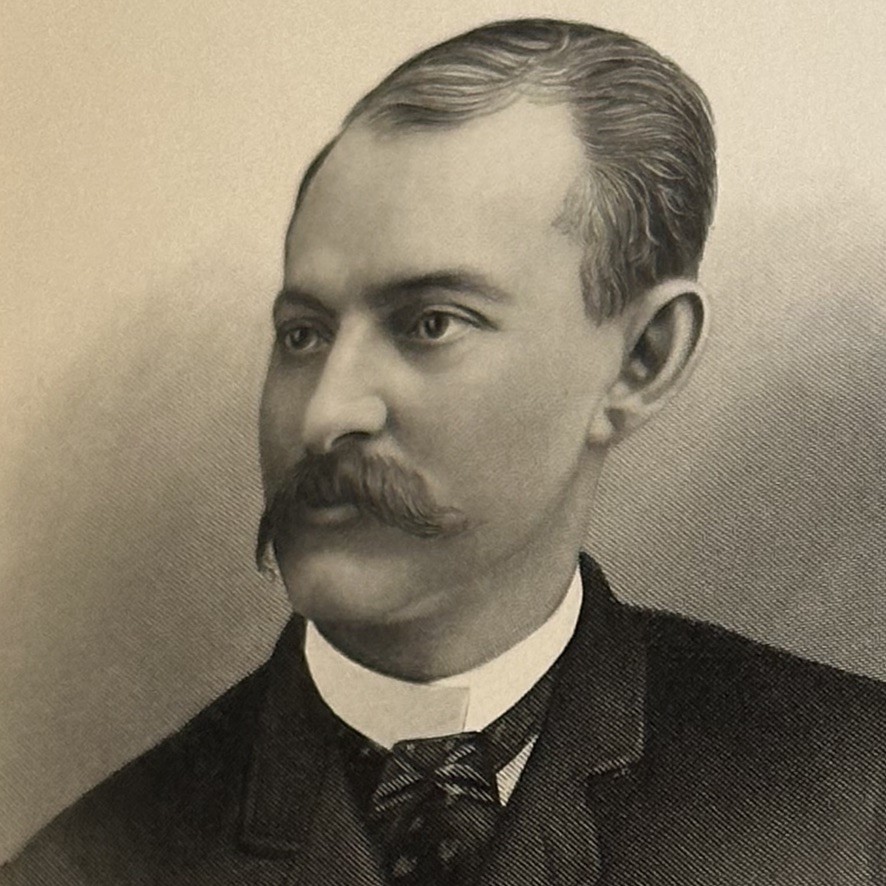
Mr. William Davis Cleveland, now so well-known throughout the State of Texas, spent his boyhood days upon the quiet farm of his father at Travis, Tex., and until he reached the age of 19 he knew little of the routine of commercial life. He frequently remarks to his honored father: “Well, pa, I owe my success entirely to the manner in which you raised me and taught me when young.” At this time he entered the employ of Mr. H. Muller of Bellville, Tex., who now takes pleasure in saying that he “started Mr. Cleveland out in life.” In 1858 Mr. Cleveland came to Houston and was employed in the retail dry goods house of Mr. William Clark, where he remained until 1861, when he entered the Confederate service.
He volunteered as a private soldier of the Bayou City Guards, Fifth Regiment, Hood’s Brigade, and was one among the first to leave Texas for the front. In February, 1862, he was transferred from Virginia to Col. Clinton Terry’s famous Texas Rangers, 8th Tex. Cav. in Wheeler’s Cav.; participated in every engagement of the Confederate Army of the Tennessee, some 245 battles and collisions, including Murfreesboro 1862-3, Ft. Donelson 1862, Nashville ’62, Shelbyville, Missionary Ridge, Knoxville ’64, Winchester, Franklin co., Tenn., Shiloh, Perryville ’64, Bardstown, Nelson co., Ky., ’64, Chattanooga, Dalton, Marietta, Cassville, Atlanta, Franklin ; went ahead of Sherman on his march, and was in the last battle (so thought) of the war, being the fight with Gen. Judson A. Kilpatrick, 5 miles south of Raleigh, N. C, Apr., 1865. His command escaped to their Texas homes before Gen. Joseph E. Johnston surrendered. Mr. Cleveland, accompanied by four comrades, endeavored to make his way back to Texas, hoping to reach the Confederate forces there who had not yet surrendered, but in this they were disappointed, for on reaching the Mississippi River they learned that all of the Confederate leaders had surrendered, and that the war was over.
He and his companions soon afterwards took passage on a Government transport from New Orleans and landed in Galveston thoroughly broken down and without a dollar in the world. Here Mr. Cleveland met a friend, Mr. Alex. McGowen, an old citizen of Houston, who loaned him $25, and with his characteristic generosity, he divided it equallyamong his comrades, giving to each $5. We can state here that Mr. McGowen has always refused to accept any payment of the money loaned at this time, although it was tendered him soon afterward.
Mr. Cleveland reached Houston and went to work as a clerk for Alexander Sessum on July 1, 1865, at the very modest salary of $50 per month, but was so diligent in his attention to business that when Mr. Sessum removed to Galveston in 1867 he turned over his business to the firm of Massie, [Mortimer J.], Smith [Benjamin J.] & Co. [W. D. Cleveland], of which he was the junior member. It was at this period of his life that the real business ability of Mr. Cleveland was developed. The firm of young men was for a time very successful, and in the summer he went to New York to purchase goods. While there that dreadful scourge, yellow fever, broke out in Galveston and Houston, and desolated the two cities, and in fact the whole of Texas, On his return in the fall he found the business of the firm thoroughly demoralized and apparently hopelessly embarrassed. Disease and death had done well its work, and the hand of the fell destroyer had swept away every vestige of the prosperous business which had resulted from many months of incessant labor and the firm was more than $40,000 in debt.
Nothing daunted, Mr. Cleveland set to work to recover lost ground and at the suggestion of Mr. Sessum,. who was the principal creditor, and who agreed to furnish the money necessary to carry on the new business, he assumed the entire indebtedness of the firm, continued on his own account, and started out to pay up dollar for dollar. In this he was remarkably successful, for in a short period of unprecedented prosperity he not only repaid the whole debt of the firm with. interest, and the large amount furnished by Mr. Sessum, which left him entirely free of debt, but established a business which since that time has gone on steadily increasing until it has assumed the gigantic proportions — wholesale grocer and cotton factor, sales thousands of bales annually. [The firm is, 1891, W. D. Cleveland & Co. (Caesar M. Lombard).]
Personally, Mr. Cleveland is a gentleman of pleasing address and affable manners, and favorably impresses every one with whom he comes in contact. He was married in Houston to Miss Tina Latham on the 26th of April, 1869, and an amusing anecdote may be related in this connection which is entirely characteristic of the man. About the time he was ready to get married he owned three city lots, for which he had paid the sum of $1,500 and as he needed some ready money he endeavored to realize on his property, but found he could only get $800 for it. He delayed the matter a short while, but getting more anxious than ever to be married, he made a second attempt, and this time was only offered $600, half of which was to be cash.
Mr. Cleveland was unwilling to sacrifice all of his hard earning in this manner, but he was more than ever determined to get married without further delay. In order to raise the necessary funds he undertook to move a crop of Texas sugar from the plantation and place it on the market, and in this venture which was surrounded by almost unheard-of difficulties, he succeeded in making the small amount that he needed. This-was undoubtedly the luckiest speculation of his life, for he has always attributed his success to the happy union that was then consummated.
Mr. Cleveland served as president of the Cotton Exchange during the third year of its organization, 1876, ’77, and was again elected to the position in 1884. No fitter man could be selected for the office, and his efforts and influence are always directed to the advancement of the institution.
After the war the city of Houston suffered much by ” carpet bag rule,” the city government loaded the city with a hopeless bonded debt, and town offices became so disreputable as to be undesirable. However, in 1880, from a sense of duty, Mr. Cleveland accepted the election of Alderman, and served several terms to 1885 with credit. Much, of the foregoing sketch of W. D. Cleveland, accompanied by his portrait, appeared in The Houston Chronicle, Mar. 1, 1885, containing also an engraving of the new, large, and elegant Houston Cotton Exchange, and the history of that body since organization 1874; W. D. Cleveland, Pres. [1884-95], H. W. Garrow, Vice-Pres., George W. Kidd, Sec , F. A. Rice, Treas., 1885. He is, 1891-5, Pres. Houston Cotton Exch. and Board of Trade, and Vice-Pres. Merchants and Planters Oil Co.
In 1886 Mr. Cleveland was spoken of as a candidate for Governor. From the Terrell, Kaufman co., Tex., Times, Apr. 27, 1886—
” While the Times would prefer to see a North Texas man chosen governor, still it would most gladly and heartily support that prosperous, philanthropic, big-hearted, and brainy merchant and statesman. Win. D. Cleveland, of Houston. He would make a governor that all Texas would love and honor, and by his ability and energy place Texas in the front rank among the sisterhood of States. He is a man of the people and for the people. For once let politicians stand aside and allow the people to make a selection.”
The Hemphill, Sabine co., Tex, Reporter, Palestine, Anderson co., Tex., Advocate, Cameron, Milan co., Herald made similar mention, One of the Gen. Managers of the Houston Inter-State Drill and Encampment May 7-10, 1884. The State militia encampment at Houston, 1887, was named- “Camp William D. Cleveland.”
Mr. Cleveland is a member of the Episcopal Church, has, for years been Junior Warden of Christ Church, Houston, and superintendent of the Sunday-school. A prominent Mason, and member of M. W. Grand Lodge of Tex. Residence still in Houston (1898). Is a subscriber for this Genealogy.
Biography 2 - Texas State Historical Society -
https://www.tshaonline.org/handbook/entries/cleveland-william-davis
Cleveland, William Davis (1839–1912)
By: Ron Bass, “Cleveland, William Davis,” Handbook of Texas Online
Published: August 26, 2020
CLEVELAND, WILLIAM DAVIS (1839–1912).William Davis Cleveland, Houston merchant, cotton broker, and civic leader, was born in Dallas County, Alabama, on September 1, 1839, to Ezra Cleveland and Sarah Sheppard (Davis) Cleveland. While still a child, Cleveland moved to Austin County, Texas, with his parents. In 1858 he set out on his own and moved to Houston. Soon after he arrived in Houston he met businessman Alexander Sessums, who hired Cleveland as a clerk to help with his growing dry goods business. Sessums and Cleveland developed a strong personal friendship; both named children for each other.
During the Civil War Cleveland enlisted on October 23, 1861, and joined Company B, Tenth Texas Infantry. He served until he was captured in Franklin, Tennessee, on November 30, 1864. After the war, Cleveland returned to Houston and rejoined Sessums’s business. Sessums expanded to Galveston where his work grew as a commission merchant and by 1870 had moved to Galveston and left Houston operations to Cleveland. In 1869 William D. Cleveland married Justina Latham; they had seven children.
In 1872 Cleveland took over the interests of Sessums’s Houston business in Sessums’s former building at 37 Main Street at Franklin Avenue and renamed it “Wm. D. Cleveland, Wholesale Grocer and Commission Merchant.” Sessums died in 1873. In the aftermath of the Civil War and during Reconstruction, Houston’s economy suffered. The recession of the 1870s left the city with a huge debt, and business leaders pulled together to address these problems. Cleveland took a leadership role, served without pay on the city council, and often paid for city improvements out of his own pocket. A founding member of the Houston Board of Trade and Cotton Exchange, organized in 1874, he served as president three times.
During the 1870s Cleveland expanded both his mercantile trade and cotton factor business and emerged as the lead entrepreneur in the Houston market which, by 1877, was lauded as the best grocery and produce market in Texas. His growing business expanded into offices on the southeast corner of Travis Street and Franklin Avenue. Cleveland was also elected vice president of the Buffalo Warehouse and Cotton Compress Company, on the north side of Buffalo Bayou, and within two years became president. In 1880 he built a new mercantile on the northeast corner of Main and Commerce. His commission business, in particular, was thriving; in 1880 the company conducted what the local newspaper described as “the largest single cotton transaction ever made in Texas,” with the sale of 3,071 cotton bales for $150,000.
By 1885 his enterprise leased additional warehouse space for grocery operations in the former Sam Allen warehouse at 2nd Street and Railroad Street. That same year, with the expansion of his business, Cleveland brought in longtime employee Caesar M. Lombardi, who had joined the company in 1871 and knew all aspects of the business, as a partner. The business was renamed W. D. Cleveland and Company. In 1888 Cleveland was elected a director of the Union Compress and Warehouse Company. In 1889 he also invested in the growing cottonseed oil business with other local businessmen.
On April 7, 1893, the wholesale house of W. D. Cleveland and Company on the corner of Main Street and Commerce Avenue caught fire; the building and all its stock burned to the ground. To continue operations, Cleveland leased the nearby old electric light plant while he rebuilt at the northwest corner of Commerce and Fannin within a year. In 1894 his company began to manufacture baking powder and roasted coffee under the Apex Brand.
In 1898 partner Caesar Lombardi left the company to pursue other business and family interests. Cleveland brought his two sons (William Davis Cleveland, Jr., and Alexander Sessums Cleveland) and renamed the company W. D. Cleveland and Sons, then the largest wholesale grocery company in Texas. The company’s holdings included the Cleveland Compress and Warehouse Company on the east side of Hill Street (present-day Jensen Drive) at Buffalo Bayou. Nevertheless, Cleveland’s company was deeply in debt and in 1899 filed for bankruptcy. On the strength of Cleveland’s reputation, creditors agreed to allow the company to resume business operations, and he revitalized his wholesale grocery enterprise around its facilities at the foot of Main Street (Allen’s Landing)
In 1907 Cleveland purchased the International Coffee Company of Galveston. He then constructed a building at Allen’s Landing (which was still standing in the 2020s) for his coffee roasting and distribution business, replacing an older two-story structure. The International Coffee Company roasted coffee from Central America under the Sunset Coffee label and distributed it throughout the southwest. On February 21, 1912, an enormous fire swept through the Fifth Ward and destroyed all facilities and stock of the Cleveland Compress Company.
Cleveland was an active city leader who served as a director for several local banks. Throughout his life he was a devoted member of Christ Episcopal Church and was superintendent of its Sunday School.
On December 22, 1912, at age seventy-three, William Davis Cleveland died of heart trouble at his home at 806 San Jacinto. He was buried at Glenwood Cemetery. His wife predeceased him. His sons continued to run the business until the Great Depression set in and the firm closed for good in March 1930. In 1927 William D. Cleveland Elementary School was constructed in Houston; the school closed in 1977. The W. D. Cleveland Warehouse on Commerce Avenue was demolished in 1973. As of the 2020s Cleveland was commemorated in Houston through Cleveland Park, Cleveland Street, and the International Coffee Company building, renovated in 2017, which briefly housed the psychedelic nightclub Love Street Light Circus and Feel Good Machine in the late 1960s.